Market Byte: Bitcoin Trading More Like Growth Than Gold

Zach Pandl
Last Updated: 2/9/2026 | 13 min. read
Key Takeaways
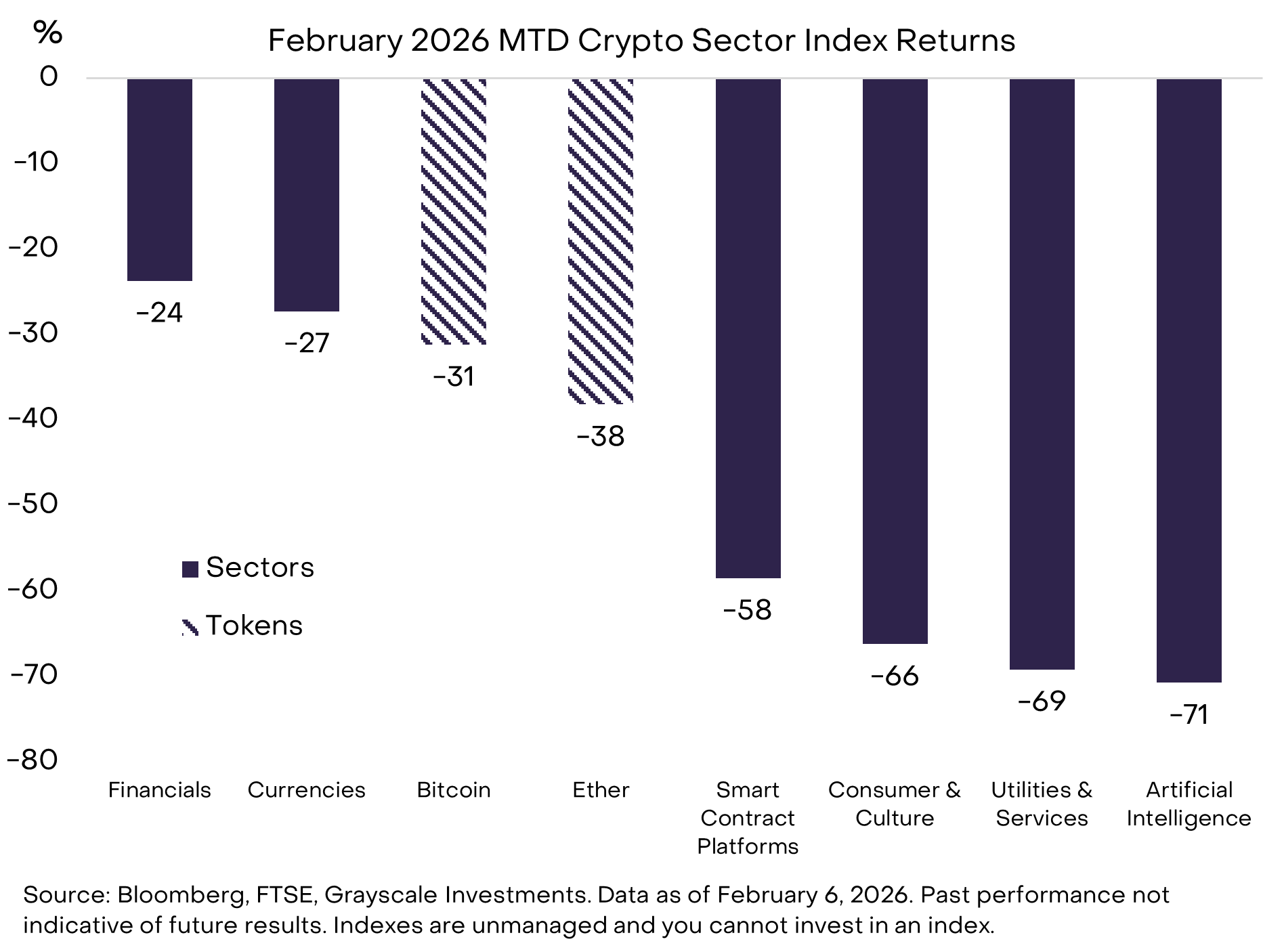
The Bitcoin drawdown underway since early October accelerated over the last two weeks. Bitcoin’s price touched a new local low of about $60,000 on February 5 — equating to a peak-to-trough drawdown of more than 50% — before partially rebounding in recent days. The latest phase of the sell-off was broad-based across Crypto Sectors, with some altcoin market segments down 65%-70% month to date (Exhibit 1).
Exhibit 1: Broad-based drawdown across Crypto Sectors
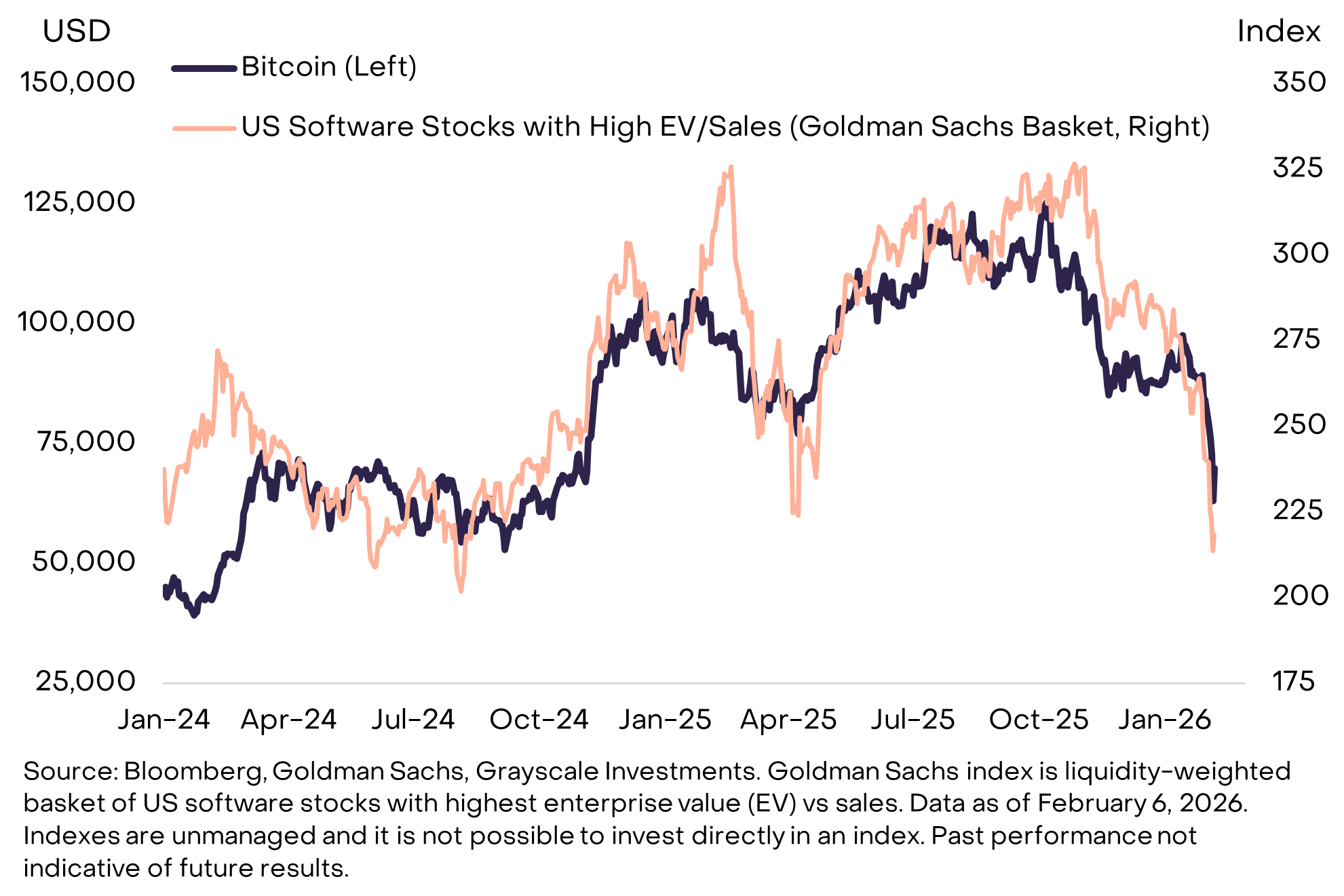
For at least the last 12 months, changes in the price of Bitcoin have been tightly correlated to early-stage tech equity market segments. For example, Exhibit 2 compares Bitcoin’s price to an index of U.S. software stocks with relatively high enterprise values (EV) compared to sales. A high EV-to-sales ratio can imply that investors are expecting relatively high revenue growth over time — often a feature of emerging technologies. Although the crypto asset class faces some unique challenges (e.g., related to delays on the CLARITY Act and quantum readiness; see more below), the fact that Bitcoin moved in lockstep with software stocks during the latest sell-off suggests the drawdown likely had more to do with broad derisking of growth-oriented portfolios rather than problems unique to crypto.
Exhibit 2: Bitcoin price moving closely with software stocks
Bitcoin’s recent correlations raise a natural question: is Bitcoin a store of value like gold or a growth asset like tech stocks? The short answer: we believe it’s both.
Bitcoin is a digital currency and digital payments system with attributes akin to monetary gold, including supply scarcity and autonomy from nation states. It has demonstrated remarkable resilience across boom/bust cycles, against potential attackers, and in the face of many competitors. Bitcoin is open-source, highly decentralized, and supported by a network of physical infrastructure that has achieved enormous scale. Because of these features, Grayscale believes Bitcoin can be considered a long-term store of value: the network will likely continue operating well beyond our lifetimes and the asset may retain its value in real terms (i.e., accounting or inflation) in a wide range of outcomes for the economy and society. In this sense it can be analogized to “digital gold.”
But Bitcoin is still growing up. Gold has been used as money for thousands of years and was the basis of the international monetary system until the early 1970s. Today it is the second-largest asset held in official foreign exchange reserves after the U.S. Dollar (and ahead of the Euro).[1] Bitcoin is only 17 years old, and the internet itself is only a couple decades old.
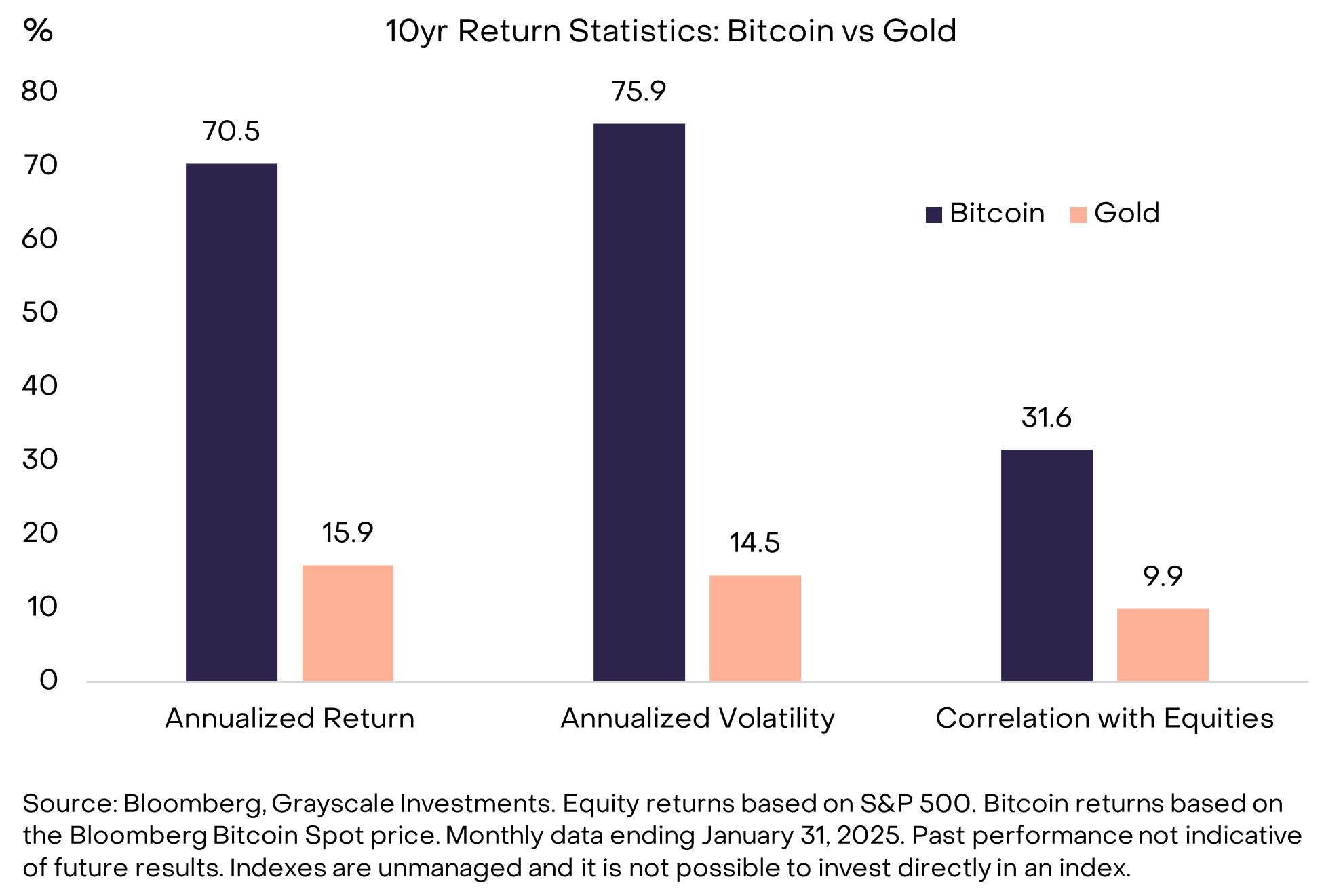
Bitcoin has not yet achieved the same status as gold as a monetary asset, and that is central to the investment thesis. In the economy of the future — featuring AI agents, humanoid robots, and tokenized capital markets — we believe it will be natural for the dominant store of value monetary asset to be a digital, blockchain-based commodity like Bitcoin rather than a physical commodity like gold or silver. Investing in Bitcoin today means positioning for this potential growth. If Bitcoin succeeds in the longer term, its price return characteristics may eventually look more like gold than growth stocks, with lower volatility, a lower correlation to equity markets, and lower expected returns (Exhibit 3).
Exhibit 3: In longer term, Bitcoin’s returns could look less like growth and more like gold
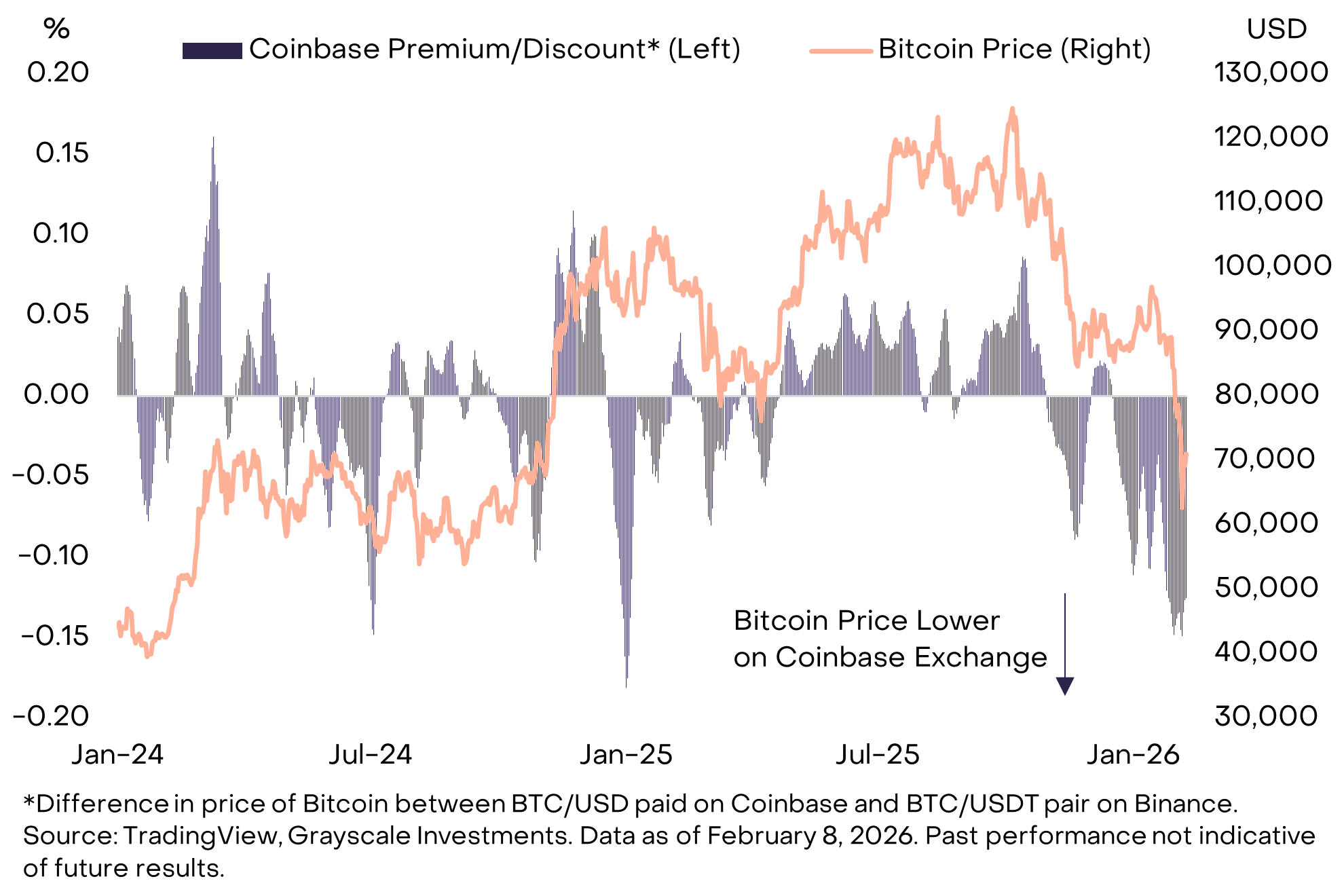
Unlike the start of the most recent Bitcoin drawdown in October, the latest price weakness seemed to stem from U.S.-based sellers (Exhibit 4). Since the start of 2026, but especially around the recent market lows, the price of Bitcoin on Coinbase (the largest U.S. exchange by volume) traded significantly below the price of Bitcoin on Binance (the largest offshore exchange by volume) — a possible indication that U.S.-based sellers were in the drivers’ seat. The U.S.-listed spot Bitcoin exchange-traded products (ETPs) also saw an additional ~$318 million of net outflows since the start of February.[2] Notably, there did not seem to be new liquidations from Bitcoin “OG Whales,” based on on-chain indicators.[3]
Exhibit 4: Coinbase discount may indicate U.S.-based selling
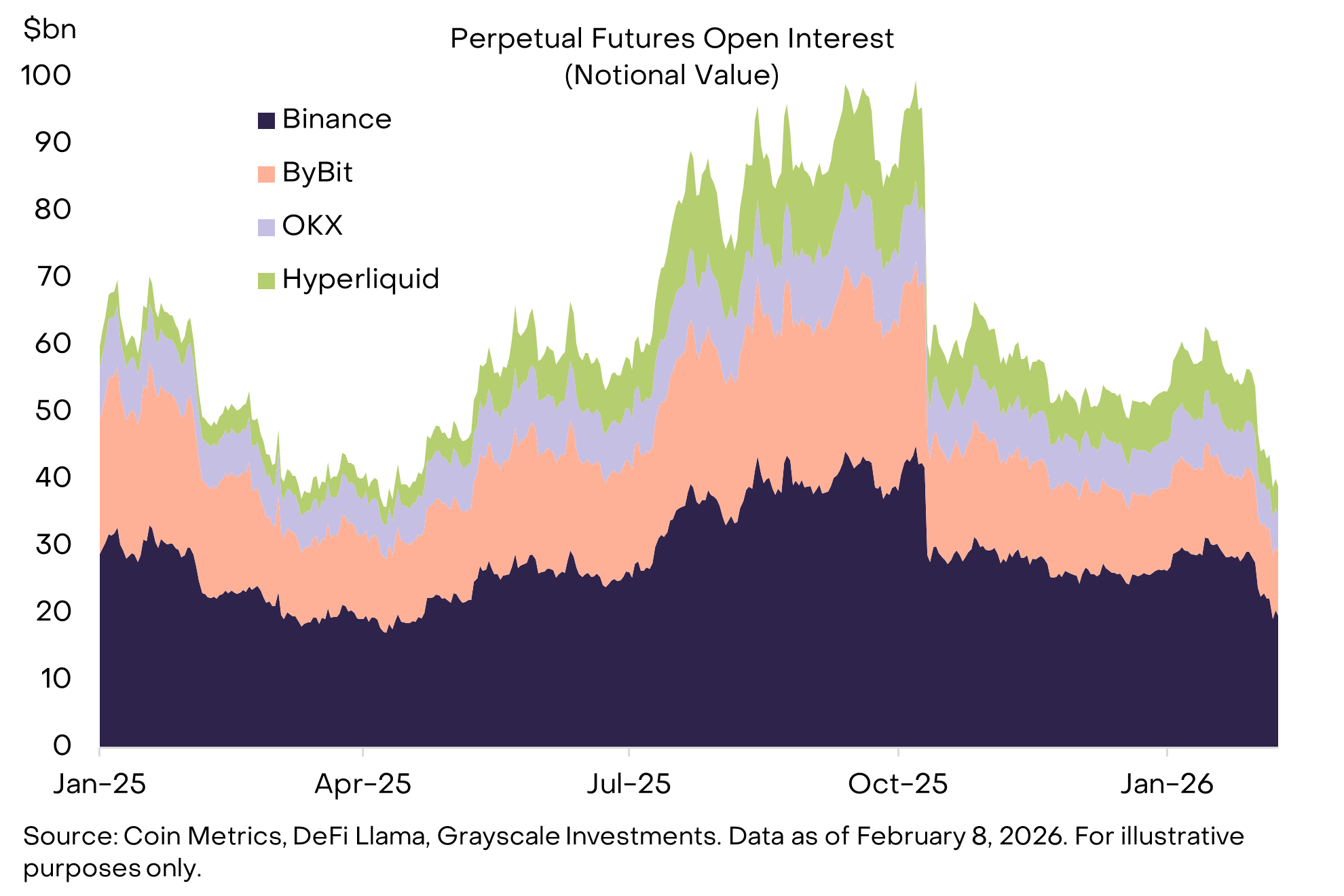
Technical indicators point to a significant deleveraging across crypto derivative markets, which can be a sign that valuations have reached a local low. For instance, aggregate open interest for the four largest perpetual futures exchanges has fallen by more than half since October (Exhibit 5). Funding rates, or the cost of holding long positions in perpetual futures contracts, turned negative for the largest crypto assets by market cap; option skew moved to even more extreme levels than we highlighted last month.
Exhibit 5: Lower open interest on perpetual futures exchanges
In addition to uncertainty about risk appetite across all markets, the short-term outlook for the crypto asset class may depend on progress (or lack thereof) on the CLARITY Act in the U.S. Senate.[4] Delays in the Senate Banking Committee’s process in January likely weighed on valuations last month, in our view. According to press reports, the White House will convene a second meeting with crypto and banking industry participants later today to try to move the bill forward.[5] We had expected this legislation to become law in 2026, but its prospects now seem more uncertain.
While passing the CLAIRTY Act would be a positive for crypto markets, in our view, improving regulatory clarity for the crypto industry is a structural trend much bigger than one piece of legislation. The bipartisan GENIUS Act, the many other changes by U.S. regulatory agencies, and parallel efforts in other countries are driving institutional investment in stablecoins, tokenized assets, and other applications of public blockchain technology. Rising adoption of these use cases (by both traditional users and AI agents) will in turn drive value to blockchain networks and their native tokens. For investors looking to position portfolios for growth in stablecoins and tokenized assets specifically, we believe the most direct beneficiaries are likely to be leading smart contracts platforms like Ethereum (ETH) and Solana (SOL) and critical middleware technology like Chainlink (LINK).
Beyond these macro trends driving the entire crypto asset class, we see the most innovation in three areas: privacy, perpetual futures, and prediction markets. These market segments have shown outsized price performance, experienced rising volume, and/or offer some of the most compelling use cases for blockchain-based financial services. Assets that may benefit from continued market focus on these areas include Zcash (ZEC), a decentralized digital currency like Bitcoin with privacy features, and Hyperliquid (HYPE), a perpetual futures exchange that may be expanding into prediction markets.[6]
Whether Bitcoin leads or lags a recovery in the broader crypto asset class will depend on investor interest in its specific use case: as a decentralized digital currency and potential longer-term alternative to physical gold in global capital markets. There are lots of questions Bitcoin will need to answer along this journey (e.g., the sustainability of fee revenue, the success of the Lightning Network for payments, etc.), but at the moment the issue in focus for investors appears to be Bitcoin’s readiness for a future in which quantum computers make legacy cryptography obsolete. Look for much more discussion on this topic within the Bitcoin community over the coming months.
While short-term price movements have captured the market’s attention in recent weeks, the quantum question is the major long-term consideration for crypto assets. If Bitcoin can overcome this challenge, it will likely reinforce the view of it being an effective long-term store of value — something that will move it even closer to gold in the eyes of investors.
Index Definitions: The S&P 500 Index is a market-capitalization-weighted index that measures the performance of 500 of the largest publicly traded companies in the United States. The FTSE Grayscale Smart Contract Platforms Crypto Sector Index was developed to measure the performance of crypto assets that serve as the baseline platforms, upon which self-executing contracts are developed and deployed. The FTSE Grayscale Utilities and Services Crypto Sector Index was developed to measure the performance of crypto assets that aim to deliver practical and enterprise-level applications and functionalities. The FTSE Grayscale Consumer and Culture Crypto Sector Index was developed to measure the performance of crypto assets that support consumption-centric activities across a variety of goods and services. The FTSE Grayscale Currencies Crypto Sector Index was developed to measure the performance of crypto assets that serve at least one of three fundamental roles: store of value, medium of exchange, and unit of account. The FTSE Grayscale Financials Crypto Sector Index was developed to measure the performance of crypto assets that seek to deliver financial transactions and services. The FTSE Grayscale Artificial Intelligence Crypto Sector Index was developed to measure the protocols for which AI applications are the primary use case.
[1] Source: Bloomberg. As of June 2025. Subject to change.
[2] Source: Bloomberg, Grayscale Investments. Data as of February 6, 2026.
[3] Grayscale monitors Coin Days Destroyed (CDD) for evidence of selling by “OG Whales”, or large long-time Bitcoin holders. Unlike July and November 2025, there was no spike recently in CDD. Source: Glassnode, Grayscale Investments. Data as of February 9, 2026.
[4] Technically the CALRITY Act refers to the version of market structure legislation passed by the House. In the Senate, legislation from the Banking Committee is called the Responsible Financial Innovation Act and legislation from the Agricultural Committee is called the Digital Commodity Intermediaries Act.
[5] Source: Crypto in America.
[6] The largest prediction markets by volume, Polymarket and Kalshi, have not yet issued tokens, but Polymarket has confirmed a token is coming and recently filed associated trademark applications. Source: The Block 1, and The Block 2.