January 2026: Bitcoin and the Debasement Trade

Research Team
Last Updated: 2/2/2026 | 19 min. read
The debasement trade refers to the idea that excessive government debt growth will result in fiat currency depreciation versus assets with scarce supply — like real estate or precious metals. The modern debasement trade arguably kicked off with governments’ response to the Covid pandemic, which involved sharply higher budget deficits and near-zero interest rates.[1] Since that time Bitcoin has been one of the best-performing major assets, rising roughly 10x from its levels in Q1 2020 (Exhibit 1).
Exhibit 1: Bitcoin up a casual 10x since January 2020

However, in January 2026, when the debasement trade seemed to shift into a higher gear, Bitcoin’s price declined. The U.S. Dollar had its worst month since April 2025 — the month of President Trump’s “Liberation Day” announcements — amid new geopolitical tensions (related to Venezuela, Greenland, and Iran), threats of more tariffs (on Canada and Western Europe), another potential government shutdown (due to conflict over funding immigration enforcement), and questions about Federal Reserve independence (with the Supreme Court hearing a case over the ability of the president to remove governors).
The price of gold increased 13%, silver gained 19%, and several emerging-market (EM) currencies appreciated sharply. In contrast, large-cap crypto assets generally declined in price during the month (Exhibit 2). Bitcoin and gold are kindred spirits: demand for both can have common underlying drivers and can be found in the same portfolios. As one example, stablecoin issuer tether holds large stockpiles of both Bitcoin and gold.[2] The underperformance of Bitcoin in January therefore surprised some observers.
Exhibit 2: The Dollar depreciated vs. other currencies and precious metals

Bitcoin is a digital currency and digital payments system that operates on a network of computers around the world. Like other currencies, demand for Bitcoin derives from its properties as a store of value (scarce and transparent supply) and as a medium of exchange (censorship-resistant digital payments). Grayscale believes Bitcoin’s monetary properties will see rising demand, but it is not a perfect substitute for physical gold. Gold has a long history and is more suitable for the world’s most conservative investors, including central banks. Bitcoin is innovative technology that has spawned an entirely new industry and asset class, and its price is often correlated with other frontier tech market segments. Central banks and other conservative investors will likely be slower to allocate to Bitcoin than other institutions — and they may miss out on portfolio returns as a result.
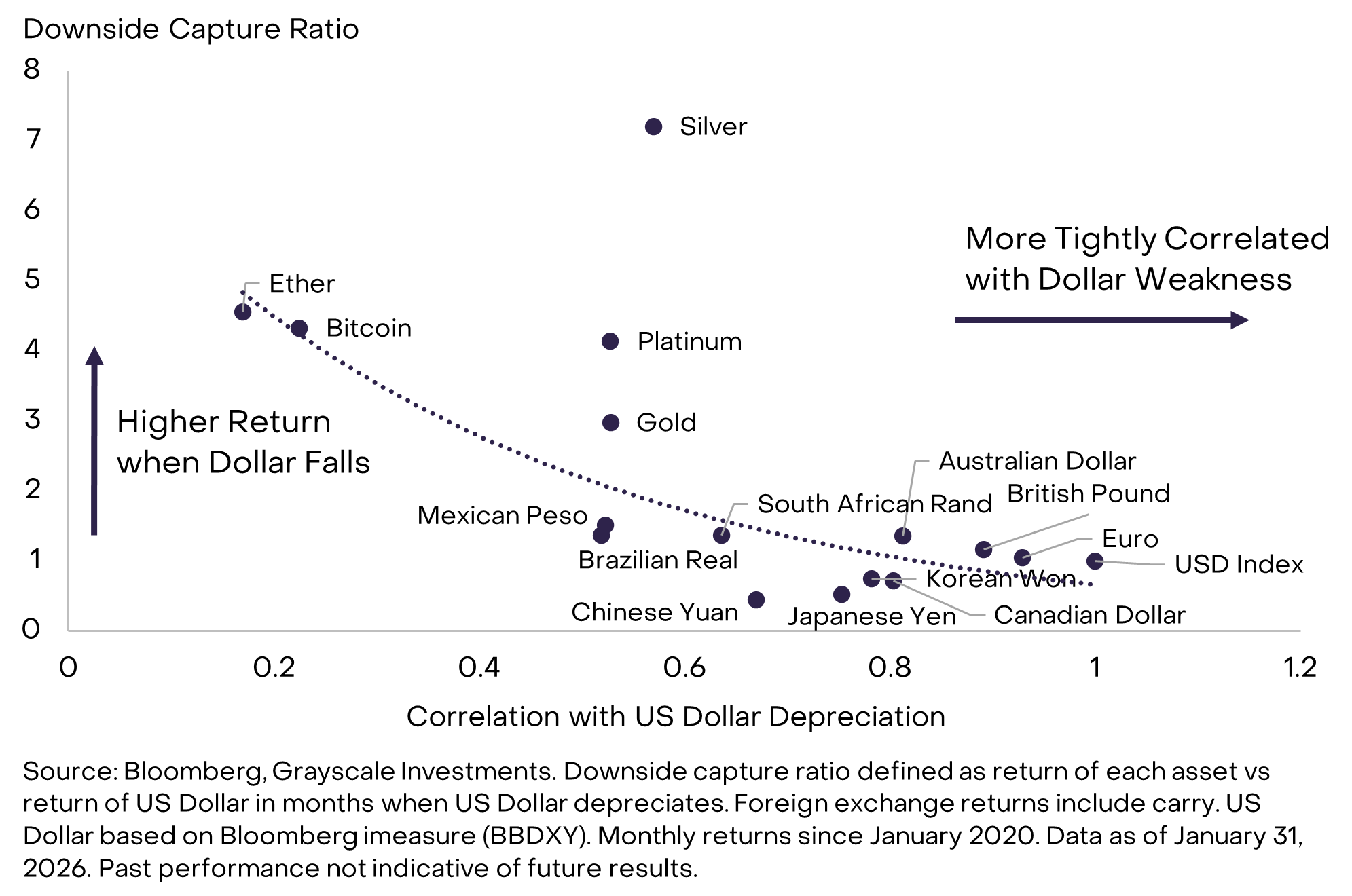
In more technical terms, investors can think of Bitcoin’s relationship with the debasement trade in terms of correlation and downside capture. To build a portfolio that consistently benefits from U.S. Dollar depreciation, the best assets are those that are tightly (and inversely) correlated with the Dollar. These are typically other developed market currencies like the Euro and British Pound.[3] Alternatively, to find assets that may produce high returns when the Dollar falls, investors could consider those with a high downside capture ratio.[4] Such assets tend to deliver higher percent returns when the dollar depreciates. These assets can include EM currencies and precious metals.
Crypto assets like Bitcoin and Ether tend to have a low (inverse) correlation with the Dollar and a high downside capture ratio (Exhibit 3). In practical terms, this suggests crypto assets offer potentially high returns during periods of Dollar depreciation, but with less consistency than certain other assets.
Exhibit 3: Bitcoin has high downside capture ratio vs. U.S. Dollar
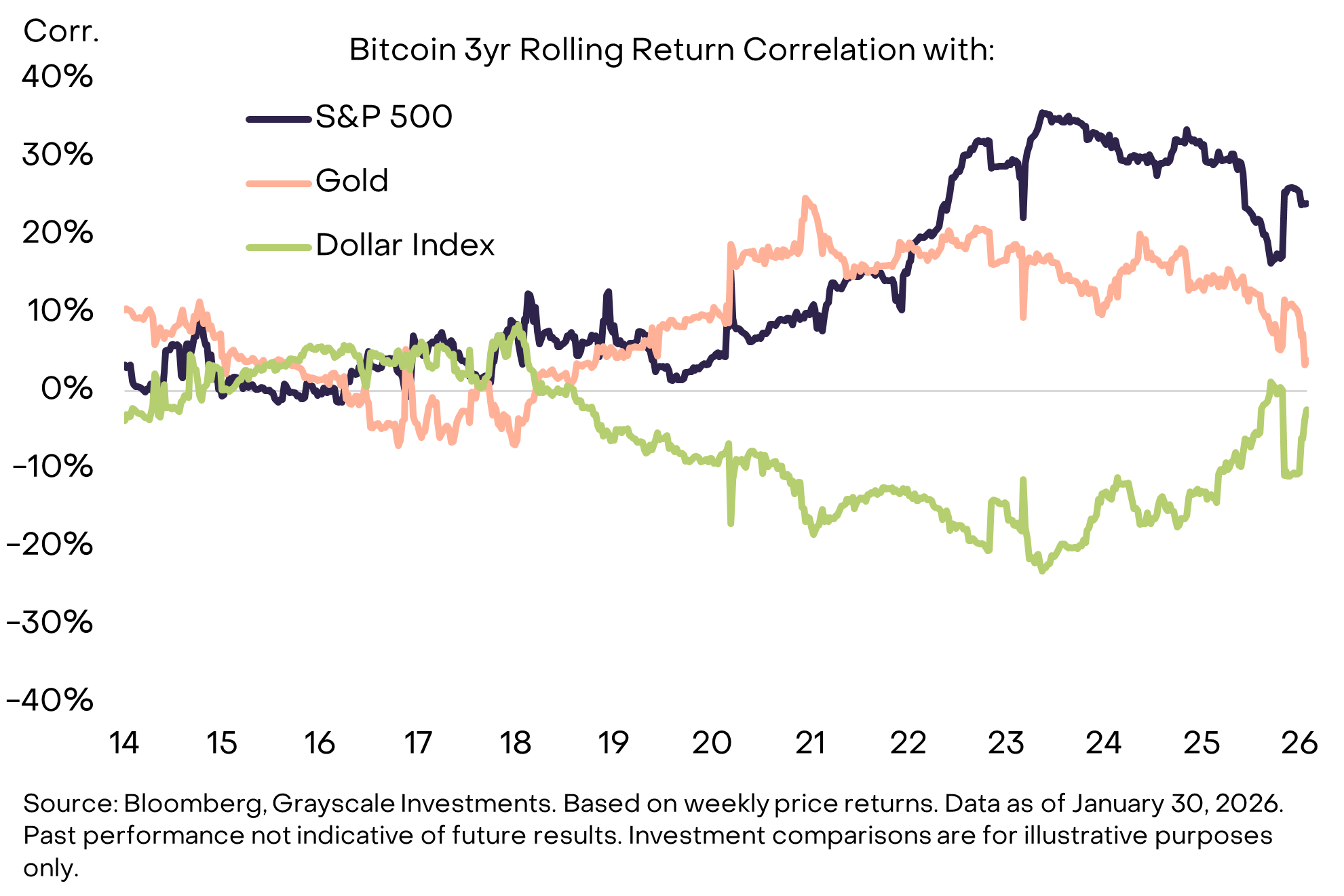
As Bitcoin has matured, its price volatility has declined, but its return correlations with other macro assets have continued to evolve. On average, Bitcoin returns have been positively correlated to stocks, positively correlated to gold, and negatively correlated with the U.S. Dollar (Exhibit 4). Each of the pairwise correlations can be considered moderate (e.g., <40%). Low correlations are a good property of portfolio diversifiers, but by definition, they mean Bitcoin and other crypto assets may often move out of sync with other markets.
Exhibit 4: Bitcoin’s evolving correlations with traditional assets
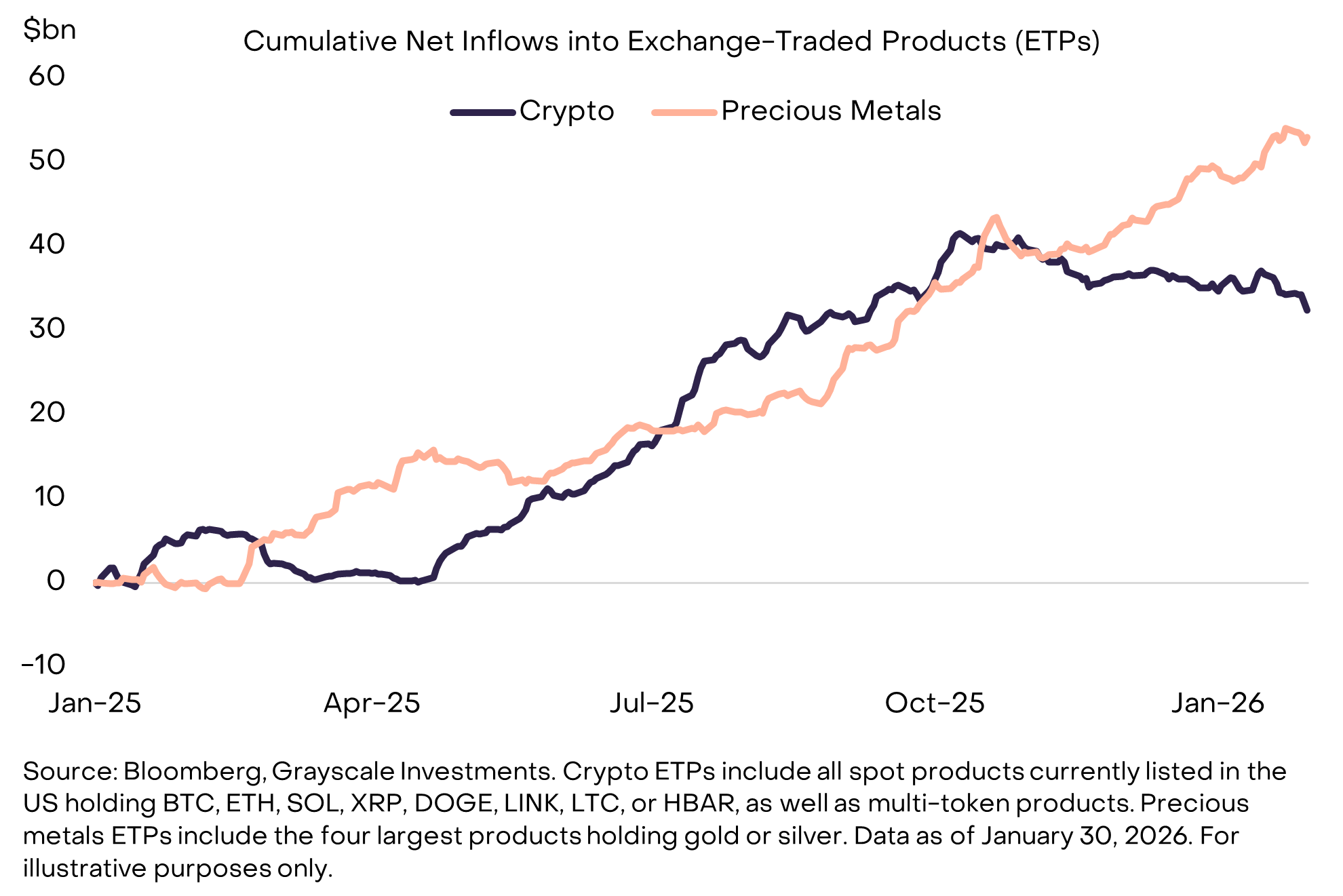
So why did Bitcoin and other crypto assets trail the debasement trade in January?[5] From a fund flow standpoint, the U.S.-listed spot Bitcoin exchange-traded products (ETPs) saw net outflows of about $2.3 billion, whereas the largest precious metals ETPs saw net inflows of more than $3.5 billion (Exhibit 5).Possibly related to ETP net selling, the price of Bitcoin on U.S.-dominant Coinbase was consistently below the price of Bitcoin on primarily offshore exchanges like Binance (i.e., there was a negative “Coinbase premium”). In contrast, perpetual futures open interest increased during the month, suggesting that deleveraging in futures markets was not holding back crypto markets during January.
Exhibit 5: ETP net inflows have favored precious metals since early October
From a fundamental standpoint, two factors likely contributed to investor caution toward crypto: (i) delays for the market structure bill/CLARITY Act in the U.S. Senate and (ii) growing debate over Bitcoin’s ability to eventually transition to post-quantum cryptography.
The crypto market structure bill — known in the House of Representatives as the CLARITY Act[6] — has been making its way through the U.S. Senate for several months. The Senate Banking Committee was widely expected to hold a markup on this legislation on January 15 — the final step before moving the legislation to the full Senate (and beginning the process of merging the text with other relevant bills). However, Senate Banking Committee Chairman Scott canceled the markup after Coinbase withdrew its support for the legislation over issues related to stablecoin yields.[7] The Banking Committee will now working on housing-related topics for the next month or so, before potentially taking up the legislation thereafter.[8] The White House will convene a group of banking and crypto industry leaders this week to try to move the process forward.[9] We continue to expect the market structure bill to become law this year, but the timeline is now longer than we previously expected, and there is a higher probability that the legislation stalls.
Separately, there has been a sharp increase in discussion in the crypto industry about an eventual transition to post-quantum cryptography. Very briefly, this issue relates to the idea that sufficiently advanced quantum computers may eventually be able to “break” many standard cryptographic methods.[10] To mitigate this risk, public blockchain (and all other internet infrastructure) may need to transition to new techniques that do not have this vulnerability.
To highlight the growing public debate about these topics, Exhibit 6 shows the number of times the technical term “Shor’s Algorithm” was mentioned in press articles. Shor’s Algorithm is a method by which a quantum computer could solve the mathematical problems that underpin standard cryptographic methods (including those used in Bitcoin). In addition to growing public discussion about quantum computers and cryptography, during January Coinbase created an independent advisory board on quantum computing and blockchains and Ethereum announced its post-quantum strategy.[11]
Exhibit 6: Rising press coverage of quantum computing and cryptography

The threat to public blockchains from quantum computers is far away, and we continue to see this issue as a “red herring” for the 2026 market outlook. Moreover, the transition to post-quantum cryptography is conceptually straightforward, and quantum-secure methods already exist. However, there may be unique challenges for Bitcoin (because of Satoshi-era coins and infrequent protocol updates). In any case it’s natural for investors to want to understand quantum risk before allocating capital. The heightened debate about quantum risk may be holding back some capital allocation decisions over the short term, but we do not expect this topic to be a long-term drag on the asset class. In our view, crypto will see net new capital inflows when uncertainty about U.S. legislation and quantum readiness abate.
This month saw a flurry of developments in the tokenization space, signaling early innings of mainstream adoption and institutional support. The New York Stock Exchange (NYSE) announced plans to launch a regulated blockchain platform for tokenized US equities and ETFs which could help modernize market infrastructure and enable 24/7 trading and instant settlement.[12] Ondo announced the expansion of its over 200 tokenized equities and ETFs to Solana.[13] South Korea’s parliament also approved a legal framework for tokenized securities, that are scheduled to take effect in January 2027.[14]Tokenization firm Superstate also raised $82.5 million in funding to allow companies to raise capital, issue shares, and run IPOs directly on public blockchains.[15] Binance also announced it is considering bringing back tokenized stock trading back onto its platform.[16]
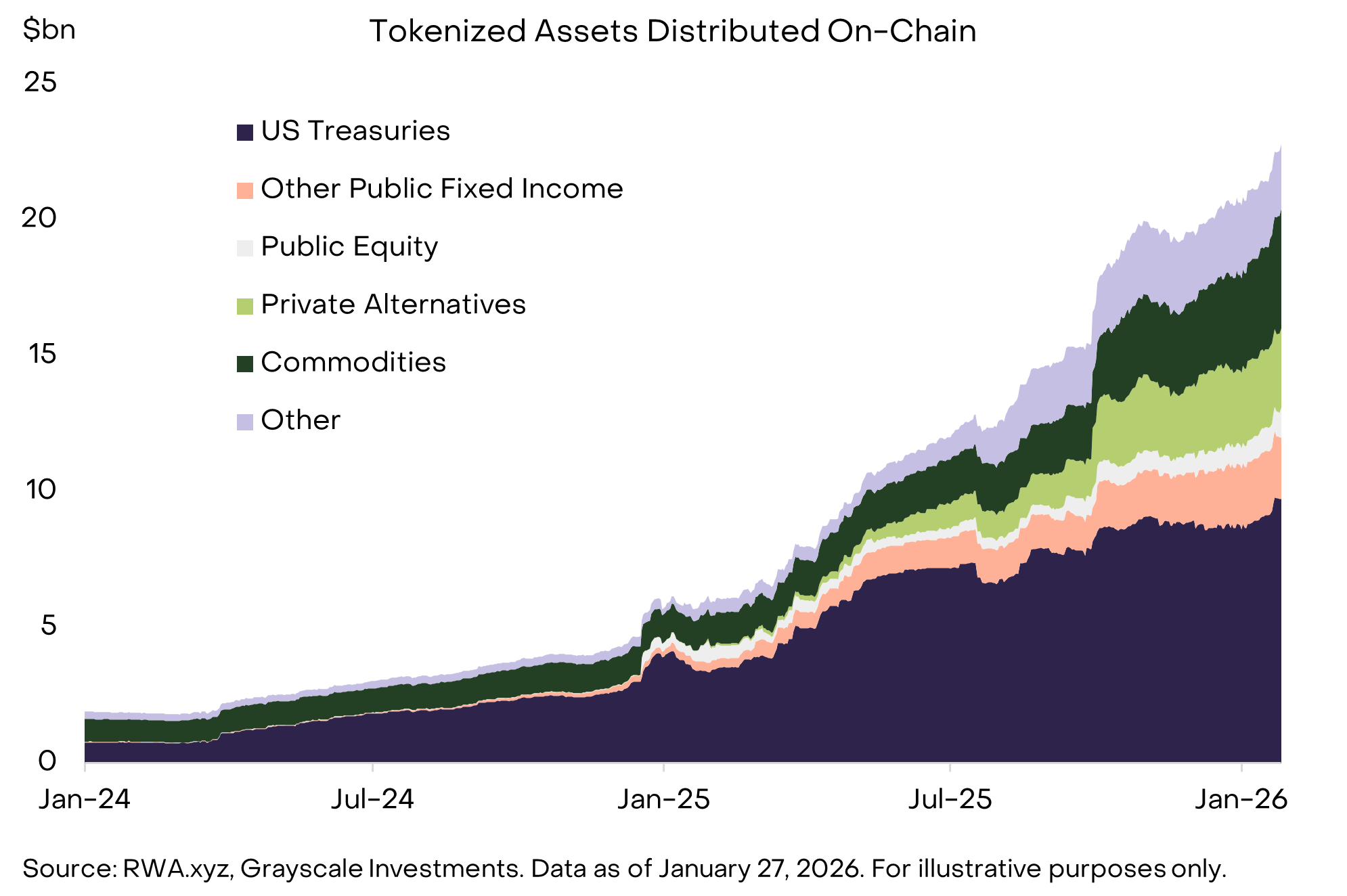
The push to tokenized securities markets is still in the early innings but will likely be a major trend. Today, the total value of tokenized assets on public blockchains is still relatively small at just under $25 billion, representing a tiny fraction of the global pool of financial assets (Exhibit 7). The nascency of the market means that many foundational questions remain unresolved. One key uncertainty is the eventual market structure: it is unclear whether large, general-purpose blockchains such as Ethereum and Solana will ultimately dominate by leveraging early network effects, liquidity, and developer ecosystems, or whether tokenized assets will migrate toward smaller, more specialized, and potentially private blockchains designed specifically for institutional tokenization use cases.
Exhibit 7: Steady growth in tokenized assets from small base
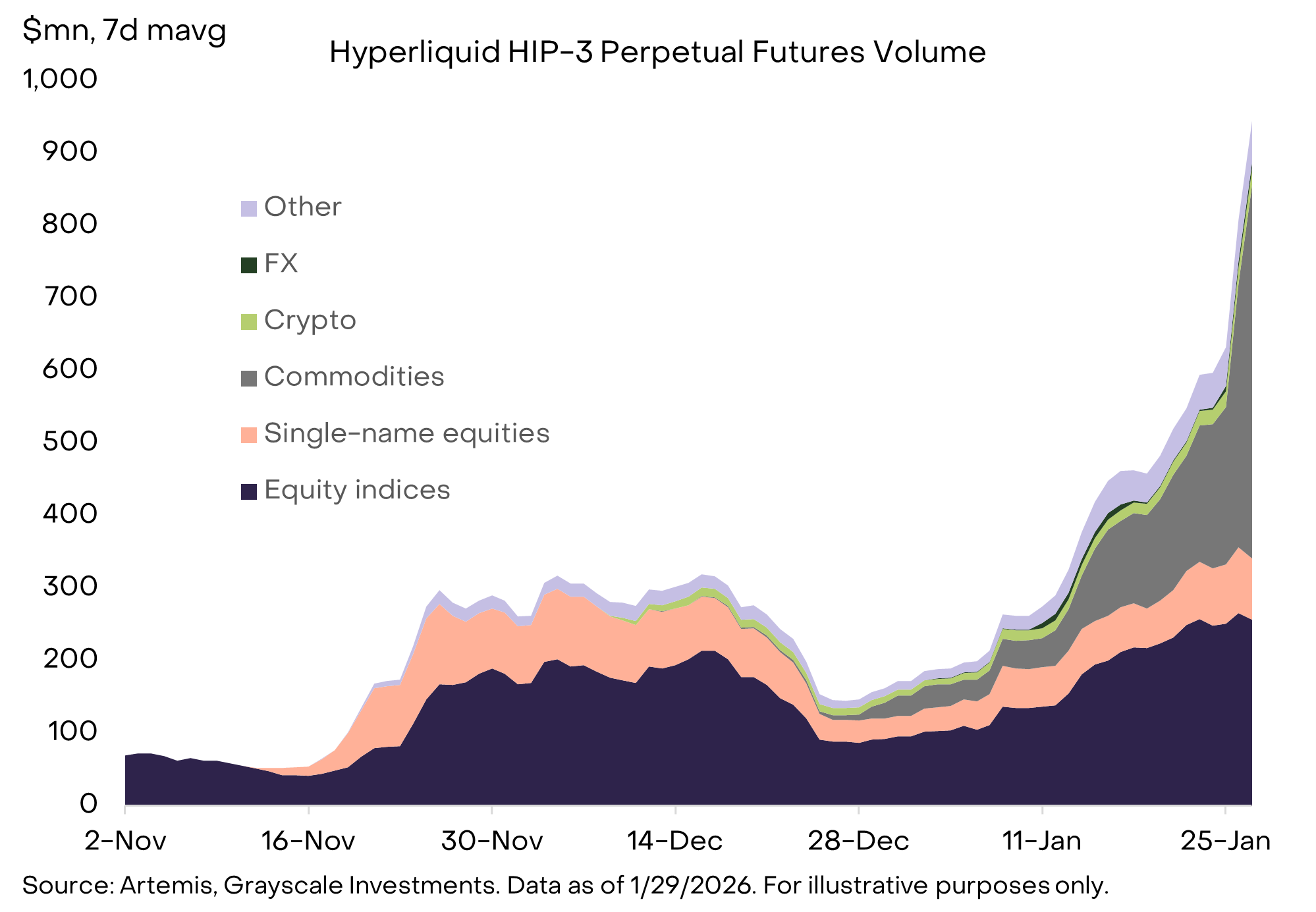
Separately, we were encouraged by the takeoff in perpetual futures trading for non-crypto assets on Hyperliquid, a decentralized exchange (DEX) specializing in these types of derivatives. The new products were catalyzed by a change to the protocol (called Hyperliquid Improvement Proposal 3 or HIP-3 for short) that allowed community members to launch new products, and market participants were quick to focus on futures for non-crypto assets like equity indices, single-name equities, and commodities.[17] For a product this new, the adoption curve has been strong: over the last three months, daily notional volume moved from early-stage levels to sustained hundreds of millions (Exhibit 8). The broader significance is what this implies about DEXs as a trading platform: with simpler, always-on rails and unified collateral, traders can express views on mainstream markets without relying on tokenized wrappers.
Exhibit 8: HIP-3 perpetual futures volume grows during a heated commodity rally
Lastly, there were encouraging signs of institutional capital availability for the crypto industry. Custodian BitGo went public at a valuation of about $2 billion, and press reports indicated that hardware wallet provider Ledger is also planning an IPO, reportedly at a $4 billion valuation.[18] Separately, Bloomberg reported that Anchorage Digital is looking to raise $200 million to $400 million ahead of a potential IPO in 2027.[19]
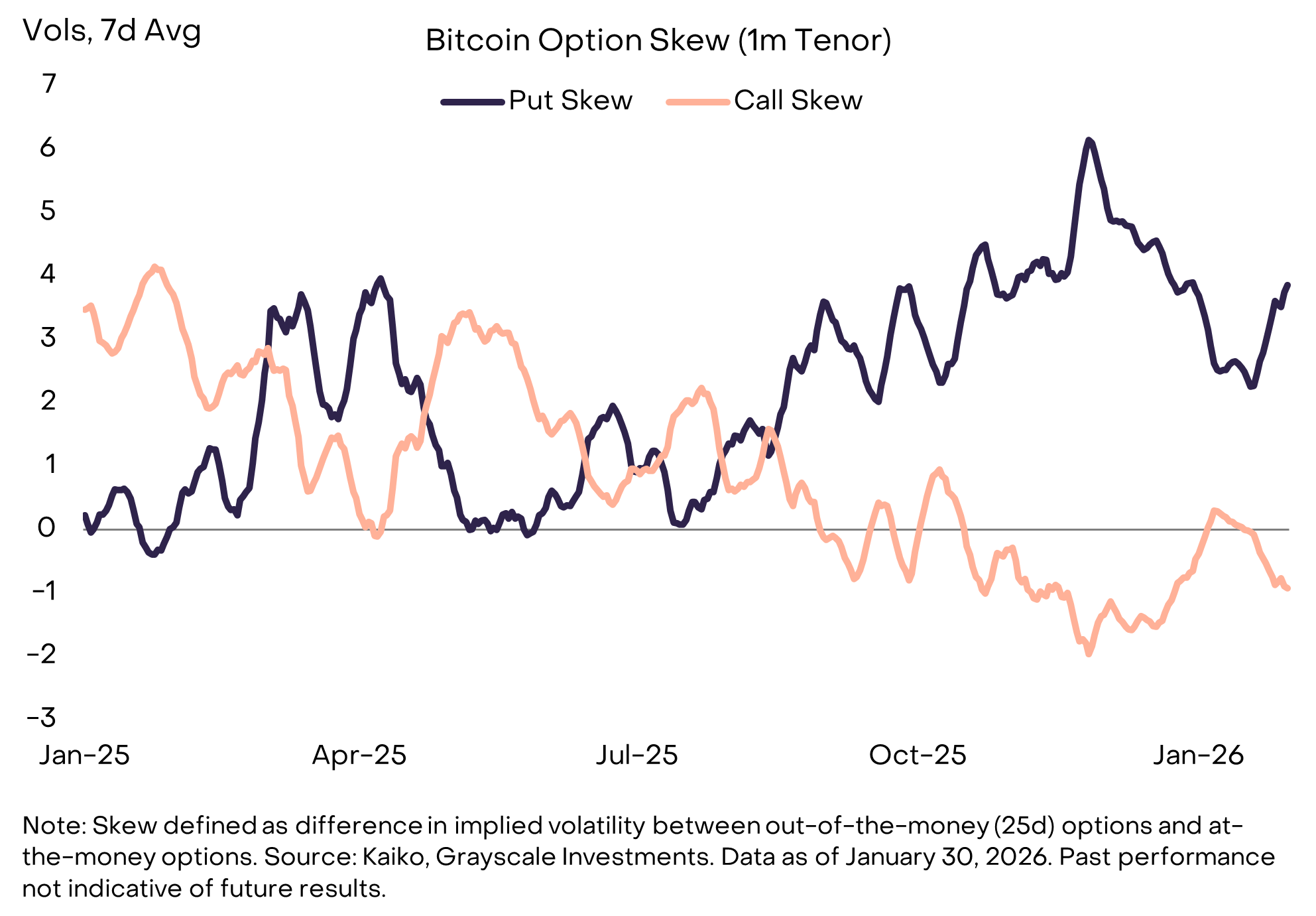
After reaching an all-time high in early October, Bitcoin’s price is currently down about 35-40%, and sentiment in crypto markets seems low. One indication of downbeat sentiment comes from Bitcoin options markets. Currently, Bitcoin “call skew” is relatively low and Bitcoin “put skew” is relatively high (Exhibit 9).[20] In other words, there appears to be relatively low demand for options that benefit from rising prices, and relatively high demand for options that protect or hedge against further declines in prices. This can be a sign of conservative investor positioning and/or cautious sentiment.
Exhibit 9: Options market suggests conservative positioning
We continue to see a favorable outlook for both Bitcoin and the crypto asset class. There is clear demand for alternative stores of value, and regulatory clarity continues to improve for the crypto industry — despite short-term setbacks on the market structure bill. And quantum risk, while an important issue, is still theoretical: there’s plenty of time for fundamental research, community preparedness, and engineering.
Unlike fiat currencies, inflation in the supply of Bitcoin is low and predictable: the 20 millionth Bitcoin will be mined next month, and roughly 450 new Bitcoin will be supplied to the market every day until the next halving in April 2028. In our view, investors will continue to be attracted to a money system with transparent, predictable, and ultimately scarce supply in an era of fiat currency debasement. The crypto asset class also includes a wide range of other software technologies that are transforming financial markets, related to stablecoins, tokenized assets, and decentralized finance. Bitcoin, smart contract platform tokens, and other crypto assets can be considered unique diversifiers available to investors comfortable with their volatility and positioning portfolios for growth.
Index definitions: The Bloomberg Dollar Spot Index (BBDXY) tracks the performance of a basket of 10 global currencies against the U.S. dollar. The S&P 500 Index is a market-capitalization-weighted index that measures the performance of 500 of the largest publicly traded companies in the United States. The S&P 500 Financials comprises those companies included in the S&P 500 that are classified as members of the GICS financials sector. Bloomberg Magnificent 7 Total Return Index is an equal-dollar weighted equity benchmark consisting of a fixed basket of 7 widely-traded companies classified in the United States and representing the Communications, Consumer Discretionary and Technology sectors as defined by Bloomberg Industry Classification System. The Deutsche Bank EM FX Equally Weighted Trading Index is one of a set of proprietary foreign exchange indices developed to track the performance of emerging markets currencies.
[1] News reports also show an increase in frequency of the term “debasement” around the start of the Covid pandemic in 2020. Source: Bloomberg.
[2] Source: Tether. Bloomberg reported in January that Tether holds 140 tons of gold valued at $24bn as of prices on January 27, 2026.
[3] This is partly by construction: the Dollar index is a weighted average of bilateral exchange rates.
[4] Downside capture refers to the return of one asset (e.g. Bitcoin) when the price of another asset (e.g. the Dollar) declines. It is typically expressed as the ratio of percent changes in the two assets.
[5] In addition to these factors, President Trump’s nomination of Kevin Warsh for Fed Chair appeared to weigh on crypto valuations late in the month.
[6] In the Senate, legislation from the Banking Committee is called the Responsible Financial Innovation Act and legislation from the Agricultural Committee is called the Digital Commodity Intermediaries Act.
[9] Source: Reuters. The Senate Agriculture Committee voted along party lines to move its section of the market structure bill forward during January.
[10] Technically, a sufficiently advanced quantum computer could derive private keys from public keys and therefore generate valid digital signatures to spending coins.
[11] Source: Coinbase, Justin Drake.
[17] Source: Hyperliquid.
[18] Source: Financial Times.
[20] “Skew” refers to the price of out-of-the-month options relative to at-the-money options, typically quoted in terms of implied volatility.