February 2026: Signs of Stability

Research Team
Last Updated: 3/2/2026 | 11 min. read
Crypto markets tumbled in early February alongside high-growth software stocks and other equity market segments related to early-stage technology. Innovations in artificial intelligence (AI) seem to be accelerating, which has begun to weigh on assets tied to businesses facing potential disruption. For example, at the end of January, Anthropic announced plug-ins for its Claude Cowork tools that have potential applications in professional business services like HR, compliance, and legal.[1] Blockchains do not compete with AI — we think the two technologies are complementary, as discussed below — but the derisking of growth-oriented portfolios likely spilled over into crypto assets (Exhibit 1).
Exhibit 1: Bitcoin Price Stabilized After Early-February Drop
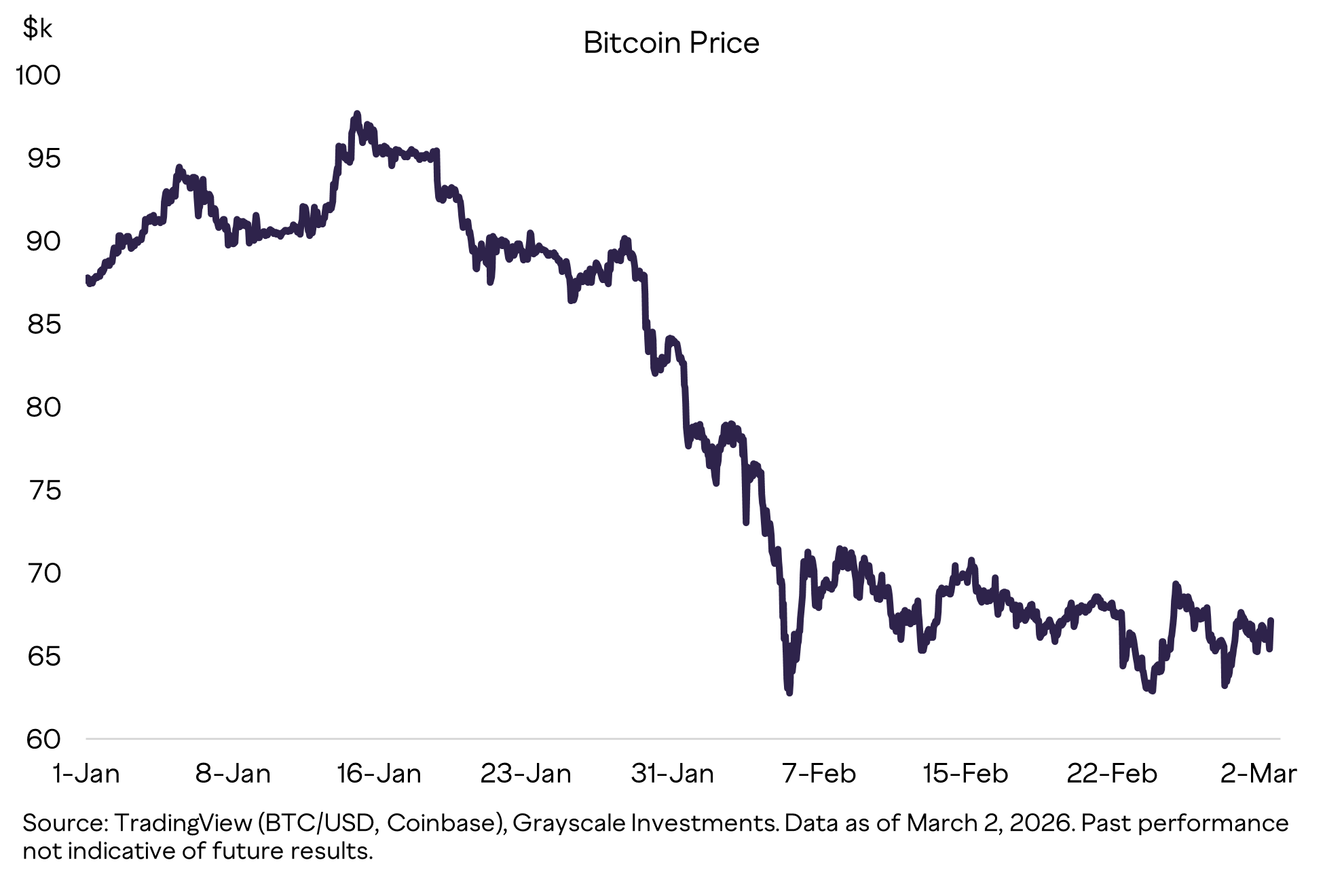
Markets stabilized later in February, in terms of price performance, volume, and other indicators. For example, the market cap-weighted FTSE/Grayscale Crypto Sectors Index declined 26% from January 30 through February 5, then gained about 4% from that point to the end of the month.[2] After spiking during the drawdown, spot trading volume and option-implied volatility both settled down later in the month (Exhibit 2), and open interest in perpetual futures contracts stabilized.
Exhibit 2: Bitcoin Trading Volume Spiked During Drawdown

Bitcoin and other crypto assets have experienced a meaningful drawdown, and uncertainty around the near-term outlook admittedly remains high. However, for investors with longer-term horizons, we believe now may be an appropriate time to consider allocating.
Three reasons for our relatively constructive view:
The fate of the Clarity Act in the U.S. Senate is a wildcard for the near-term market outlook.[7] The legislation faced a meaningful setback in January, when the Senate Banking Committee delayed its scheduled markup. Since that time, the White House has convened three meetings with crypto and banking industry participants. According to press reports, the third meeting on February 19 involved a smaller group, more focused discussion, and specific draft text on the thorny issue of stablecoin yield.[8]
The Clarity Act provides a traditional finance rulebook for many aspects of the digital assets industry, and passage would likely facilitate institutional capital inflows into the asset class, in our view. At the same time, progress toward regulatory clarity has advanced along many fronts and is bigger than any one piece of legislation. The industry can move forward without the Clarity Act, with more rulemaking provided by regulatory agencies. But, in our view, the best-case scenario would be to pass the bipartisan legislation to codify digital assets regulation into law.
From a Crypto Sectors perspective, the best-performing market segment in February was AI, which saw a smaller drawdown than other sectors (Exhibit 3). The outperformance seemed due to renewed enthusiasm around AI agents — autonomous software that can work independently on your behalf to pursue a complex set of objectives. Technological innovation appears to be accelerating with the rise of agent-based systems, particularly OpenClaw — a locally hosted productivity assistant that became one of the fastest-growing open-source projects in history. Within the AI Crypto Sector, leading performers included Kite AI, a blockchain built for agent-native stablecoin payments, and Pippin AI, which is building infrastructure to support on-chain AI agents.
Exhibit 3: AI Crypto Sector Outperformed in February

Across the digital assets ecosystem, there were several developments related to the Three P’s of privacy, perpetual futures, and prediction markets. For example, Near, a project also in the AI Crypto Sector, unveiled a few initiatives at the intersection of AI and privacy. This included the introduction of confidential transactions for its popular intents feature and support for AI agents with built-in privacy and encryption guarantees.[9]
Separately, Hyperliquid, a perpetual futures exchange, continued to expand beyond crypto-native assets (HIP-3 perps). For example, on January 30, Hyperliquid silver futures reached roughly ~2% of CME COMEX silver futures volume[10], suggesting these markets are becoming large enough to be worth watching alongside legacy venues, particularly outside traditional trading hours. Beyond commodities, Hyperliquid futures already exist for international equities. If liquidity continues to build, Hyperliquid futures may increasingly serve as an always-on venue for expressing and hedging views in a subset of global macro assets.
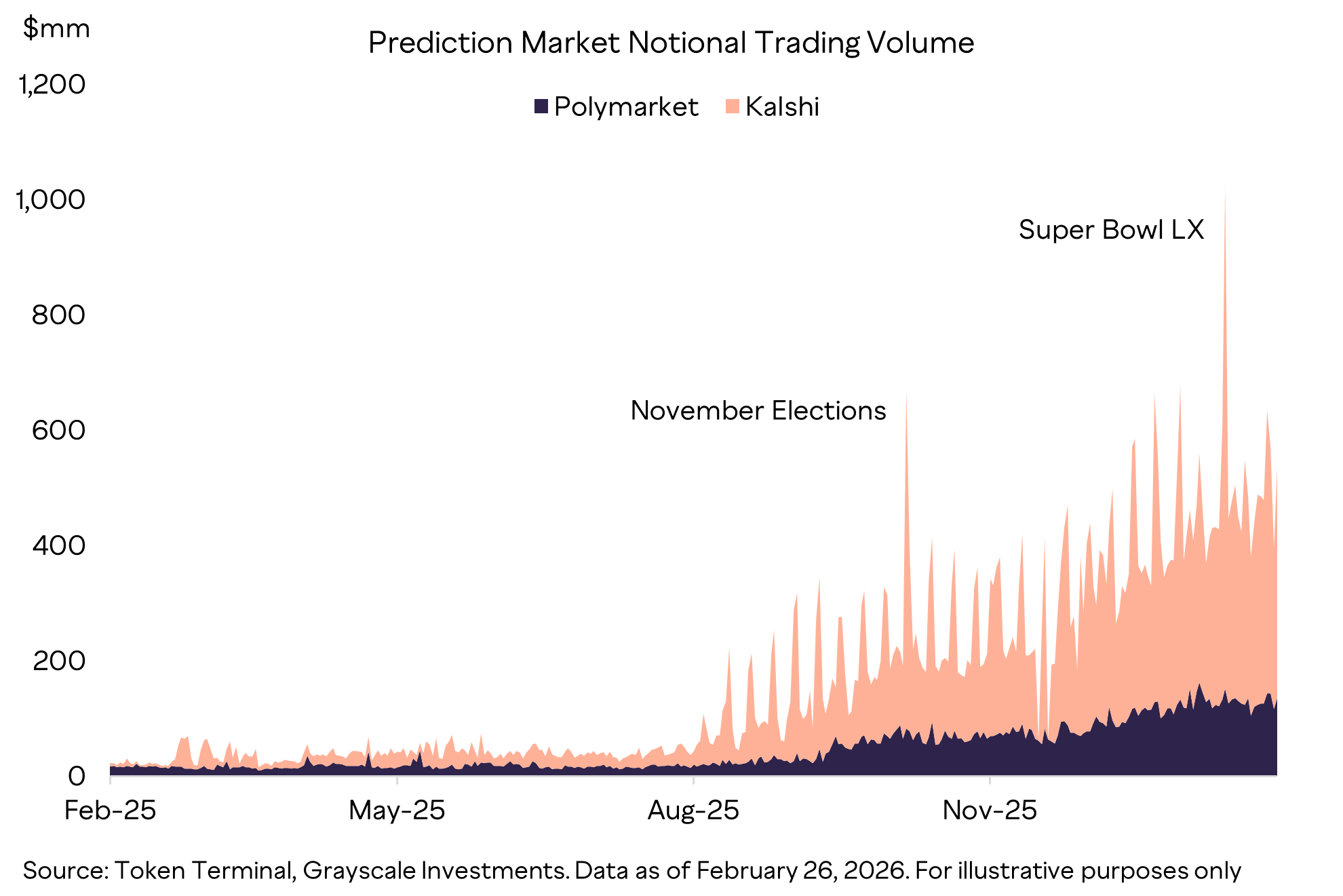
Prediction markets Polymarket and Kalshi saw another surge in volume around the Super Bowl on February 8 (Exhibit 4). But perhaps most notable was how well trading volume held up in the weeks afterward. These platforms have become a part of the news and information landscape, with sustained activity beyond marquee events. Last month Polymarket filed a trademark application for a POLY token, and the firm’s CMO has previously signaled that a token launch is coming.[11] Meanwhile, the Federal Reserve published analysis showing the value of prediction markets for forecasting economic variables like CPI inflation.[12] Despite the progress, there are still regulatory questions around these platforms: during February the CFTC reaffirmed its exclusive federal authority and stepped into litigation opposing state efforts to regulate them as unlicensed gaming.[13]
Exhibit 4: Sustained Prediction Market Volume After Super Bowl
After a meaningful drawdown since October, crypto markets are showing signs of stability. Stablecoins and tokenized assets are likely to continue fueling adoption, and we are seeing steady innovation across the industry, related to AI, privacy, perpetual futures, prediction markets, and other use cases. If the fundamental trends remain positive, crypto asset valuations will eventually follow.
[2] Source: FTSE/Russell, Bloomberg, Grayscale Investments. Data as of February 27, 2026. Index returns are presented for illustrative purposes only and exclude management fees and expenses. Indexes are unmanaged, and investors cannot invest directly in an index.
[7] The Clarity Act was the name of the House-based version of the market structure bill. Draft legislation in the Senate has different names depending on committee.
[8] Source: Crypto in America.
[10] Calculated by Grayscale based on data from CME and Artemis. Data as of January 30, 2026.
[11] Source: The Block, The Block.
[12] Source: Federal Reserve.