Solana: Crypto’s Financial Bazaar

Research Team
Last Updated: 6/26/2026 | 20 min. read
Grayscale Solana Staking ETF ("GSOL" or the "Fund"), an exchange traded product, is not registered under the Investment Company Act of 1940 (or the ’40 Act) and therefore is not subject to the same regulations and protections as 1940 Act registered ETFs and mutual funds. An investment in GSOL is subject to a high degree of risk and heightened volatility. GSOL is not suitable for an investor that cannot afford the loss of the entire investment. An investment in the Fund is not a direct investment in SOL.
From a purely technical standpoint, Solana is a decentralized computer network that processes transactions and records them sequentially into a blockchain. But this description is like saying that Manhattan is an island with roads and buildings. Solana is a vibrant community and onchain economy: an invisible metropolis with millions of users, conducting thousands of transactions per second, and interacting with an almost overwhelming diversity of applications. Solana is crypto’s financial bazaar.
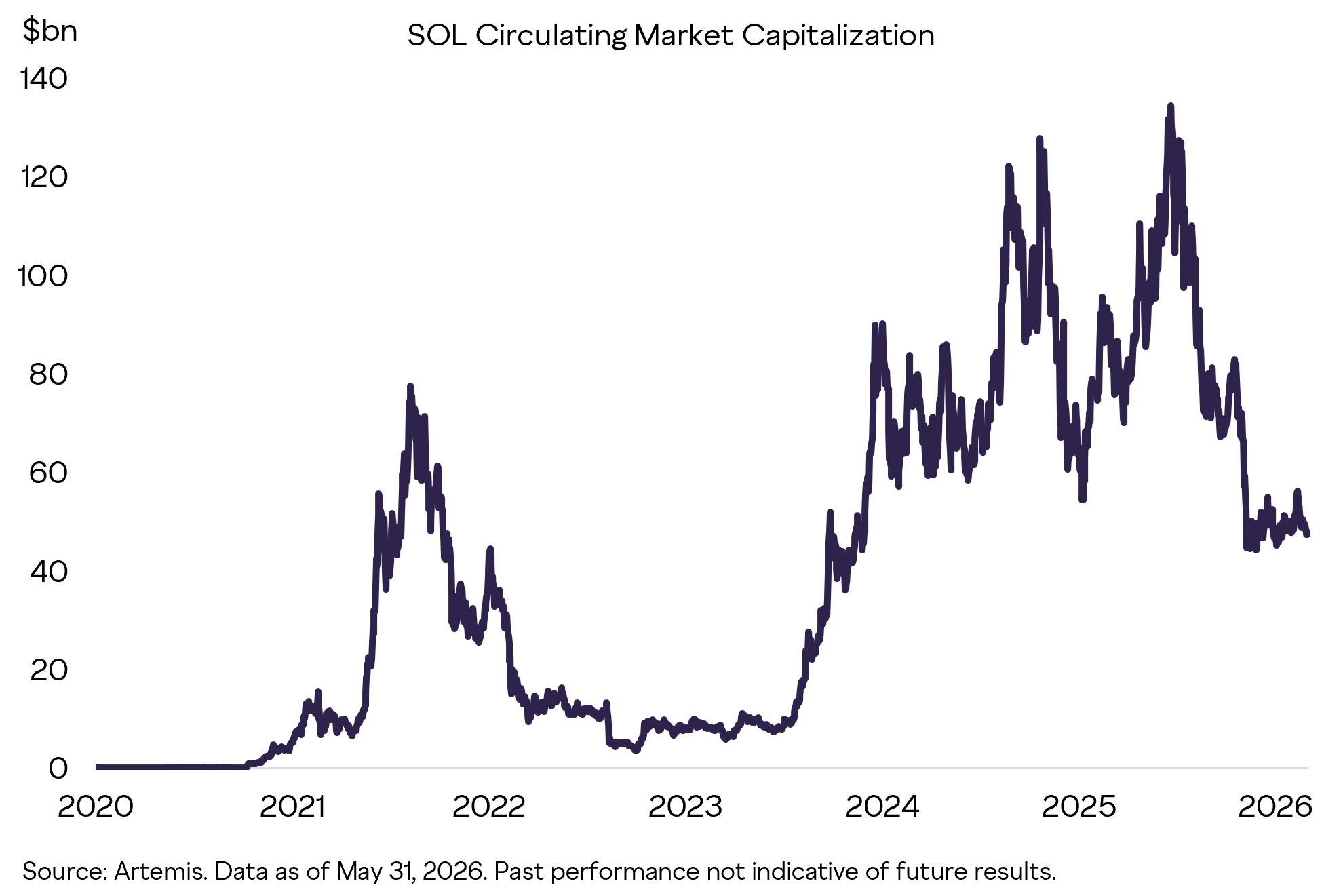
The SOL token is a digital commodity that helps operate the network and provides investment access to growth in the Solana ecosystem (Exhibit 1). Currently, SOL is the fifth-largest crypto asset by market capitalization (excluding stablecoins) and the third-most liquid (based on average daily trading volume).[2]
Exhibit 1: SOL is the fifth-largest crypto asset by market cap[3]
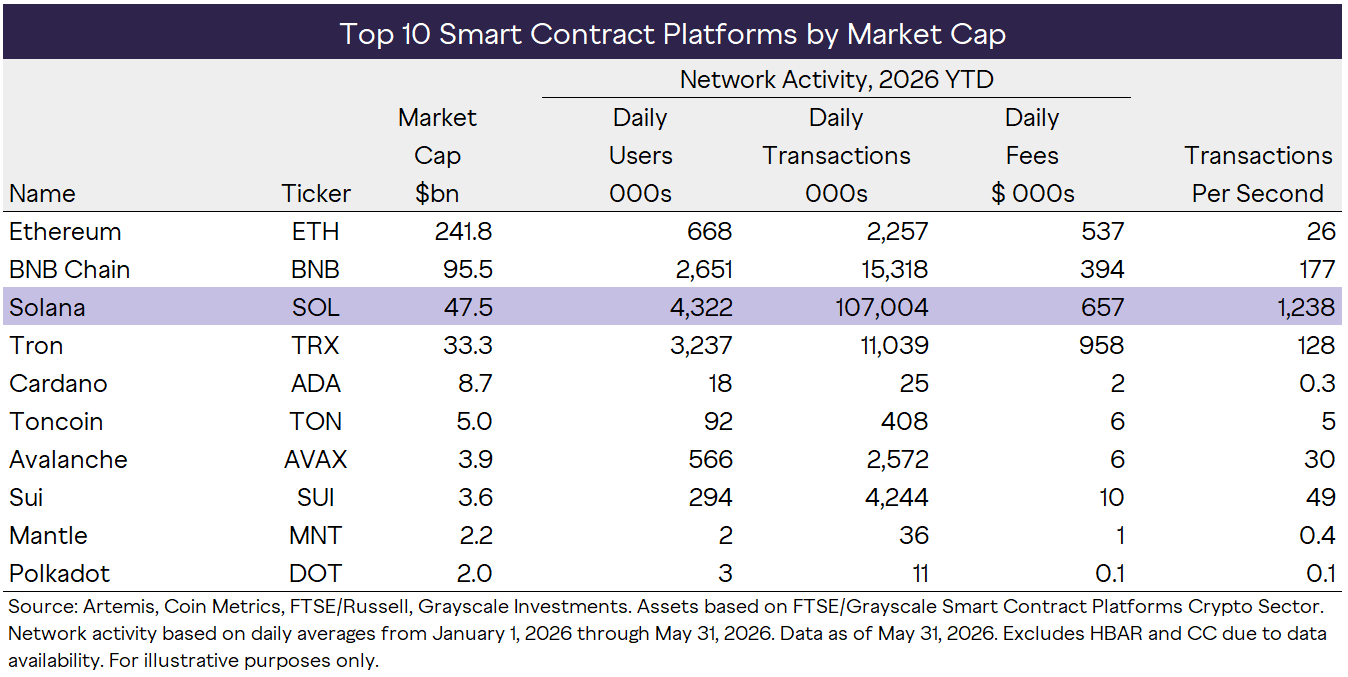
Solana is a component of the Smart Contract Platforms Crypto Sector, along with Ethereum, BNB Chain, Tron, Cardano, Sui, and other networks (Exhibit 2). Among this group, Solana stands out for the depth and diversity in its onchain activity. Today it’s the category leader in terms of users and transaction volume.[4] Blockchains are network technologies, which means that, in general, bigger is better: more users and more economic activity typically equates to higher network value. These aren’t the only considerations that matter, but on these core blockchain fundamentals, Solana stands apart from its peers.
Exhibit 2: Solana is a category leader in onchain activity
Smart contract blockchains are networks that host applications, and Solana is home to industry-leading applications across an impressive range of functions. These include:
These examples represent a small subset of Solana’s more than 1,000 unique applications.[9] As a general-purpose blockchain with virtually all the functionality of other major networks, Solana ranks third in trading of non-fungible tokens (NFTs), fourth in stablecoin transaction volume, and third in tokenized assets.[10] Other use cases gaining recent traction include trading of collectible trading cards (e.g., Collector Crypt) and onchain issuance of tokenized equities (e.g., Backpack).[11]
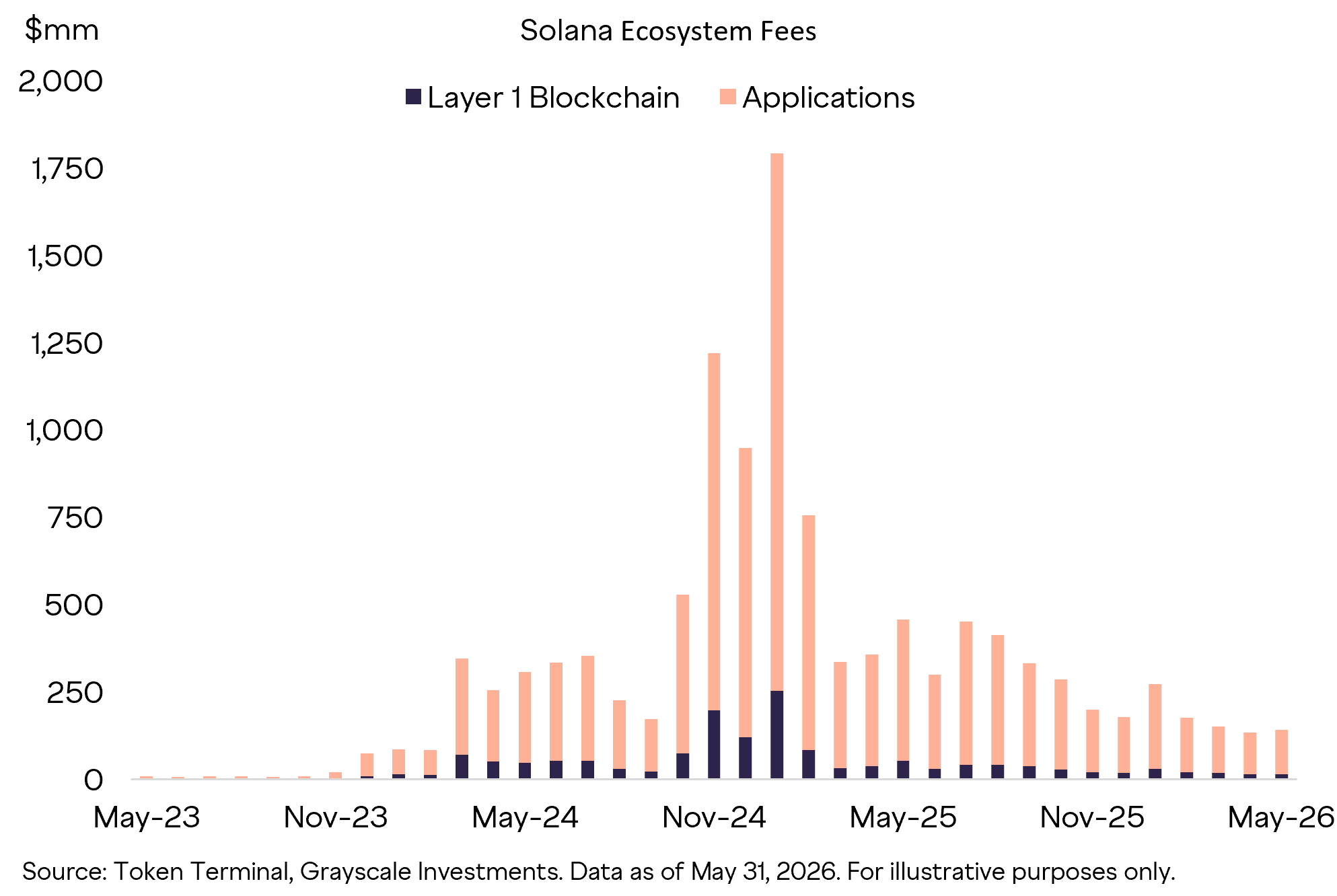
Measuring the Solana ecosystem should take into account transaction activity on both the blockchain itself and its hosted applications. Although there’s variation over time, the Solana ecosystem earns about $227 million in fees per month[12] — or more than $2.7 billion annualized (Exhibit 3). We believe that fees are the most direct measure of total demand for a blockchain and its applications, and the data indicate there’s significant demand for Solana.
Exhibit 3: Solana ecosystem now generates significant fees
Solana has managed to stand out in a competitive market by offering fast and cheap transactions, a compelling new-user experience and, in our view, partly by going its own way.
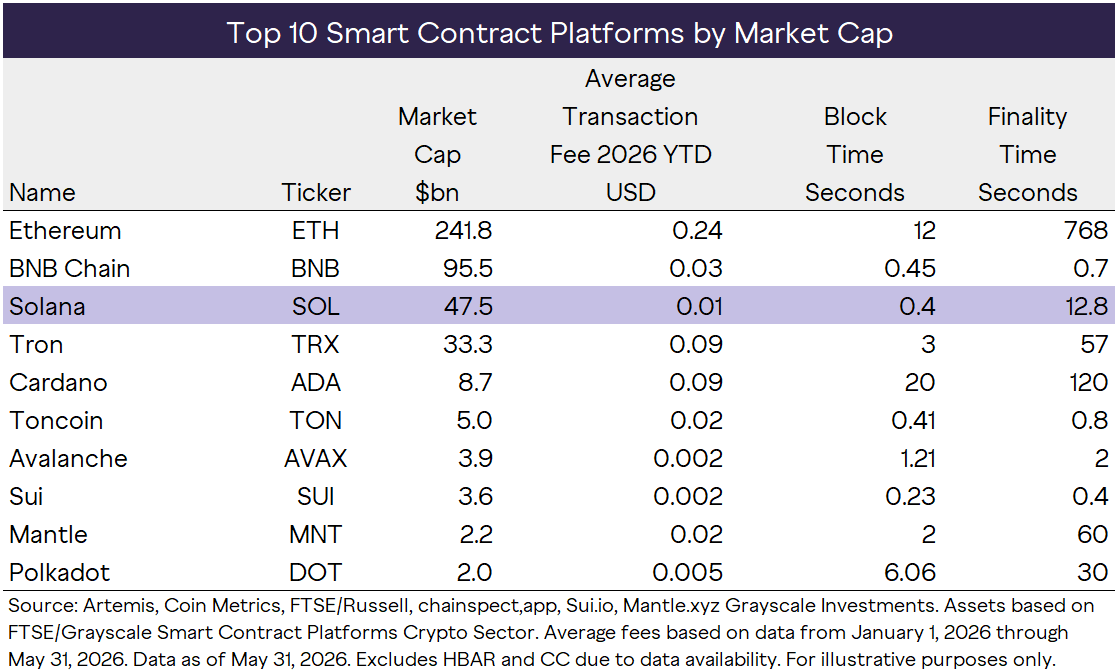
The network produces new blocks every 400 milliseconds, and transactions can be considered final in about 12–13 seconds.[13] In addition to high throughput, transaction costs have remained relatively low: users have paid an average transaction fee of just $0.01 year to date. Solana uses a technology called local fee markets, which limits fee competition to specific in-demand applications. Partly because of this feature, median daily transaction fees this year have averaged just $0.001 (i.e., one-tenth of one cent).[14] Solana’s speed and cost effectiveness compare favorably to other smart contract platforms, although a few are even faster and cheaper, including Sui (Exhibit 4). A forthcoming upgrade to Solana called Alpenglow is expected to reduce finality time to 100–150 milliseconds.[15]
Exhibit 4: Solana offers relatively fast and cheap transactions
In our view, Solana offers arguably one of the best new-user experiences in crypto. Partly this reflects its fast and cheap transactions and the diversity of its applications. But additional factors include its “monolithic” rather than layered design (which avoids the need to bridge assets between network components), as well as its excellent wallet infrastructure, led by Phantom. Solana has also had fewer network outages in recent years — a critical feature for every user.[16]
In addition, Solana has pursued a distinct development strategy that may contribute to competitive moats over time. Smart contract blockchains can be thought of as software-based computers[17], and today the dominant architecture for those “computers” is the Ethereum Virtual Machine (EVM) — the system used by Ethereum and many other smart contract platforms, including BNB Chain, Polygon, and Avalanche. EVM-based applications can be easily ported from one EVM chain to another. In contrast, Solana uses a distinct architecture called the Solana Virtual Machine (SVM). SVM-based applications can’t be easily transferred to non-SVM blockchains, potentially contributing to sticky demand.
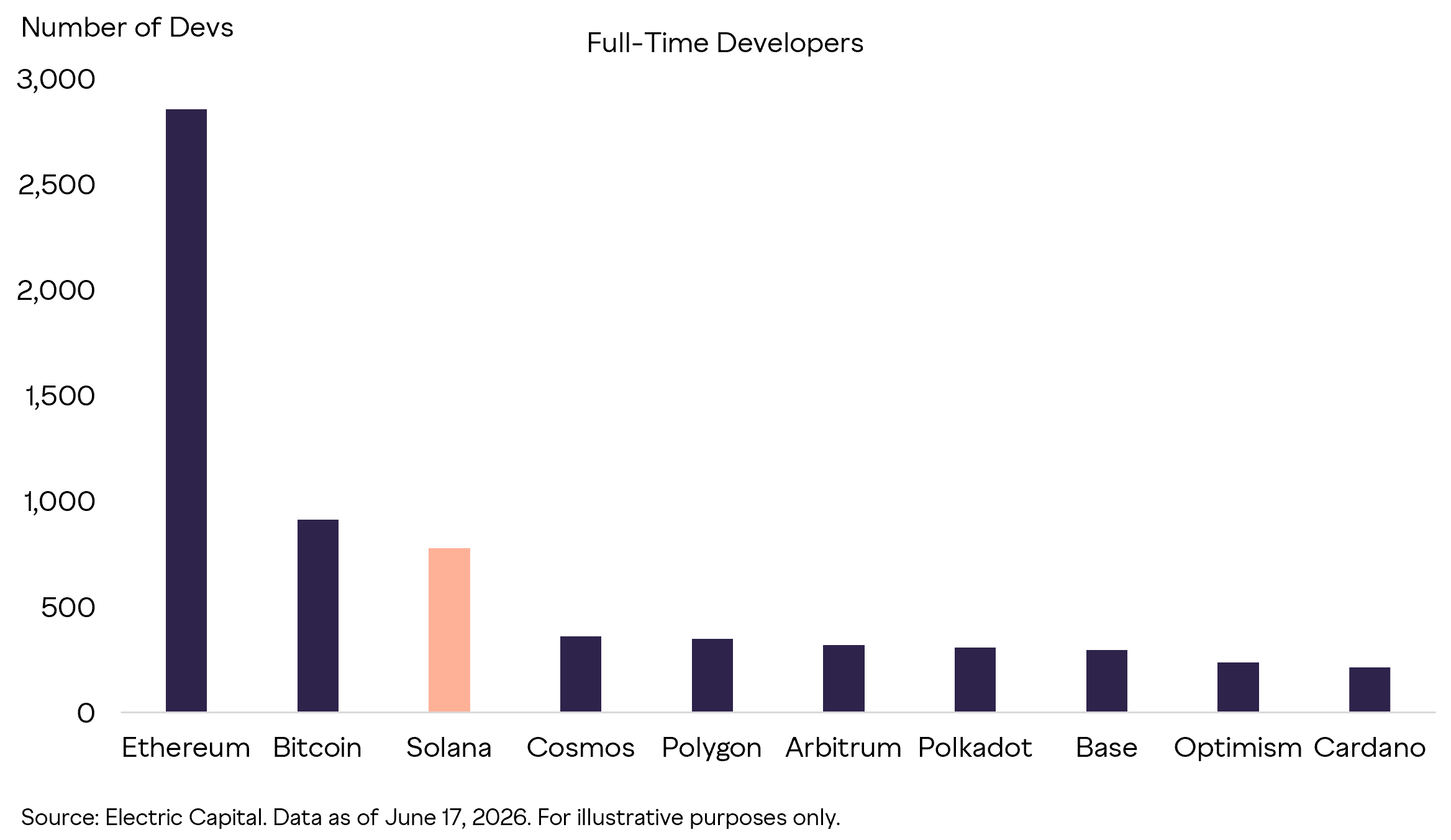
Today there are more than 770 full-time developers working on Solana and SVM-based applications, placing Solana as the third-highest network by monthly active developers (Exhibit 5).[18] This human capital could contribute to ongoing Solana-dedicated innovation over time.
Exhibit 5: Solana has third-largest developer ecosystem after Bitcoin[19]
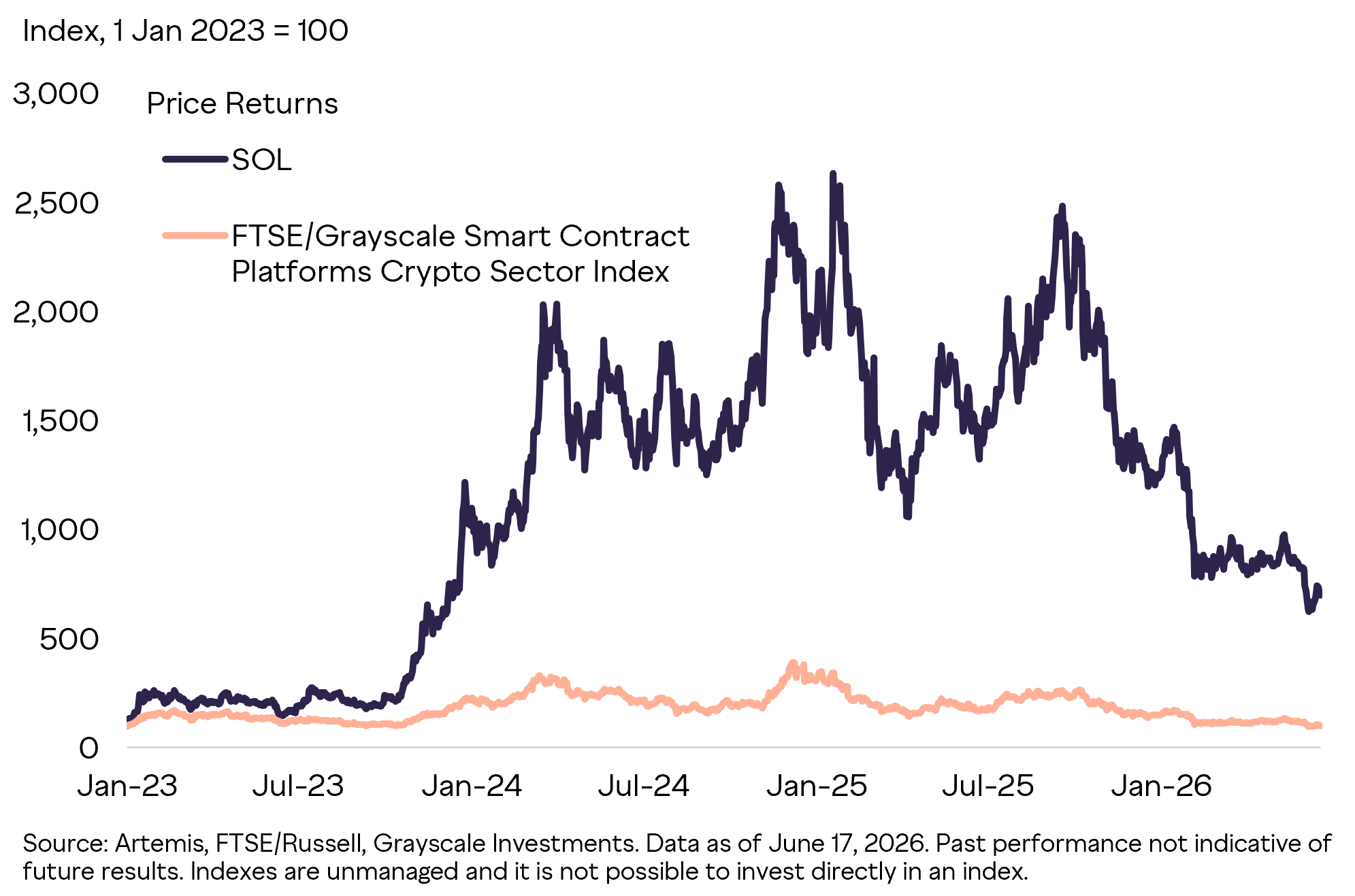
During the last crypto cycle, the price of the SOL token fell from a peak of almost $260 in November 2021 to just $2 in December 2022.[20] For a time, Solana was associated with failed crypto exchange FTX, which had invested capital and contributed some development resources. Perhaps not surprisingly, many casual observers were unsure about Solana’s future after the FTX bankruptcy, even as plenty of SVM developers stuck around. Starting in late 2023, though, the SOL token began to recover. Since that time, it has significantly outperformed the FTSE/Grayscale Smart Contract Platforms Crypto Sector Index (Exhibit 6).
Exhibit 6: SOL has outperformed its peer group since 2023
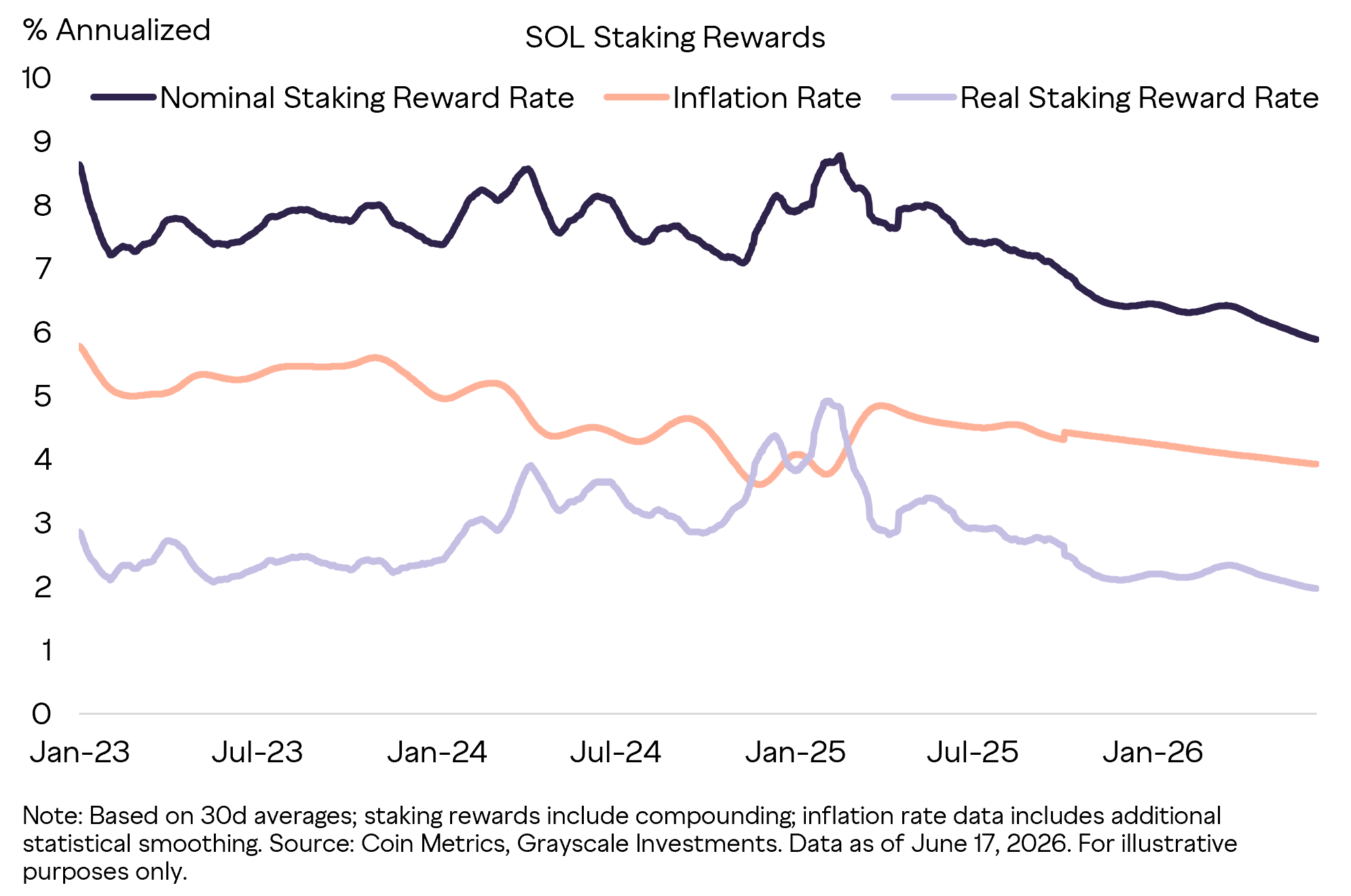
The supply of SOL tokens currently increases at a rate of about ~4% per year.[21] This can be considered a source of dilution for token holders, all else equal. However, SOL stakers can receive a nominal reward rate of around 6%, depending on network conditions.[22] Therefore, SOL stakers earn a “real” (inflation-adjusted) reward rate of roughly 2% (Exhibit 7). Currently around two-thirds of outstanding SOL tokens are staked.[23]
Exhibit 7: SOL stakers can earn a nominal reward rate of about 6%
Smart contract platform tokens like SOL are digital commodities that offer utility in the context of their networks, plus the possibility of additional financial returns (e.g., staking rewards). Their values are correlated to measures of network size. Like other smart contract platform tokens, the investment thesis for the SOL token centers on potential growth in the size of the Solana network. Like any other asset, price does not always move one-for-one with changes in fundamentals. But, if the Solana network grows over time — if it hosts more users, processes more transactions, and earns more fees — investors can anticipate a rising SOL price, in our view.
Solana has executed well on its vision, which we interpret as a fast and cheap blockchain open to anyone. Nonetheless, its specific design choices leave space for competitors to capture or retain market share in certain use cases.
For example, other blockchains offer even faster and/or cheaper transactions, sometimes by operating a more centralized network (e.g., using only a small number of active network nodes). Users may favor this convenience even if centralization could introduce risks. Other blockchains may compete with Solana by keeping their networks permissioned — i.e., by only allowing approved users and/or approved activity. This can have advantages in certain contexts. Because Solana is a permissionless network — everyone is welcome — it’s home to both high-tech startups and speculative retail trading.
At the other end of the spectrum, the SOL token may be less suitable as a long-term “store of value” monetary asset compared to Bitcoin or Ether. Partly this reflects SOL’s higher nominal supply inflation: scarcity is a key feature of any long-term store of value. But an even more important factor may be network resilience from third-party interference. For a digital asset to serve as a long-term store of value, users need to have confidence that they can transact in the future under virtually all circumstances. One way to support this outcome is by keeping node requirements low so the network remains highly decentralized and easily reproducible. Solana’s efficiency comes at the cost of comparatively high hardware and bandwidth requirements, such that many of the network’s nodes operate in data centers.[24] Theoretically, this could become a source of centralization over time and a vector for third-party interference with the network.[25]
All that being said, these are complex and unsettled issues, and investor perceptions over which crypto assets can serve as long-term stores of value may change over time.
Blockchains are not businesses, and blockchain tokens are not stocks — they’re digital commodities with functional utility in the context of these decentralized networks. Nonetheless, it’s possible to analyze blockchain fundamentals and invest in tokens on the basis of fundamentals. The three most important measures of onchain activity, in our view, are users, transactions, and transaction fees. And based on those indicators, Solana is a leading network for onchain activity today. Other blockchain fundamentals can be important for token price, and the Solana network has formidable competitors. But the depth and diversity of Solana’s onchain economy create a strong foundation for SOL valuation and, in our view, the necessary conditions for further growth over time.
Looking to gain exposure to SOL? Search for ticker GSOL through your brokerage account. As an exchange-traded product, GSOL provides investors with exposure to the SOL token through a familiar investment vehicle, with the added benefit of earning potential staking rewards.
Learn more: Grayscale Solana Staking ETF
Decentralized exchange (DEX): A blockchain-based trading platform that allows users to trade digital assets directly from their own wallets rather than through a centralized intermediary.
Decentralized finance (DeFi): Financial applications and services built on blockchain networks that operate without traditional intermediaries such as banks or brokerages.
Decentralized Physical Infrastructure Network (DePIN): Blockchain-based networks that incentivize participants to build and operate real-world infrastructure, such as wireless connectivity, storage, or location services.
Local fee markets: A mechanism that limits higher transaction fees to specific high-demand applications rather than the entire blockchain network, helping keep costs low for other users.
Node: A computer connected to a blockchain network that helps process transactions and maintain the network.
Onchain: Activity that occurs directly on a blockchain network and is publicly recorded on the blockchain ledger.
Smart contract: Self-executing code deployed on a blockchain that automatically carries out actions when predetermined conditions are met.
Smart contract platform: A blockchain designed to host smart contracts and decentralized applications, allowing developers to build a wide range of blockchain-based services.
Solana Virtual Machine (SVM): The software environment that executes smart contracts on the Solana blockchain. Unlike the Ethereum Virtual Machine (EVM), the SVM uses a distinct architecture designed to support Solana's performance and scalability.
Staking: Locking digital assets to help support blockchain network operations and potentially earn rewards.
Validator: A participant in a blockchain network responsible for helping verify transactions and maintain network security.
[1] Coin Metrics, Grayscale Investments. Measurement based on current level. Data as of May 31, 2026.
[2] Source: Coin Metrics, Grayscale Investments. Data as of May 31, 2026. Volume ranking based on average daily spot volume for the 90 days ending May 31, 2026.
[3] Rank based on coinmarketcap.com as of May 31, 2026. Excludes stablecoins.
[4] Note: Ranking by transactions excludes Internet Computer (ICP), which counts queries as transactions, and therefore reports artificially high transaction counts.
[5] Source: DeFi Llama. Data as of June 17, 2026.
[6] Source: DeFi Llama. Based on the 30 days ending June 17, 2026.
[7] Source: Token Terminal, Grayscale Investments. Data as of June 16, 2026. Estimates of users and revenue based on 90 day averages ending June 16, 2026.
[8] Source: Geodnet, Artemis. Data as of 6/17/26
[9] Source: DappRadar. Data as of June 17, 2026.
[10] Source: Allium, rwa.xyz, Artemis, Grayscale Investments. Data as of May 31, 2026. Stablecoin transaction volume based on the three months ending May. Tokenized assets based on level as of June 17, 2026. NFT volume based on 90 days ending June 20, 2026.
[11] Collector; “Issuing Tokenized Equities on Solana Report,” March 19, 2026, Solana.
[12] Token Terminal. Based on median monthly ecosystem fees over the 12 months ending May 31, 2026.
[13] Source: Chainspect.app.
[14] Source: Coin Metrics, Grayscale Investments. Data as of June 17, 2026. For illustrative purposes only.
[15] Source: Helius. The Alpenglow upgrade will also reduce the network’s Byzantine fault tolerance threshold to ~20% from ~33% currently.
[16] Source: Solana Uptime, no outages since February 2024.
[17] For more background, see the Grayscale Research report “Ethereum: The OG Smart Contract Blockchain,” March 20, 2025.
[18] Electric Capital, Developer Report
[19] Largest ecosystems by number of developers
[20] Source: Artemis. Data as of May 31, 2026. Past performance not indicative of future results.
[21] Source: Tokenomist.ai. Half of SOL paid in base transaction fees is burned and permanently removed from circulating supply.
[22] The staking reward rate equates to the inflation rate divided by the share of SOL supply that is staked, plus any transacted-related rewards that are shared by validators to delegated stake.
[23] Source: Coin Metrics, Grayscale Investments. For the 90 days ending June 17, 2026, the share of SOL staked averaged ~68%.
[24] Solana’s validator docs recommend 12 cores/24 threads, 256 GB RAM, and 1 TB. Ethereum docs recommend 8 cores/16 threads, 64 GB RAM, and 4 TB. In other words, Solana requires higher ~50% more CPU, ~4x more RAM, and less disk than Ethereum’s validator guidance. Ethereum requires 100 Mbps of download bandwidth and 50Mbps of upload bandwidth; Solana requires 1Gbps for both, but 10Gbps is preferred. EIP-7870, proposed in early 2025, recommends that validators increase hardware specs from 32GB to 64Gb, signaling a push for higher performance hardware. Source: Solana Labs, Ethereum.org. According to validators.app, ~99% of staked SOL represents validators in data centers, and ~45% in the top two hosting providers. According to ethernodes.org, Ethereum has 43% of nodes in data centers (“hosting”) versus 51% in residential settings. The Dollar cost of any specific hardware and bandwidth requirement should be expected to decline over time.
[25] There is no one measure of decentralization, and what users ultimately value is network resilience and the ability to transact peer-to-peer without fear of censorship. This is a byproduct of decentralization, as well as other network design choices. For details on Solana’s current node distribution, see “Measuring Solana’s Decentralization,” November 18, 2024, Helius.