Zcash is a decentralized digital currency that shares many of Bitcoin’s fundamental characteristics,with the addition of optional privacy features based on zero-knowledge proofs[1].
As crypto adoption broadens, demand for privacy tools should increase. Most users will not want their financial activity exposed on a public ledger by default. Bitcoin’s transactions are pseudonymous rather than private, which creates an opening for Zcash as a digital asset that combines Bitcoin-like monetary properties with optional on-chain privacy.
Zcash is similar to Bitcoin in many respects:
Transfers: it enables peer-to-peer transfers;
Scarcity: its supply is limited to 21 million coins;
Security: its network is secured by Proof of Work mining.
However, while Bitcoin operates on a fully transparent public ledger of transactions, Zcash offers users the option of privacy. The network supports two types of transactions:
Transparent transfers: Sender, receiver, and amount are publicly visible on-chain.
Shielded transfers: Sender, receiver, and amount can be hidden while the network can still verify the transaction is valid.
Zcash’s approach stresses optional privacy over mandatory privacy — users and applications can choose transparent or shielded behavior based on their needs.
Zcash has delivered multiple generations of shielded transaction designs aimed at improving usability.
The network’s privacy features are based on zero-knowledge proofs, which allow the blockchain to verify that a shielded transaction follows the rules without revealing details.
Zcash has delivered multiple protocol upgrades focused on improving usability and performance, including updates to shielded transaction formats, fee policy, and proposed scaling improvements such as the Tachyon upgrade.
TOKEN
ZEC is the native asset of the Zcash network, used for transaction fees and transferring value in both transparent and shielded forms. ZEC is also the unit used to compensate miners via block rewards and to fund protocol-directed ecosystem development through defined funding streams.
USE CASES
Zcash supports use cases centered on private value transfer and selective disclosure, with practical adoption shaped by wallet and service-provider support.
Private payments: Shielded transfers can conceal transaction details while preserving decentralized verification.
Selective disclosure and audit workflows: Viewing key standards enables controlled sharing of transaction visibility with trusted counterparties such as auditors or compliance teams when applicable.
Developer ecosystem and wallet infrastructure: Standards such as unified addresses and unified viewing keys aim to improve usability across recipient types and reduce user error.
INVESTMENT THESIS
Grayscale views Zcash as a differentiated asset focused on private digital cash functionality, with return potential tied to improved usability and broader support for shielded transfers.
Privacy as financial infrastructure: As more financial activity moves onto transparent digital rails, privacy may become a necessary feature rather than an optional one. Zcash is one of the few crypto assets explicitly built to help serve this need.
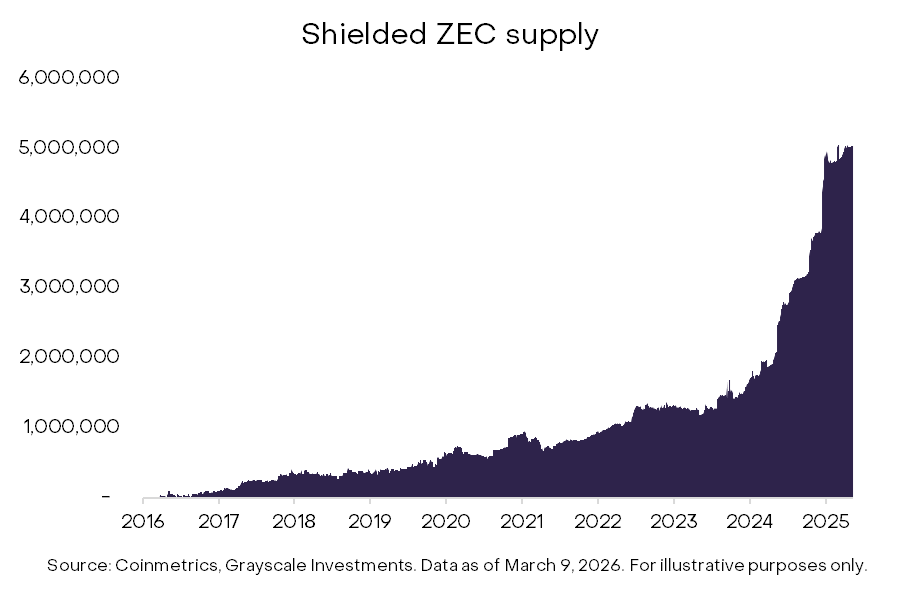
Purpose-built design with evidence of adoption: Zcash’s shielded transactions use zero-knowledge proofs to minimize on-chain disclosure while allowing optional transparency. The share of ZEC held in shielded supply has increased over time and recently reached an all-time high, suggesting growing use of the network’s core privacy functionality.
Improving usability and access: Zcash has delivered multiple protocol upgrades focused on usability and performance, while wallet integrations such as Zodl are making shielded ZEC easier to use through built-in swaps and cross-chain functionality.
In Grayscale’s view, Zcash may be well positioned to benefit as demand for financial privacy grows alongside broader digital asset adoption, particularly with continued improvements in usability.