Hyperliquid is a high-performance onchain trading network built around perpetual futures and spot markets, combining a fully onchain orderbook with a broader financial application layer.
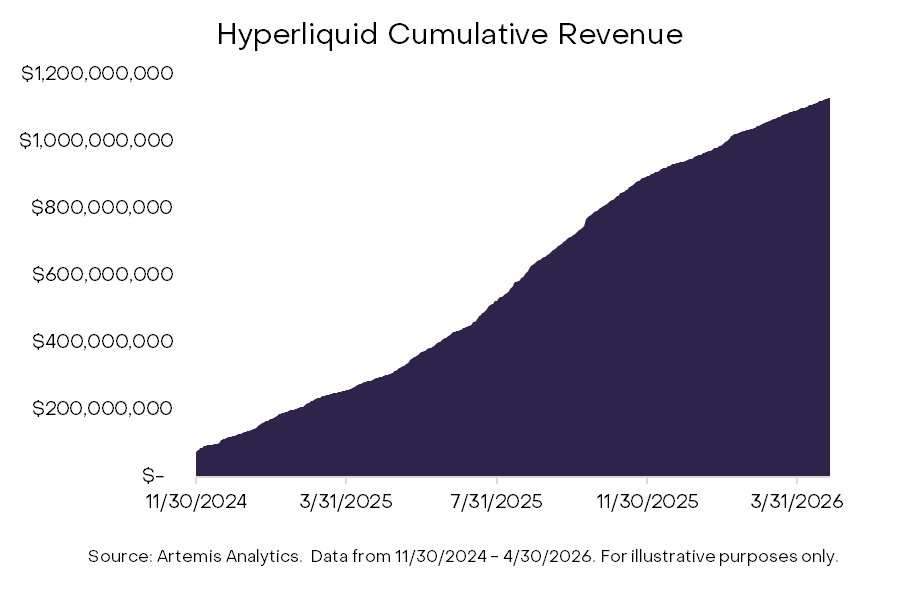
Trading activity on the platform generates fee revenue, primarily from perpetual futures markets, making usage and monetization more direct than for other protocols.
As more digital-asset trading moves onchain, we believe demand could increase for market infrastructure that offers exchange-quality execution without giving up the transparency and composability of public blockchains. Hyperliquid’s growth suggests unusually strong product-market fit because traders have been using the venue at meaningful scale[1].
Hyperliquid is similar to a high-performance exchange stack in many respects:
Execution: its low latency, one-block finality, and throughput are designed for exchange-style trading that features approximately 200,000 transactions per second[2].
Market structure: the protocol supports fully onchain order books for spot markets and perpetual futures.
Infrastructure: it is designed to let traders, validators, and builders operate inside the same system rather than across separate venues and settlement layers.
However, while centralized exchanges generally separate trading, settlement, and application development across closed systems, Hyperliquid keeps those functions onchain[3]. The network has two main components:
HyperCore: the trading engine, where fully onchain spot and perpetual futures order books settle directly on the network.
HyperEVM: the application environment, where developers can build financial applications that connect to Hyperliquid’s native liquidity. This is similar to Ethereum’s EVM.
Hyperliquid's approach stresses integration over fragmentation: trading activity, liquidity, settlement, and applications are meant to reinforce one another inside a single stack.
Hyperliquid's own framing is that it aims to provide liquidity infrastructure for developers, not just a single end-user app.
The network's design allows HyperEVM applications to access order-book functionality directly rather than rebuilding trading distribution from scratch.
Hyperliquid has already expanded beyond a narrow perp-only framing through HyperEVM and builder-deployed markets aimed at widening the set of exposures that can trade onchain (e.g., commodities, equities, pre-IPO startups).
The platform's scale also matters. Hyperliquid leads against all onchain perpetual futures on trailing-year trading volume, fee generation, and open interest[4]. For a trading venue, those are core indicators of liquidity, monetization, and user retention.
Even against centralized venues with longer history, Hyperliquid already has scaled to roughly 92% of Coinbase’s open interest, 25% of Bybit’s, 35% of OKX’s, and 13% of Binance’s[5].
TOKEN
HYPE is the native asset of the Hyperliquid ecosystem. It is used for staking, transaction costs on HyperEVM, and trading-fee discounts. Hyperliquid’s fee design also links platform activity to an automatic assistance-fund mechanism that buys back HYPE based on trading fees, giving the token a clearer connection to network usage than a purely symbolic governance asset.
USE CASES
Hyperliquid's practical use cases center on high-performance onchain trading and the financial applications that can be built around that liquidity.
Trading and market access: Users can trade fully onchain spot and perpetual markets through exchange-like order books and settlement.
Builder deployment: Developers can use HyperEVM to launch financial applications that tap into Hyperliquid’s native liquidity.
Network participation and economics: HYPE supports staking, pays for HyperEVM gas and priority fees, and can lower fees for active traders (based on amount staked).
INVESTMENT THESIS
Grayscale's working view is that Hyperliquid is a differentiated crypto asset because it combines a leading onchain trading venue with a token that is directly tied to network usage.
Scale and product quality: Hyperliquid already leads the current decentralized perpetual futures exchanges on trading activity, fees, and open interest, which suggests users value its execution and market design[6].
Integrity and alignment: Hyperliquid's official community-first positioning around no investors and no paid market makers makes the project look unusually aligned with users relative to many crypto peers, which likely helps explain its cultural legitimacy and HYPE's strong trading performance relative to the rest of the crypto asset universe[7].
Direct economic relevance: HYPE is woven into the system through gas, staking, fee discounts, and assistance-fund-linked value accrual, giving the token clearer utility than a purely narrative-driven asset.
Platform expansion: HyperEVM and builder-deployed markets create upside beyond the base exchange business if Hyperliquid becomes a broader liquidity and market-deployment layer.
In Grayscale’s view, Hyperliquid appears to be well positioned to benefit as more trading activity moves onchain, particularly if it can sustain its product-market fit, preserve its competitive edge versus centralized exchanges, and continue expanding beyond a leading perpetual trading venue into broader financial infrastructure.
[1] In 2025, Hyperliquid earned ~$900M from trading fees indicating strong demand from users of the platform https://colossus.com/article/beyond-the-sky-jeffrey-yan-hyperliquid/#:~:text=By%20the%20end%20of%20the%20year%2C%20its%20second%20full%20year%20in%20operation%2C%20Hyperliquid%20had%20earned%20about%20%24900%20million%20in%20profit.
[4] Artemis Analytics, Date as of 4/30/2026. Trading volume measures notional value traded over the period and is a proxy for liquidity and user activity. Revenue measures protocol or application revenue captured from that activity, making it a proxy for monetization rather than just usage. Open interest measures the notional value of outstanding perpetual futures positions at a point in time; unlike volume, it reflects risk that traders continue to hold on the venue, so it is often used as a signal of market depth, trader retention, and venue trust.
[7] Coingecko. Data as of 4/30/2026. Specific tokens are mentioned for educational purposes only and should not be deemed a recommendation to buy or sell any securities, digital assets, or other financial instruments. Past performance does not guarantee future results.
Share This
Like what you see?
Subscribe below for the latest research from Grayscale.