Investing in the Tokenization Megatrend

Will Ogden Moore

Zach Pandl
Last Updated: 4/29/2026 | 23 min. read
Key Takeaways
In every industry, technological innovation improves existing systems and disrupts incumbent players. Today’s capital markets are no exception and are particularly ripe for change. At Grayscale, we believe a significant transformation of the financial system is underway and will unfold over the next decade. This change will occur as legacy financial infrastructure is replaced by blockchain-based systems — modern digital rails capable of supporting capital formation and risk transfer in a more efficient and open environment.
Tokenization enables that transformation. Tokenization is the process of converting rights to an asset into a digital representation on blockchain infrastructure. Financial assets that have been historically recorded and managed within traditional electronic book entry systems can instead be issued and transferred on a blockchain.
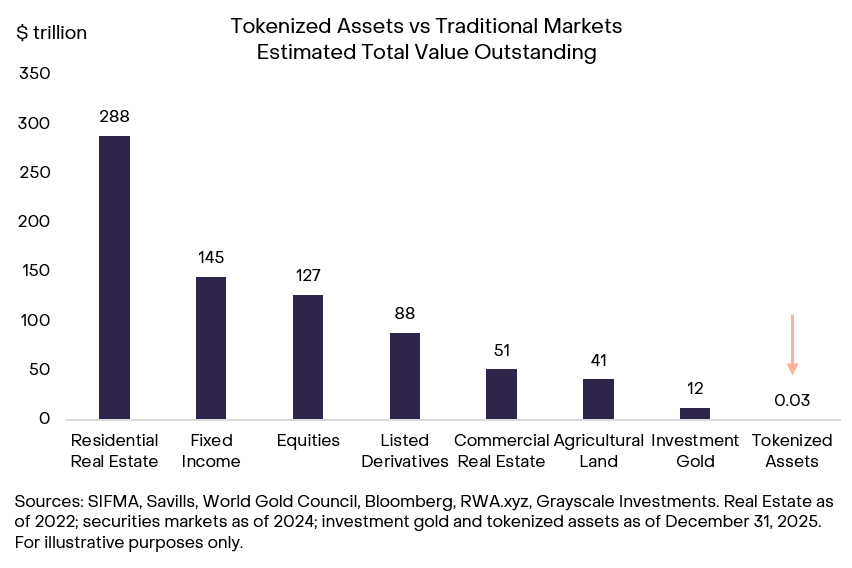
We believe the tokenization megatrend represents a huge potential investment opportunity. Traditional securities markets total approximately $300 trillion, and that figure captures only a fraction of the assets that could eventually be tokenized (Exhibit 1). Although tokenized assets have grown in size and diversity, they still represent only a tiny portion of the overall market. Estimates suggest that tokenized assets today total about $30 billion, or 0.01% of global equity and bond markets.
Though small, the market for tokenized assets has grown rapidly, up 217% year over year.[1] The current tokenized asset base is concentrated in a handful of categories led by tokenized U.S. Treasuries (~$15 billion), followed by commodities (~$5 billion), with smaller allocations to private credit, funds, equities, and other real-world assets.[2]
Over time, we believe much of the ~$300 trillion securities market — along with other types of assets like real estate — will migrate onchain. As this happens, value may increasingly accrue to blockchain platforms such as Ethereum, Solana, and Canton, which serve as the foundation for tokenized assets.
Exhibit 1: Tokenization megatrend just getting started
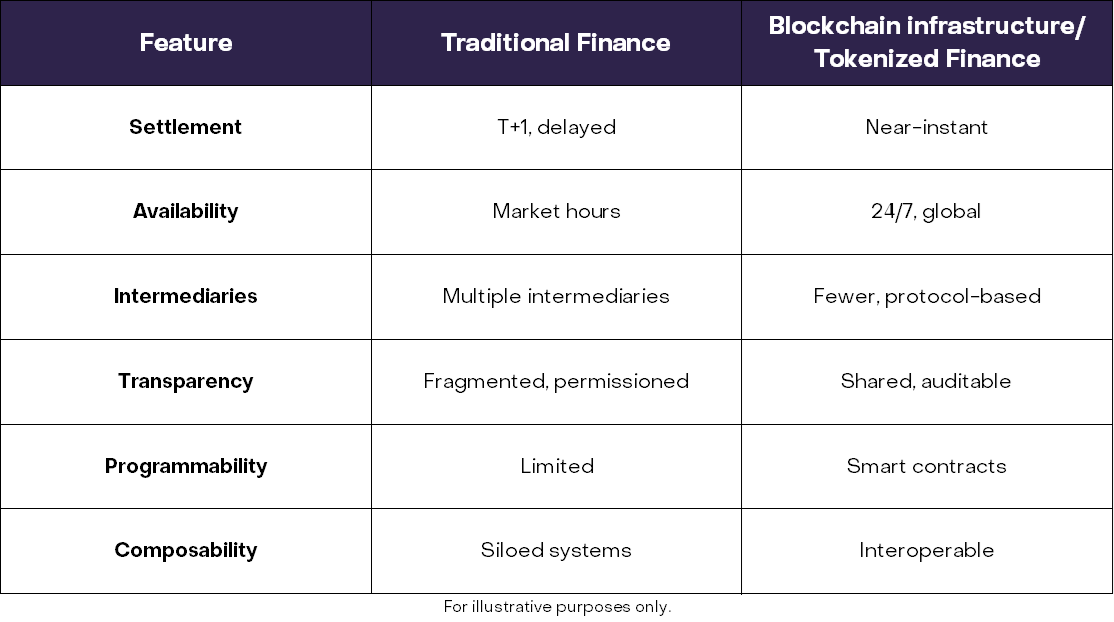
The modern financial system works well in many respects, but it relies on fragmented infrastructure. Transactions often involve multiple intermediaries, segregated ledgers, and delayed settlement processes, which can result in friction and cost for users.
Blockchain infrastructure offers a different model: a shared global settlement layer that can enable near-instant settlement, superior capital efficiency, always-on markets, and broader accessibility (Exhibit 2).
Exhibit 2: Blockchains offer an upgrade for capital markets infrastructure
Traditional securities transactions:
Tokenized transactions:
Exhibit 3: Blockchains can streamline securities transactions through smart contracts

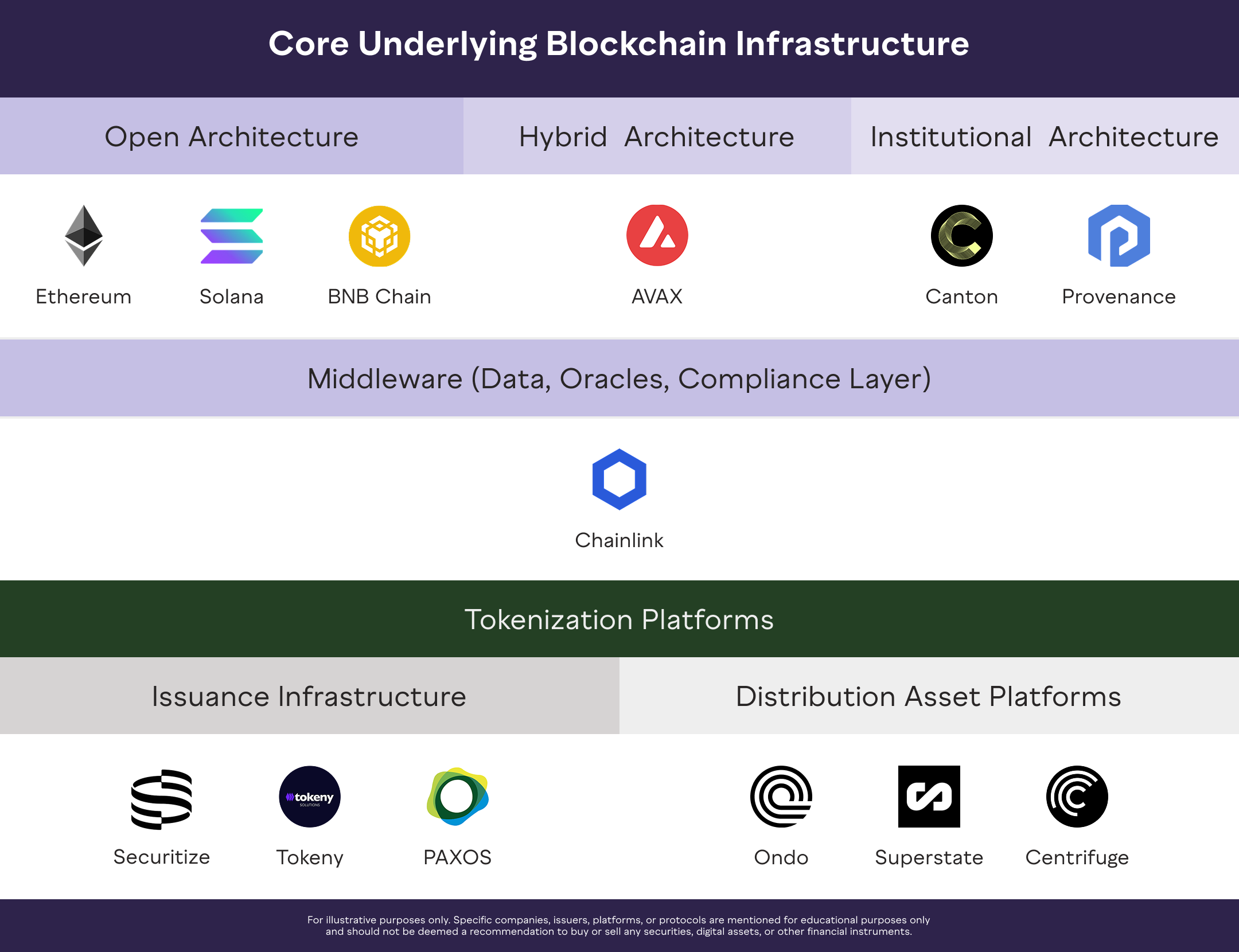
Tokenization depends on several layers of infrastructure, which can be grouped into three broad categories (Exhibit 4):
Grayscale believes one of the primary ways to invest in this megatrend is through this first category, the underlying blockchain infrastructure. Smart contract blockchains like Ethereum and Solana currently form the foundation for tokenized assets, enabling their issuance, ownership, and transfer (for background see our earlier report, Investing in Smart Contract Platforms). Activity on these networks—such as issuing or transferring a tokenized stock—requires paying transaction fees in the native token. As tokenization on these networks grows, demand increases for blockspace and for the native asset used to pay for it.
In this context, “value accrual” refers to how economic activity on a blockchain translates into returns for the network. Value from tokenization can accrue to smart contract blockchains through several reinforcing mechanisms. Higher levels of issuance, trading, and transfers generate more fees, creating a direct link between network usage and demand for the native token. In some networks, fees are burned or redistributed, connecting activity to supply dynamics. As usage grows, network effects can further concentrate liquidity, developers, and capital, reinforcing demand.
As more financial assets move onchain, these dynamics can compound. Networks that host a larger share of tokenized activity may capture a meaningful portion of the economic value created by this trend. This raises the question: which smart contract blockchains are best positioned to capture this opportunity?
Exhibit 4: Infrastructure underlying the revolution falls into three categories
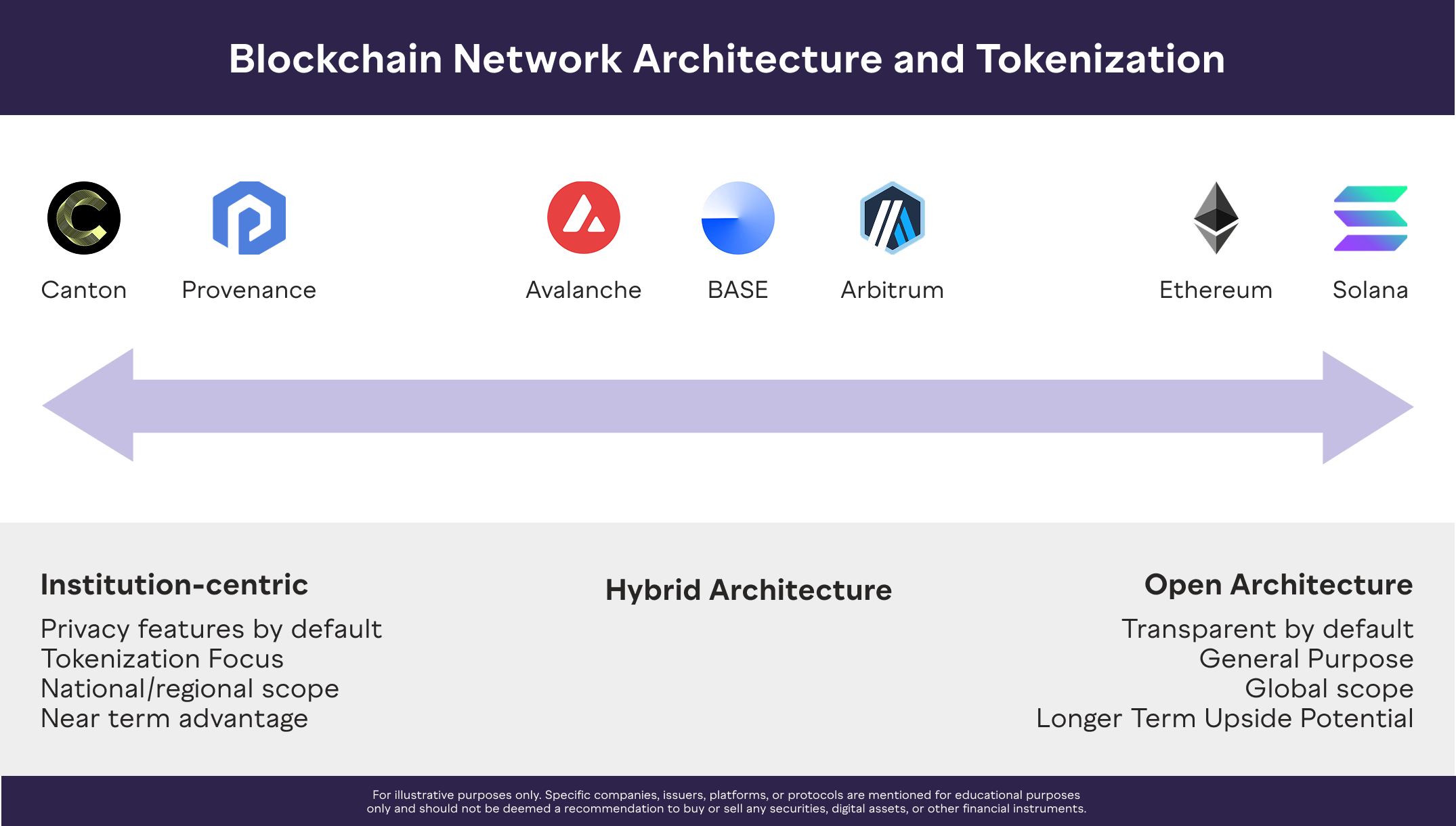
Two main types of smart contract blockchains compete for tokenization activity: open architecture networks and institution-centric networks.
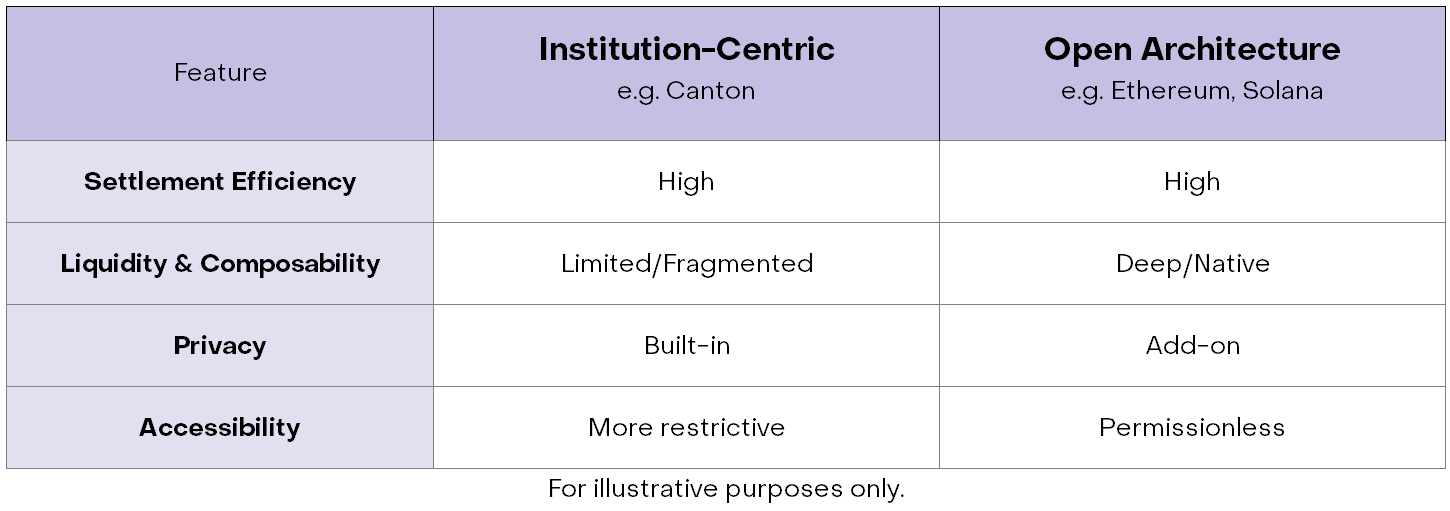
Open architecture networks such as Ethereum and Solana are fully permissionless and transparent by default. Any individual or institution can access the network to issue, build, or trade tokenized financial assets, or to operate a validator. These networks were built as general-purpose technologies for a wide variety of use cases and builders; they benefit from global distribution and deep liquidity. They also operate as transparent ledgers, where all transactions since inception are publicly recorded. That structure creates a real-time shared source of truth across all participants, which can enhance auditability and interoperability.
Institution-centric networks like Canton and Provenance were designed from the start specifically for regulated financial institutions. These systems often incorporate features such as privacy, permissioning, and compliance controls, which are critical for handling sensitive financial data. Unlike open networks, they do not maintain a fully transparent, publicly accessible record of transactions. Transaction data visibility is restricted to authorized participants, and confidentiality takes priority over openness.
Exhibit 5: Institution-Centric and Open Architecture Networks Offer Distinct Tradeoffs
A third category, hybrid blockchains, attempts to bridge these two models. Platforms such as Avalanche L1s and Ethereum Layer 2 networks like BASE and Arbitrum can combine elements of customization and access controls with connectivity to underlying open ecosystems. This allows institutions to operate within tailored environments while still benefiting from the security, liquidity, and interoperability of open networks.
A few networks stand out today, including Ethereum, Solana, and BNB among open architecture networks and Canton among institution-centric networks.[3]
Ethereum has the strongest ecosystem network effects, leading all others in market capitalization, developer activity, and number of applications. Ethereum also offers the most robust decentralized finance ecosystem, with approximately $50 billion in total value locked (TVL).[4] This ecosystem allows tokenized assets on the network to integrate with lending markets, derivatives, collateral systems, and other financial applications while benefiting from deep liquidity and composability. Ethereum’s network security also positions it as a trusted infrastructure layer for institutional use.
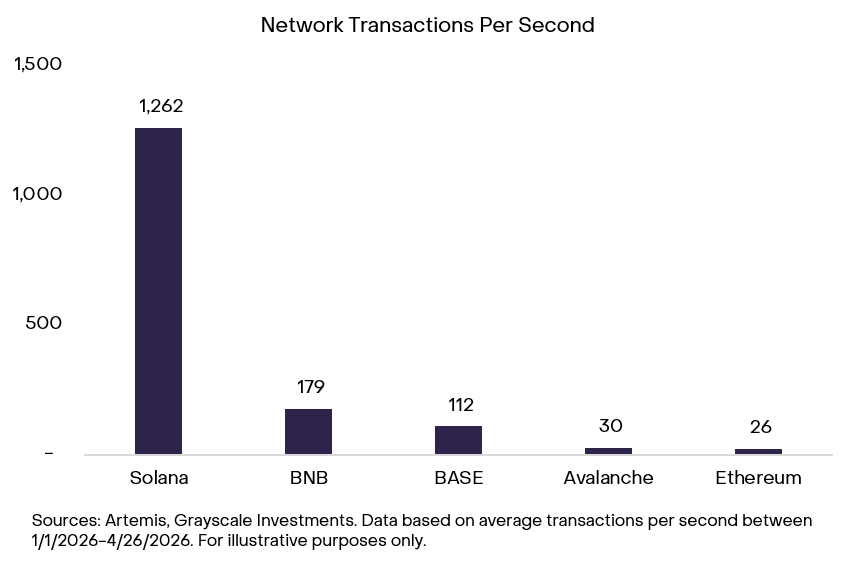
Solana offers a different set of strengths. The network has demonstrated the performance required to scale toward capital markets use cases, with throughput exceeding 1,000 transactions per second and 100 million daily transactions.[5] Solana trails Ethereum in tokenized assets on-chain today ($2 billion versus $16 billion), but it provides faster and lower-cost transactions.[6] We believe these features enable broader retail accessibility and distribution and position Solana well for specific use cases like onchain consumer stock trading.
Exhibit 6: Solana offers network performance for the capital markets
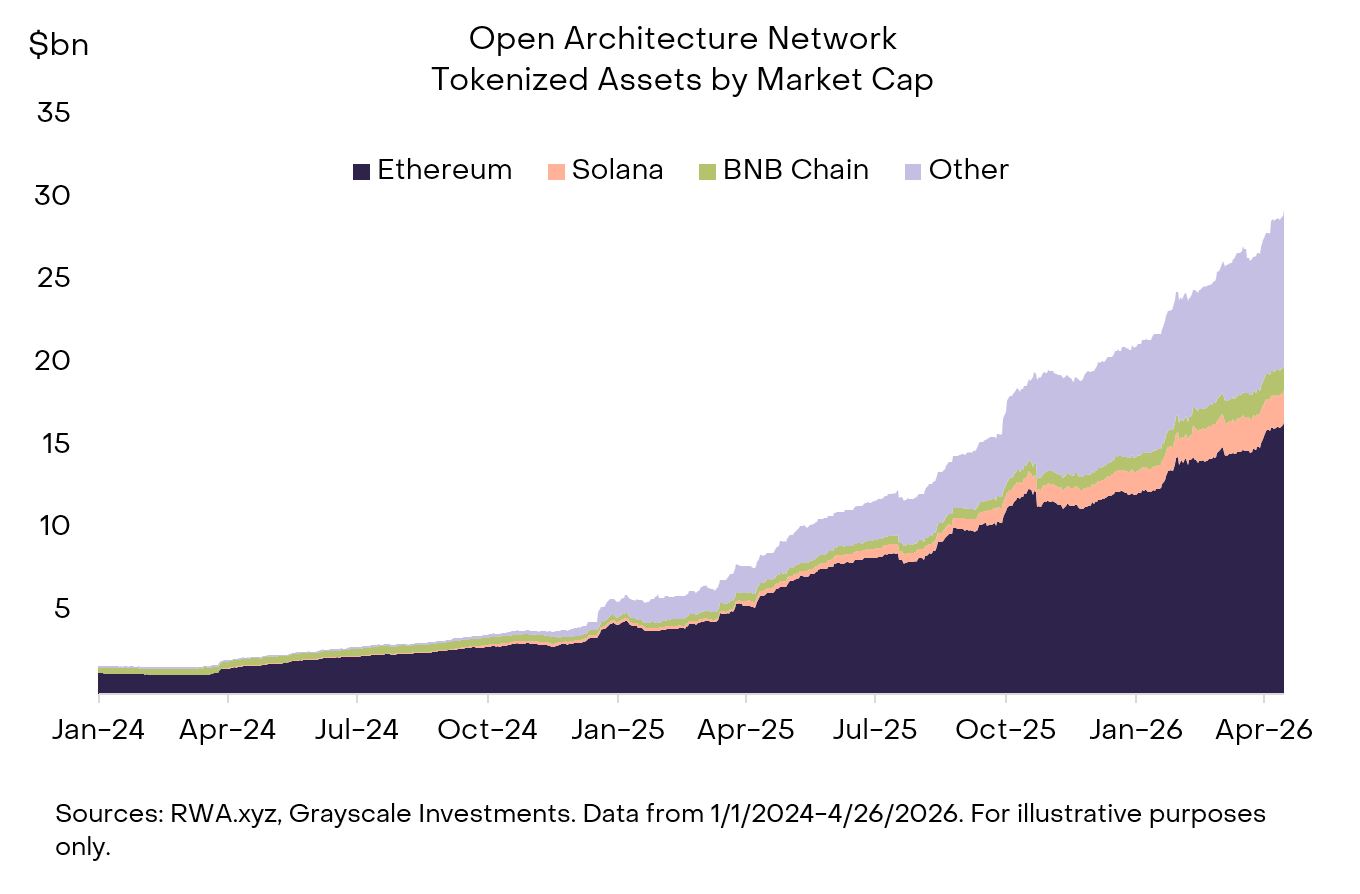
BNB Chain is another leading open architecture network. BNB enjoys a distribution advantage due to its association to the largest centralized crypto exchange by trading volume in the world, Binance. Alongside Ethereum and Solana, BNB has emerged as one of the leading open architecture networks in tokenized assets (Exhibit 7).
Exhibit 7: Ethereum, Solana, and BNB lead Open Architecture Networks in Tokenized Asset Market Cap
Canton has demonstrated production readiness to serve the requirements of major institutional capital today. Canton exploded onto the scene in 2026 with major institutional partnership announcements like Nomura and Mizuho and an increase in network users and participants (Exhibit 8). Notably, the DTCC — the primary clearing and settlement infrastructure for U.S. capital markets — has selected Canton as an initial supporting network for its tokenization service under the SEC’s No-Action Letter framework.[7] It also leads all blockchains in terms of the total capital onchain with over $348 billion in tokenized asset value (Exhibit 9).[8]
Exhibit 8: Canton has seen increased network activity in 2026

Provenance is another institution-centric network, developed by Figure Technologies. This network has been used to support the issuance, servicing, and financing of home equity lines of credit and structured credit products, and represents the second-largest institution-centric network in tokenized assets.
Other hybrid networks will compete for market share, such as Avalanche — which supports tokenized assets from major institutions like KKR, Citi, and Apollo Global — and BASE, as one of the leading Ethereum Layer 2 networks with unique distribution advantages tied to Coinbase.
Exhibit 9: Leading blockchains in tokenization (top 5 by market cap)

Each of these networks — Ethereum, Solana, and Canton — is among those competing to become the dominant platform for tokenized capital markets. As discussed above, they compete along many dimensions, but an increasingly important factor is privacy. Institutional participants cannot operate at scale in environments where transaction details such as counterparties and transaction amounts are fully public.
This creates a clear distinction between blockchain architectures. Institution-centric networks like Canton are private by default: only parties involved in a particular transaction can view its details. On the other hand, open architecture networks like Ethereum are transparent by default, with all transactions publicly auditable. While this supports openness and composability, it introduces challenges for institutional adoption, where confidentiality is essential.
The transition of capital markets onto blockchain rails is expected to unfold over a decade or more. Different architectures may lead at different stages of the process. Institution-centric platforms such as Canton may have an advantage in the early phase of adoption. Ethereum and Solana are actively developing privacy solutions, but these technologies are still maturing and may face tradeoffs in scalability or implementation.
As a result, Canton has a distinct opportunity to build an early lead. The network recently introduced Visa, Circle, and Apollo Global as key contributors (called Super Validators), adding to a network of over 60 institutions.[9] If Canton continues its success in onboarding financial institutions, it could start to create network effects and reinforce its position as a primary venue for institutions in this initial phase of adoption.
Over the longer term, however, we expect the competitive landscape to become more balanced. Open networks are likely to improve privacy solutions through a combination of base-layer upgrades, Layer 2 designs, and technologies such as zero-knowledge proofs.[10] If they can adequately deliver privacy solutions at scale, open architecture networks may be able to compete more directly for the flow of institutional capital.
If that happens, we believe open networks could have structural advantages that lead to a larger total addressable opportunity.
The permissionless nature of open networks allows access by any individual and institutional user globally — in other words, a larger total addressable market. For builders and developers, the open network design supports faster-paced innovation by allowing any developer or institution to immediately connect to the network and access its shared liquidity. This may enable participation from a broader set of institutions and counterparties, including those outside the traditional Western financial system that may be excluded from institutional architecture networks.
This expanded economic surface area, combined with open liquidity and composability, can create a flywheel that attracts more participants and reinforces network effects, which can help translate into greater long-term value accrual. In addition, strictly from a valuation perspective, commodity assets behind open networks like Ethereum and Solana could begin to capture an additional money premium as a prospective digital store of value.
Exhibit 10: Mapping architectures to the roadmap
Investors can also gain exposure to the tokenization trend through approaches that are more agnostic to adoption phase and blockchain architecture and may benefit more consistently over time.
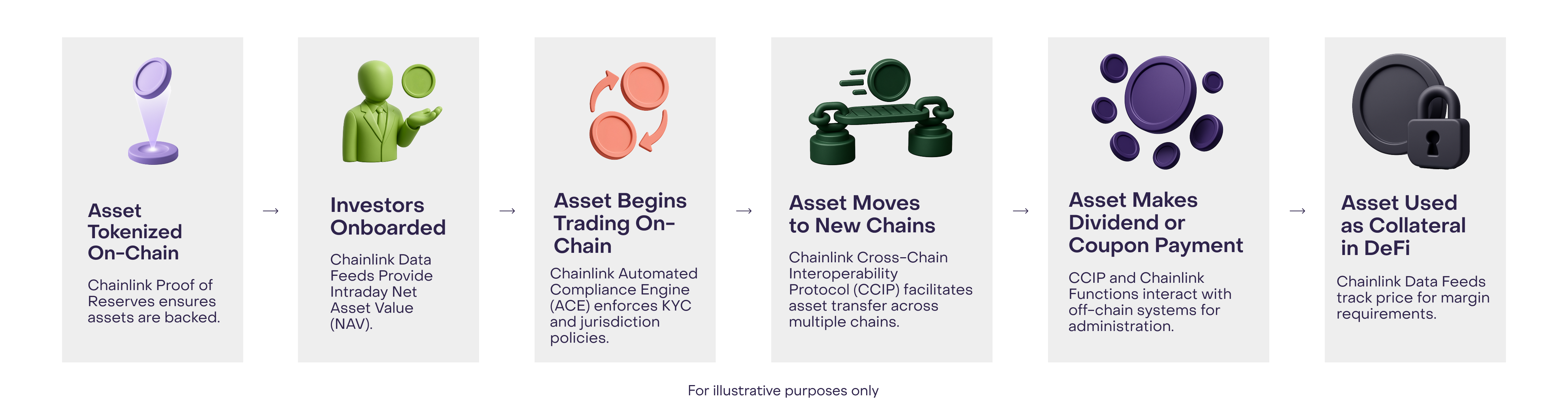
Chainlink is one of the clearest examples. Grayscale believes Chainlink may represent one of the best “picks and shovels” opportunities in tokenization because it provides critical middleware services across the lifecycle of tokenized assets. These services include proof of reserves, data delivery, and compliance-related functionality. Chainlink operates across multiple blockchains rather than depending on a single network, which may allow it to benefit under a range of market structure outcomes (Exhibit 11).
Beyond Chainlink, a range of service providers are helping drive tokenization adoption, including Securitize (up 37% in tokenized assets year-to-date), which provides infrastructure for institutions to issue assets on-chain, and Ondo (up 89% in tokenized assets year-to-date), which focuses on packaging and distributing tokenized exposure to traditional financial assets for investors.[11]
Exhibit 11: Chainlink spans the tokenization life cycle
This theme is nuanced and includes several important challenges and considerations. The blockchain infrastructure outlook could involve multiple winners including the likes of hybrid models like Avalanche. Canton could also gain durable advantages if the network achieves meaningful early adoption among traditional financial players. It may also capture dominant share in specific use cases — such as overnight repo and other institutionally constrained markets — where liquidity formation and interoperability are driven by existing institutional relationships, limiting the benefits of open, permissionless network effects.
At the same time, the distinction between open and institution-centric networks may become less binary. Institutions building on open networks like Ethereum may incorporate permissioning layers that resemble institutional networks, potentially reducing some of the liquidity and composability benefits associated with open systems. Over time, these approaches may converge at the margins through improved tooling and selective permissioning, although the fundamental tradeoff between control and full composability is likely to persist.
A related question is how much of the tokenization lifecycle will ultimately exist purely onchain. There are varying degrees of this today. Many tokenized assets use blockchains primarily as a wrapper or distribution layer, while critical functions such as custody, redemption, transfer agent records, and voting rights still often rely on offchain infrastructure. To fully realize the benefits of tokenization, we believe a greater share of these core functions will need to migrate onchain over time.
Additional risks to tokenization adoption include general regulatory risk, regulatory uncertainty that may limit the extent to which assets can move fully onchain, and broader crypto market conditions that may limit short term appetite for institutions.
Tokenization represents a massive opportunity for investors in blockchain infrastructure. In the near term, institution-centric architecture networks like Canton are well positioned to lead, optimizing existing financial infrastructure and benefiting from privacy by default. Over time, however, we expect a shift toward open architecture networks such as Ethereum and Solana. While institution-centric networks improve the current model, open networks represent a more expansive vision, rearchitecting capital markets from the ground up.
The key question for investors is not whether capital markets will move onchain, but how that migration unfolds, and which platforms and their underlying tokens are best positioned at each stage of the transition. In our view, value will accrue to the underlying blockchain tokens — including ETH, SOL, and CC — with institution-centric networks potentially capturing early activity and open networks driving longer-term upside potential. Regardless of how this transformation unfolds, LINK appears well positioned to offer consistent, chain-agnostic exposure across adoption phases.
Tokenization will not be a single-cycle theme, but a multi-phase transformation. Early institutional adoption followed by broader expansion into open networks may drive one of the most significant infrastructure shifts in modern financial history and a corresponding reallocation of value across the financial system.
[1] Rwa.xyz, data as of 4/26/2026.
[2] Rwa.xyz, data as of 4/26/2026.
[3] When comparing blockchains with different architectures it is important to distinguish the functions of tokenized assets they support. The data provider RWA.xyz has introduced the concepts of “represented assets” and “distributed assets” for this purpose. Institutional centric networks host "represented assets”: assets where blockchain is used to mirror or improve existing financial infrastructure. For example, a tokenized Treasury issued on Canton where ownership and settlement occur onchain, but within an institutional environment. Open networks host “distributed” assets: assets that exist natively on open networks and can integrate with broader on-chain applications. For example, a tokenized fund issued on Ethereum that can be used as collateral in decentralized lending protocols.
[4] Artemis, DeFi Llama, Dapp Radar, as of 4/26/2026
[5] Artemis, data as of 4/26/2026
[6] Rwa.xyz, data as of 4/26/2026
[8] Rwa.xyz as of 4/26/2026
[10] Solana, for example, already offers a range of privacy tools for different use cases.
[11] Rwa.xyz, data as of 4/26/2026.