Hyperliquid Breaks the Mold

Michael Zhao

Zach PandlGrayscale Head of Research
Last Updated: 6/3/2026 | 29 min. read
Grayscale Hyperliquid Staking ETF ("HYPG" or the "Fund"), an exchange traded product, is not registered under the Investment Company Act of 1940 (or the ’40 Act) and therefore is not subject to the same regulations and protections as 1940 Act registered ETFs and mutual funds. An investment in HYPG is subject to a high degree of risk and heightened volatility. HYPG is not suitable for an investor that cannot afford the loss of the entire investment. An investment in the Fund is not a direct investment in HYPE. Potential staking rewards are earned by the Fund and not issued directly to investors.
Imagine a startup that has broken through in a highly competitive industry in less than three years. It made around $800 million in revenue last year alone, tapping into a massive addressable market. It also runs lean and offers high operating leverage. All of this has been achieved even as many potential customers in the United States and other major markets remain unable to access the platform — but that may soon change. This is Hyperliquid (Exhibit 1).
Exhibit 1: Hyperliquid is the breakout success story of the modern digital assets industry

At its core Hyperliquid is a decentralized exchange specializing in perpetual futures — a type of financial derivative without a delivery date. Crypto perpetual futures, or “perps,” are already a big business: volume averaged about $200 billion per day across the digital assets industry in 2025.[1] Most of this trading is dominated by centralized exchanges (i.e., traditional businesses) like Binance, OKX, and Bybit. Hyperliquid is the first decentralized or blockchain-based project to capture a meaningful share of volume and open interest.
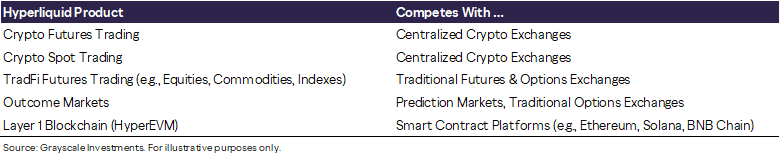
Capturing additional market share in crypto perpetual futures could be enough to drive significant further growth in the platform over time; however, Hyperliquid aspires to accomplish much more than that. Although perps still dominate revenue, today Hyperliquid is a diverse financial services platform competing across several verticals (Exhibit 2).
Exhibit 2: Hyperliquid is a diverse financial services platform
Like other blockchain protocols, Hyperliquid is not a business and does not issue shares. Instead, its token powers the network and accrues value from trading activity. The HYPE token has a circulating market capitalization of about $13 billion, making it the 8th largest crypto asset by market value (Exhibit 3).[2]
Relative to comparable public market equities, HYPE trades at a moderate multiple. Given the platform’s success onboarding users, its large addressable market, and upcoming regulatory unlocks, we believe Hyperliquid is poised for significant further growth.
Exhibit 3: HYPE market cap since inception

Notwithstanding its broader ambitions, decentralized trading of perpetual futures is what put Hyperliquid on the map. These products were invented in crypto but will eventually make deep inroads in traditional finance, in our view (see section below on regulatory clarity).
Traditional futures have an expiration date. For example, a crude oil futures contract is an agreement to deliver a certain number of barrels of oil by a specific date. Participants in these markets either take or receive delivery of the underlying asset if held until expiry. For pure financial exposure, users are required to “roll” their position to a contract with a later expiration date so that they never take or receive delivery.
Perpetual futures have no expiration date, and no one ever takes or receives delivery of the underlying asset. They are designed to be pure financial exposure to the reference asset for use by hedgers and speculators and typically trade 24/7.
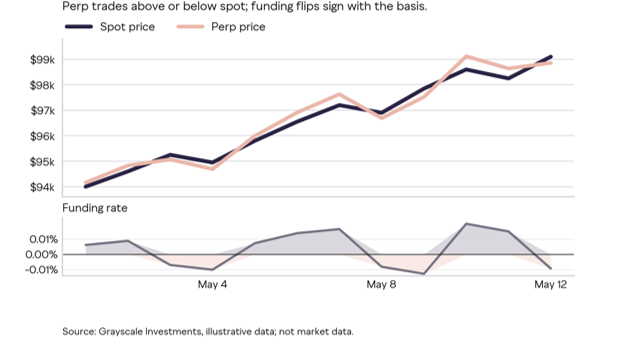
Traditional futures remain anchored to the price of the underlying reference asset because, at expiry, someone needs to deliver that asset. If perpetual futures never expire, what keeps their price near the spot price of the underlying asset? Perps use a mechanism called the funding rate — a small periodic payment between longs and shorts. When the perp price trades above the spot price, longs pay shorts; when it trades below, shorts pay longs — the bigger the difference, the larger the payment (Exhibit 4). The funding rate (and related arbitrage activity) therefore creates an economic incentive to bring the perpetual futures price back toward the underlying market.
Exhibit 4: Funding rate mechanism anchors perp to underlying asset
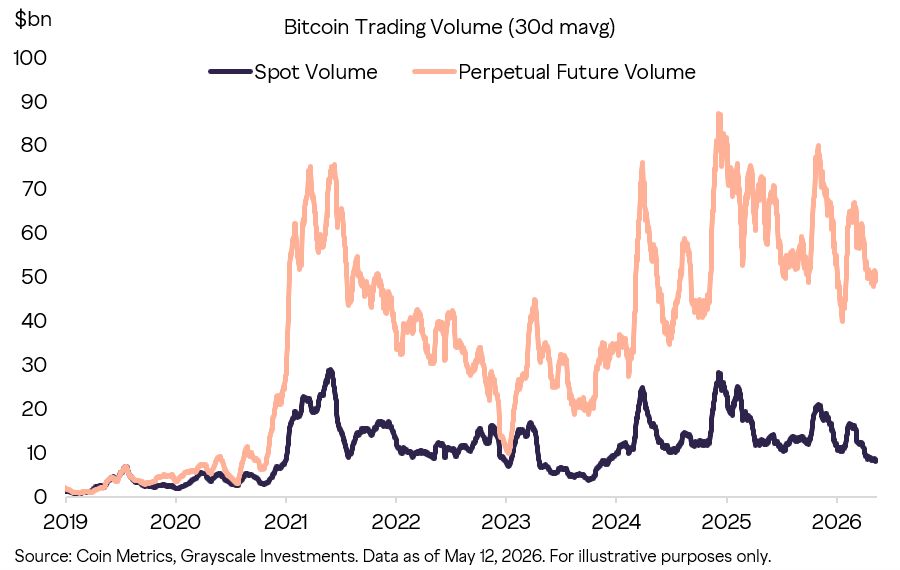
Perps have been a great fit for crypto markets (Exhibit 5). Crypto trades continuously, has high retail and professional speculative demand, and often develops new assets faster than traditional futures venues can list them. Perps gave traders a simple way to express directional views, hedge spot exposure, and access leverage around the clock. They are now one of the core markets for crypto price discovery.
Exhibit 5: Global Bitcoin reported perp and spot volume
Retail traders have a variety of ways to access leverage, including traditional brokerage account margin, dated futures, options, and leveraged ETFs. Experience from crypto markets suggests that retail traders gravitate toward perpetual futures when given the full range of choices, likely in part because of their simplicity. Perps may therefore have similar take-up once available to a broader set of participants in traditional markets.
Hyperliquid delivers the performance of a centralized exchange with the custody model of a blockchain. That is the core breakthrough. From a trader’s perspective, it can be difficult to distinguish between Hyperliquid and a centralized exchange — both offer deep order books, fast execution, and familiar position management (Exhibit 6). But every Hyperliquid transaction is recorded onchain, including liquidations, and unlike centralized exchanges, Hyperliquid offers self-custody.
Exhibit 6: Hyperliquid trading experience similar to centralized exchanges
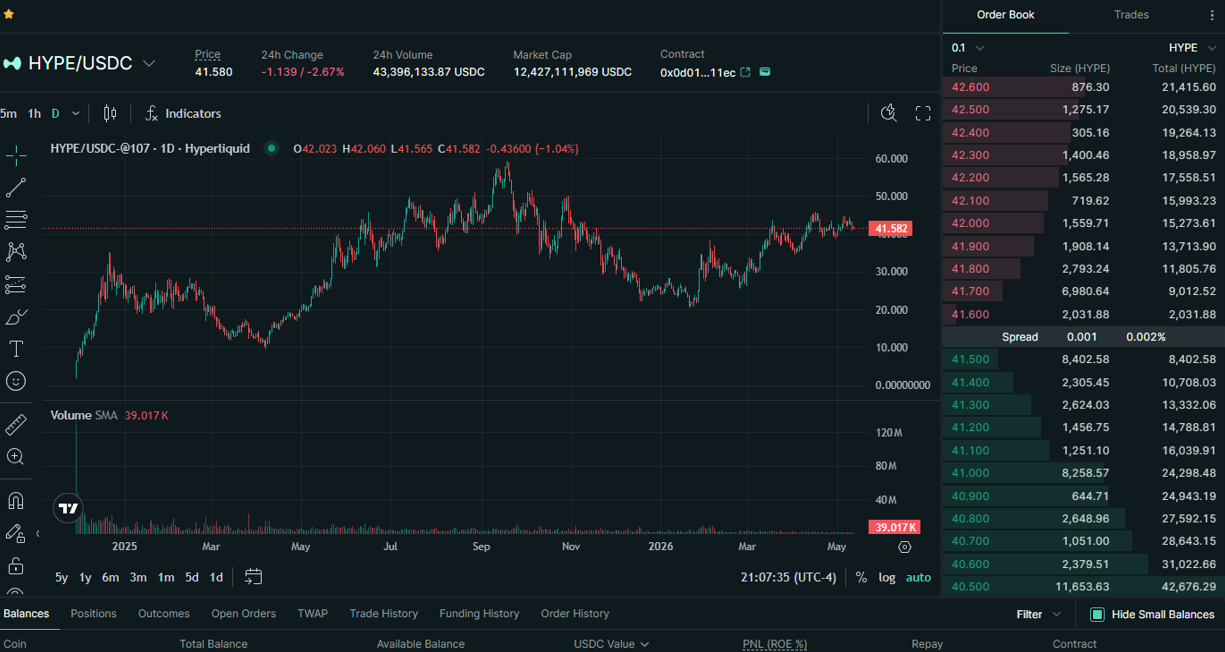
Source: Screenshot from app.hyperliquid.xyz on May 12, 2026. For illustrative purposes only.
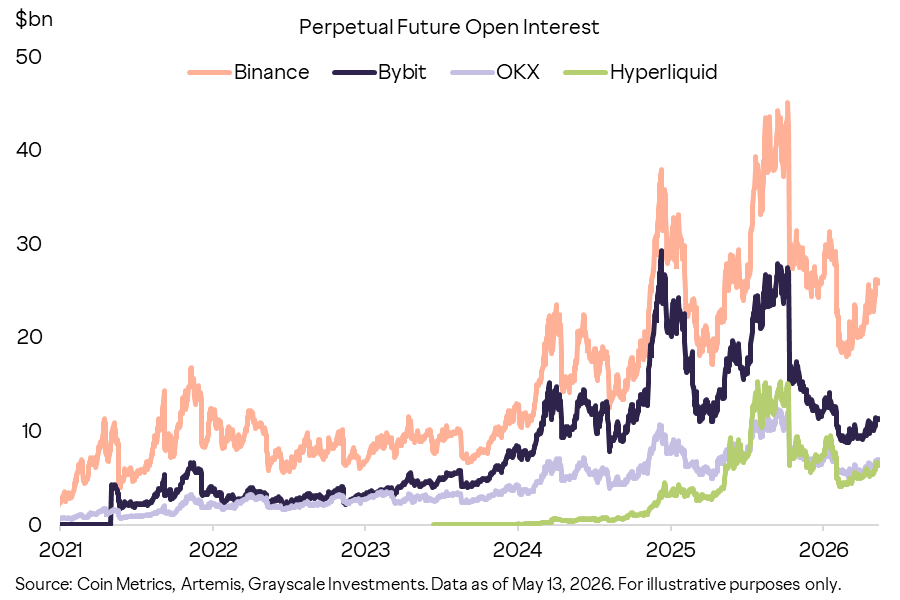
Leveraged trading is a highly competitive crypto market segment, and users can be unforgiving. Hyperliquid has succeeded because it offers a compelling product. The platform can now be compared to the largest crypto derivatives venues. Hyperliquid processed $2.9 trillion in perp volume in 2025 and currently holds about $7 billion in open interest (OI). This makes Hyperliquid the third or fourth largest perpetual futures exchange by OI (Exhibit 7). Hyperliquid’s volume, open interest, fees, and mindshare have all grown together, even as the platform has begun expanding from crypto-native markets toward a broader set of tradable exposures.
Exhibit 7: Hyperliquid now the third or fourth largest crypto perps exchange
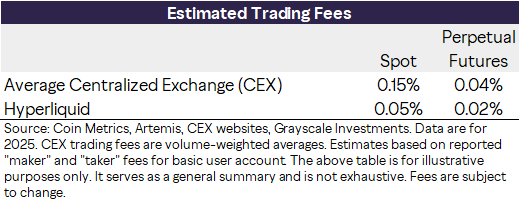
Hyperliquid is cost competitive with centralized exchanges. Using 2025 trading data on Bitcoin (BTC) and Ether (ETH), we estimate a volume-weighted average fee on centralized exchanges of 15 basis points (bp) for spot trading and 4bp for futures trading. For Hyperliquid we estimate a volume-weighted average fee of 5bp for spot and 2bp for futures (Exhibit 8). Note that Exhibit 8 shows Grayscale estimates based on reported “maker” and “taker” fees for basic user accounts. It does not include other factors which may affect the total cost of trading including fee tiers, fee discounts, and order book depth. For centralized exchanges (CEXs), values are volume-weighted averages across multiple exchanges.
Exhibit 8: Volume-weighted fees
Perhaps most promising, Hyperliquid has broadened beyond crypto perps to other products using an open architecture approach. New functionality is typically introduced through Hyperliquid Improvement Proposals (HIPs)[3], and the products are deployed by third-party builders — not the team that created Hyperliquid itself.
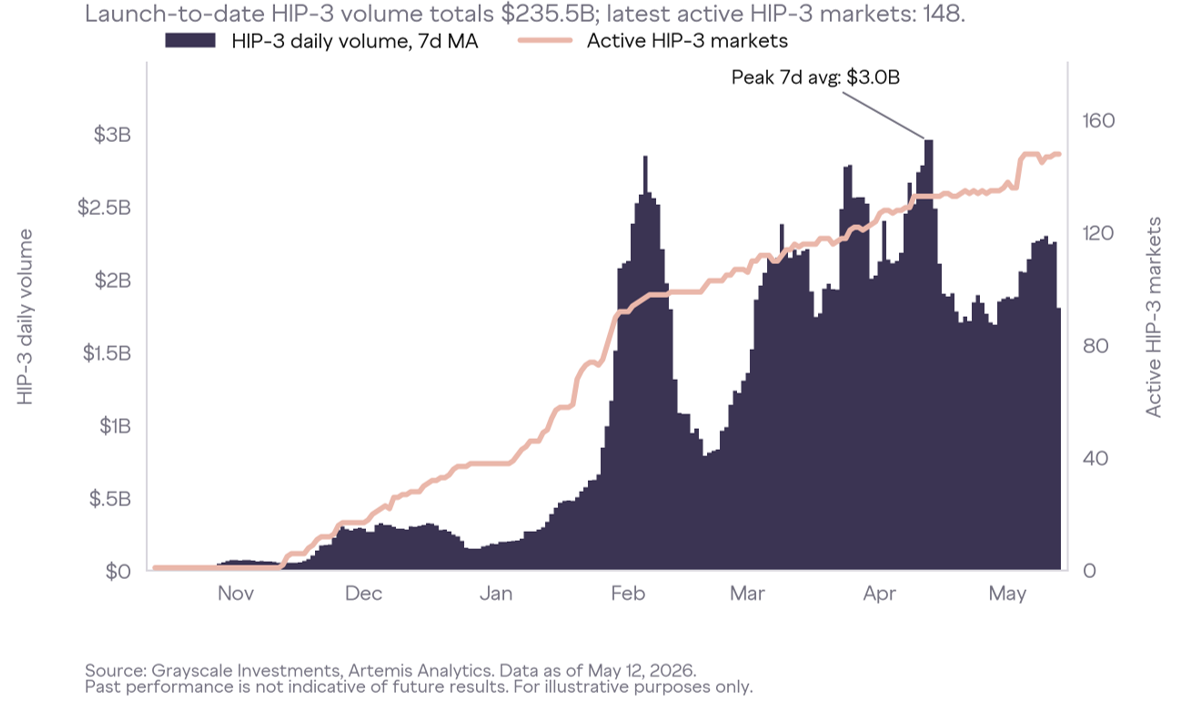
HIP-3 allows builders to deploy new perpetual markets, including for non-crypto assets like stocks, commodities, and index products. These markets have proven hugely popular with users and have begun to function as off-hours price-discovery venues for traditionally traded assets (Exhibit 9). Bloomberg directly framed Hyperliquid commodity perps this way, writing that the moves in oil, gold, and silver perps on Hyperliquid “may offer some indication of how those markets could respond once mainstream trading resumes.”[4] In a separate article, Bloomberg described Hyperliquid as “a round-the-clock venue for leveraged commodity bets,”[5] underscoring the platform’s emerging role as a 24/7 market structure layer for real-world assets.
The volume data support that framing. During the February silver spike, silver HIP-3 perps reportedly reached more than $4 billion of daily volume[6]. In a window on February 5, 2026, HIP-3 silver perp volume traded roughly 1% of COMEX’s silver notional volume[7]. During recent Middle East oil volatility, HIP-3 oil perps reached over $4 billion of 24-hour volume on April 9, and briefly surpassed Bitcoin’s perp volumes[8]. An officially licensed[9] S&P 500 contract now trades on Hyperliquid through HIP-3 — including on weekends. Launch to date, HIP-3 volume totals to over $230 billion traded with over 140 HIP-3 trading pairs currently active[10].
Exhibit 9: HIP-3 expands Hyperliquid beyond crypto perps
HIP-4 extends this vision to outcome markets — binary options that resemble prediction market contracts. These contracts are also deployed by third-party developers, although the transaction activity still generates fee revenue for Hyperliquid.
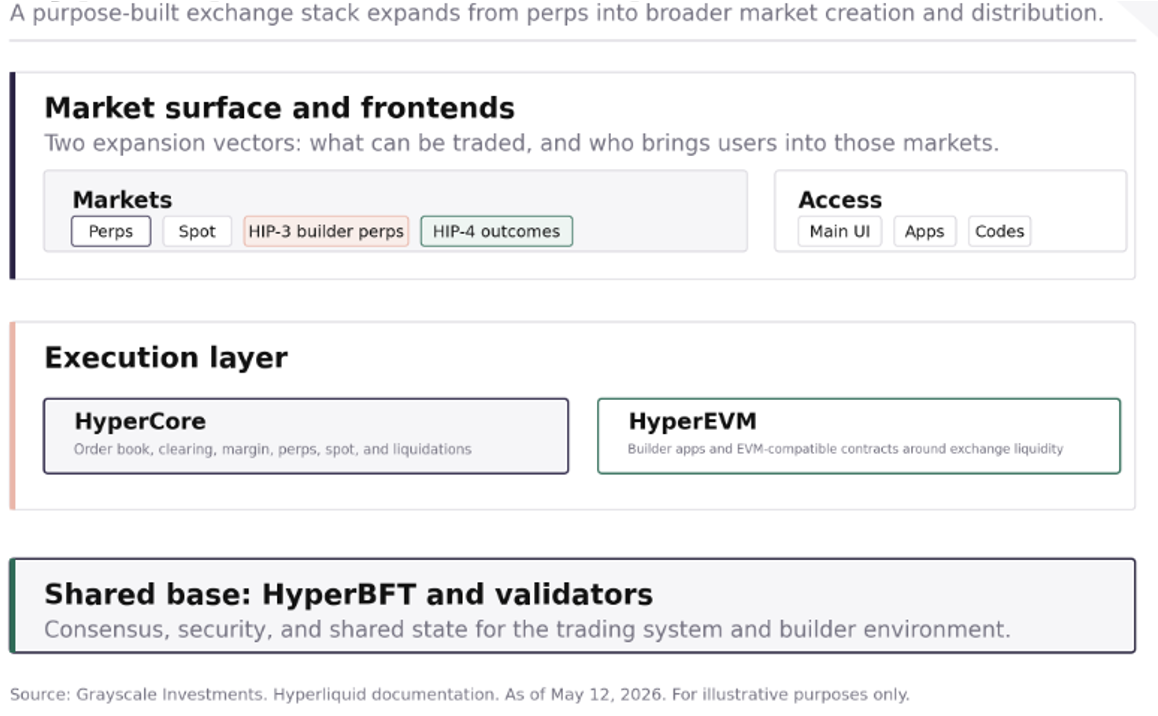
Under the hood, Hyperliquid is built around two main elements:
Additionally, HyperBFT is the delegated Proof of Stake consensus layer that secures the system.
For the purposes of this article, the technical detail matters less than the design choice: Hyperliquid is not an app sitting on a general-purpose chain. It is a purpose-built chainand execution stack optimized around exchange performance , with the goal of making the onchain venue feel competitive with centralized trading infrastructure.
Exhibit 10: Hyperliquid as a market platform
Hyperliquid opened to the public in August 2023 — before the launch of Bitcoin exchange-traded products (ETPs) in the U.S. market and during a relatively quiet period for decentralized finance (DeFi). Its success is not a function of a speculative boom. Rather, it solved a specific problem better than most crypto infrastructure projects: it made onchain trading feel usable for the people who trade the most.
We see five main factors behind the success:
None of these advantages are decisive on their own. But together they explain why Hyperliquid has become one of the few crypto applications whose success can be measured in actual usage today rather than aspirational goals.
Hyperliquid could defend this competitive position through interaction of liquidity, distribution, and builder incentives. Higher trading activity improves liquidity and execution quality, which attracts more users and third-party frontends. Builder codes and HIP-3 then give external developers an economic reason to route activity back into the same liquidity base rather than fragmenting it across competing venues. This creates a potential network effect that is difficult for new entrants to replicate: liquidity attracts distribution, distribution attracts more volume, and volume strengthens the economic base of the protocol.
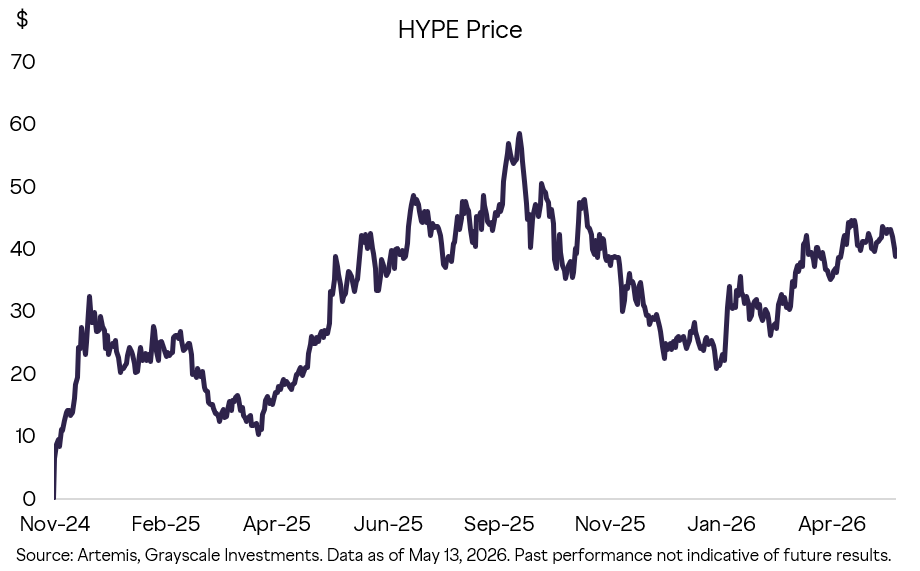
The HYPE token powers the Hyperliquid ecosystem (Exhibit 11). In an unusual model for modern crypto projects, the platform had no traditional venture capital backing, and it airdropped[13] ~30% of the token supply directly to early users. That shaped who cared about HYPE: the initial holder base was heavily skewed toward users, traders, and community members who already understood the product.
Exhibit 11: HYPE price since inception
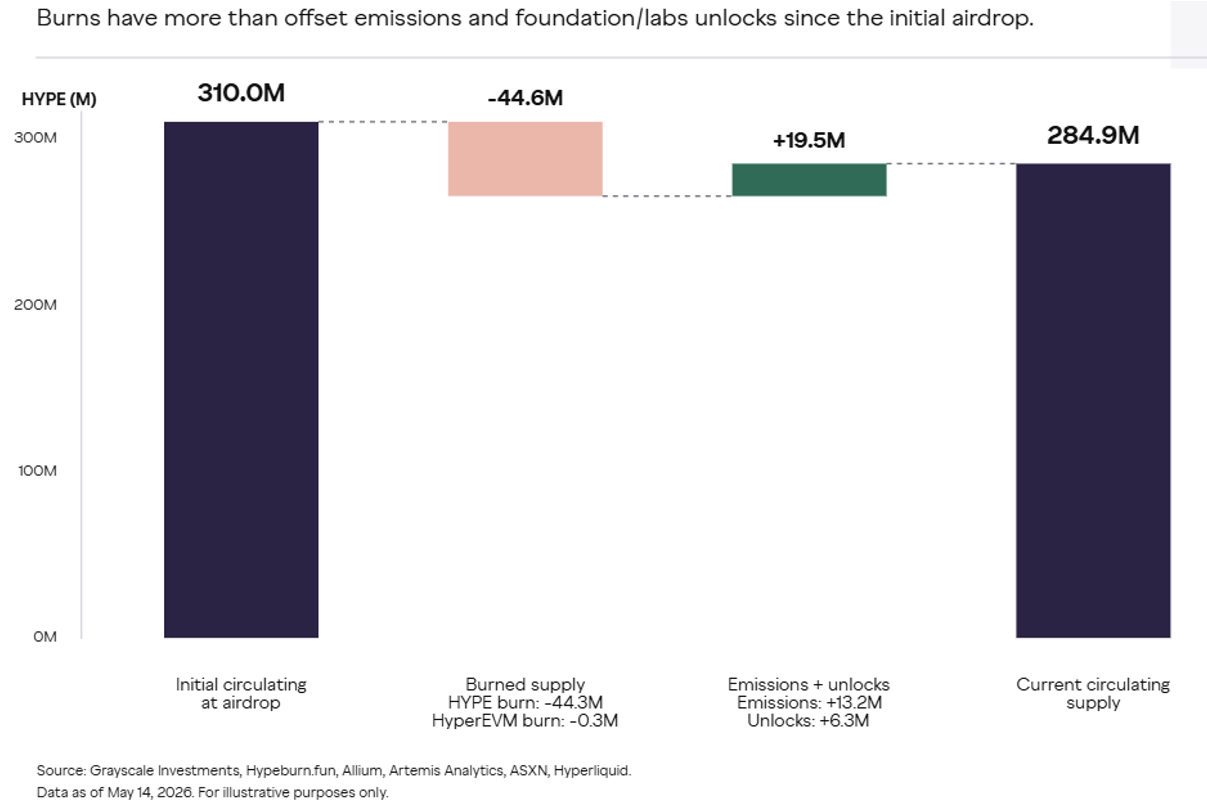
HYPE derives value from trading fees and its functional utility. Hyperliquid Labs has confirmed that 99% of fees go to the assistance fund, which converts trading fees to HYPE and burns HYPE held by the fund. Token burns resemble buybacks in traditional equity markets. Because burns exceed new issuance, the circulating supply of HYPE has declined over time (Exhibit 12).
Exhibit 12: HYPE burn, emissions, and supply
In addition, HYPE has a variety of uses within the Hyperliquid ecosystem:
HYPE is attached to a venue that already has measurable trading activity, fees, and builder demand. The more volume the venue processes, the more important the fee schedule, staking tiers, builder economics, and assistance-fund mechanics become. The more HyperEVM and HIP-3 and HIP-4 expand the platform, the greater the utility and potential value accrual for HYPE.
Hyperliquid is a unique platform offering a range of financial services. This can make it challenging to effectively size the potential upside. But based on plausible comps, we believe the platform and token offer meaningful potential growth.
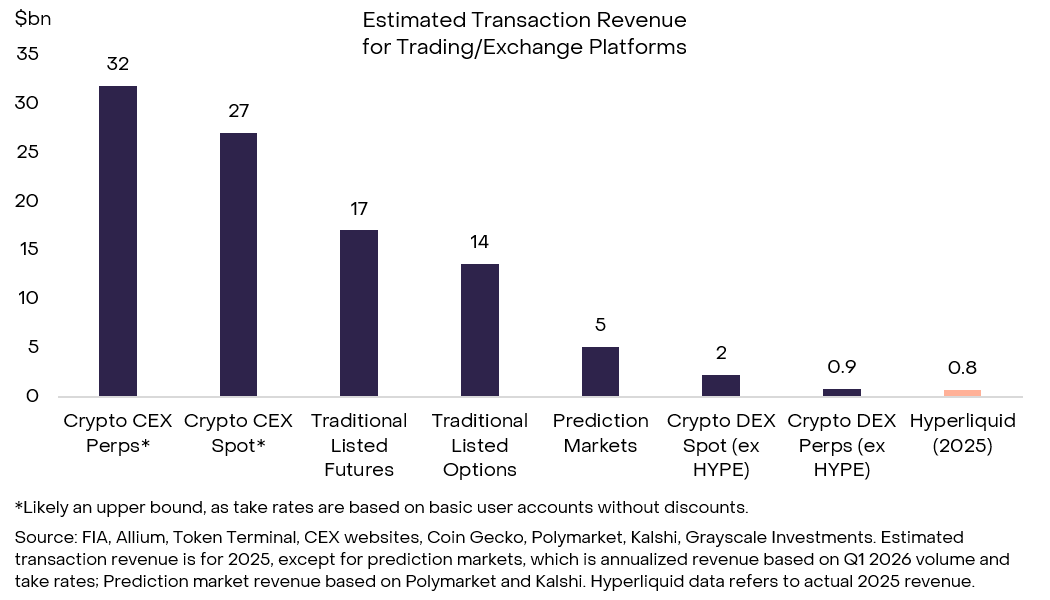
Exhibit 13 compares Hyperliquid revenue to estimated revenue for a range of other trading platforms, including centralized crypto exchanges, traditional spot and derivatives exchanges, and prediction markets.[14] Hyperliquid’s 2025 revenue of ~$800 million is substantial but only accounted for about 2% of total crypto perp transaction revenue. If Hyperliquid can see sustained adoption of its non-crypto products, it could potentially have claim to a portion of the roughly $35 billion-$40 billion in annual revenue produced by the broader derivatives exchange industry.
Exhibit 13: Hyperliquid revenue still moderate compared to exchange industry
The HYPE token is not a stock, but it can be roughly compared to traditional equities in related industries. Based on earnings over the four quarters ending Q1 2026, the HYPE token currently trades at a multiple of ~14. [15]
Hyperliquid sits at the intersection of two regulatory gaps in the U.S.: perpetual futures and decentralized exchanges—both of which appear to be moving toward clearer frameworks.
Historically, perps have been effectively unavailable in the U.S. They are not prohibited outright, but they do not cleanly fit within the Commodity Exchange Act (CEA), the federal statute that governs commodities and derivatives and sets requirements around clearing, margin, and execution on registered venues. That ambiguity has driven enforcement against both centralized and DeFi platforms offering off-exchange derivatives and explains why Hyperliquid operates offshore and geoblocks U.S. users today.
However, this backdrop is shifting quickly. Recent commentary from the Commodity Futures Trading Commission (CFTC), the regulator that implements the CEA, alongside moves by firms like Coinbase, Kraken, Robinhood, and Kalshi, signals that regulators are actively working toward enabling perpetual-like products within compliant structures. The key legal hinge remains on classification — whether perps are treated as futures or swaps under the CEA — and the mechanism regulators choose to bring clarity to this classification (rulemaking, guidance, and/or no-action relief) will determine both the timing and durability of access. Near term, regulatory progress is likely to favor centralized, registered venues first; over time, however, CFTC rulemaking, guidance, or no-action relief could create a compliant pathway for Hyperliquid to offer perp products in the U.S., reducing the need to rely exclusively on offshore access.
At the same time, Hyperliquid’s exchange-like functionality places it squarely within the ongoing debate over how DeFi protocols are regulated. The U.S. does not have a rulebook specifically designed for decentralized exchanges (DEXs). Instead, regulators apply existing Securities and Exchange Commission (SEC) and CFTC frameworks based on function, with the consistent principle that “decentralization does not exempt you.”
For derivatives-focused DEXs, this has meant heightened scrutiny and clear barriers to direct institutional participation, which today largely occurs through intermediated or offshore channels. Emerging legislative efforts like the CLARITY Act point toward a more structured, role-based framework for digital asset markets, including clearer distinctions between protocol-level activity, front-end operators, intermediaries, and registered trading venues. Separately, SEC initiatives around tokenized securities may help normalize on-chain market structure more broadly, but the more directly relevant path for perpetual-like products on Hyperliquid runs through the CFTC and the CEA.
This distinction is critical for Hyperliquid: as non-custodial infrastructure, its core protocol may ultimately be treated differently from the interfaces or entities that facilitate user access. While these proposals do not yet create a fully viable regime for onchain perps, they represent a path toward one — especially if paired with targeted safe harbors, clearer broker definitions, and tailored rules for onchain market structure (e.g., margining, funding rates, and 24/7 trading). The direction of travel is toward enabling innovation within guardrails, and Hyperliquid’s positioning — open, global, and non-custodial — aligns with the policy debate around preserving permissionless access while introducing appropriate market protections.
Investors in HYPE should be aware of both conventional risks and some that are unique to the Hyperliquid platform and its outlook. First, the HYPE token has annualized price volatility of about 80% — about 40 percentage points higher than Bitcoin.[16] Second, Hyperliquid has a more centralized set of validators than other blockchain networks and runs on closed-source software. Third, as noted above, Hyperliquid’s growth potential partly depends on changes to financial services regulation in the United States that opens up access to a broader set of users. Without those changes, the platform may be limited only to other jurisdictions, potentially putting a ceiling on its growth.
Hyperliquid is not directly comparable to another project in either crypto or traditional finance — it breaks the mold. We think it is offering a compelling vision for the future of blockchain-based finance. It’s an open architecture platform benefiting permissionless innovation and sticking to the DeFi principles of transparency and self-custody. But it is also structured around an optimized core application that has already demonstrated success with users. If it continues to execute well, retain and grow its dedicated community, and benefit from regulatory changes that open a path to broader adoption, we think Hyperliquid could become a financial services juggernaut.
Looking to gain exposure to HYPE? Search for ticker HYPG through your brokerage account. As an exchange-traded product, HYPG provides investors with exposure to the HYPE token through a familiar investment vehicle, with the added benefit of earning potential staking rewards. For risks related to the fund, please see the Important Information at the end of this document.
Airdrop: A distribution of digital tokens directly to users or wallet addresses, often used to reward early participants or encourage adoption.
Basis Point: A basis point (bps) is one hundredth of one percent (e.g. one basis point = 0.01%).
Decentralized exchange (DEX): A blockchain-based trading platform that allows users to trade digital assets directly from their own wallets rather than through a centralized intermediary.
Decentralized finance (DeFi): Financial applications and services built on blockchain networks that operate without traditional intermediaries such as banks or brokerages.
Funding rate: A recurring payment mechanism used in perpetual futures markets to help keep contract prices aligned with spot prices.
HyperBFT: The consensus mechanism for the Hyperliquid platform which determines how validators agree on the network’s state, including the ordering and finality of onchain actions such as orders, trades, cancellations, and liquidations.
Onchain: Activity that occurs directly on a blockchain network and is publicly recorded on the blockchain ledger.
Open interest (OI): The total number of outstanding derivatives contracts that have not been closed or settled.
Perpetual futures (“perps”): Futures contracts without an expiration date that are designed to track the price of an underlying asset.
Proof of Stake: A blockchain consensus mechanism in which validators help secure the network using staked digital assets.
Self-custody: Holding and controlling digital assets directly rather than relying on a third party to store or manage them.
Staking: Locking digital assets to help support blockchain network operations and potentially earn rewards.
Token burn: The permanent removal of tokens from circulation, typically intended to reduce supply over time.
Validator: A participant in a blockchain network responsible for helping verify transactions and maintain network security.
[1] Source: Coin Metrics, Artemis, Grayscale Investments. Data as of December 31, 2025.
[2] Rank based on coinmarketcap.com as of May 18, 2026. Excludes stablecoins.
[3] This is similar to the process of updating other blockchains through, for example, Ethereum Improvement Proposals (EIPs) and Bitcoin Improvement Proposals (BIPs).
[4] “Crypto Market Hedges Iran War Risks With 24/7 Oil and Gold Trading,” Bloomberg.com, February 28, 2026.
[5] “Oil Trades Are Booming on 24/7 Crypto Exchange Hyperliquid,” Bloomberg.com, March 9, 2026.
[6] Source: Allium. ~$4bn silver HIP-3 perp volume happened February 5, 2026.
[7] “HIP-3 Silver Microstructure: Hyperliquid vs. CME,“ Blockworks Research, February 6, 2026.
[8] “2026 Q1 Crypto Industry Report, CoinGecko, April 16, 2026.
[9] “S&P Dow Jones Indices Licenses S&P 500 to Trade[XYZ] for Perpetual Contracts on Hyperliquid,” S&P Global, March 18, 2026.
[10] Allium. Data as of May 11, 2026.
[11] Ethereum Virtual Machine (EVM) is the software that runs applications on many blockchains.
[12] Source: Flowscan, Hyperliquid Builder Codes, as of May 19, 2026.
[13] Delivered directly into user wallets.
[14] Estimated by Grayscale Investments based on reported volume data and assumed exchange take rates based on variety of sources (see Exhibit 13 footnote).
[15] Artemis. Data as of March 31, 2026.
[16] Source: Artemis, Grayscale Investments. Based on 90d realized price volatility. Data as of Mar 18, 2026.