Crypto Sectors Quarterly: AI and Tokenization Shine Amid Geopolitical Turmoil

Will Ogden Moore

Charlie Perkins, CFA Research
Last Updated: 3/23/2026 | 11 min. read
Q1 2026 marked another challenging quarter for crypto markets, with negative returns across all six Crypto Sectors amid heightened geopolitical and macroeconomic uncertainty. A closer look at the data, however, suggests a more constructive underlying environment, with continued growth in tokenization and sustained momentum in projects related to artificial intelligence (AI).
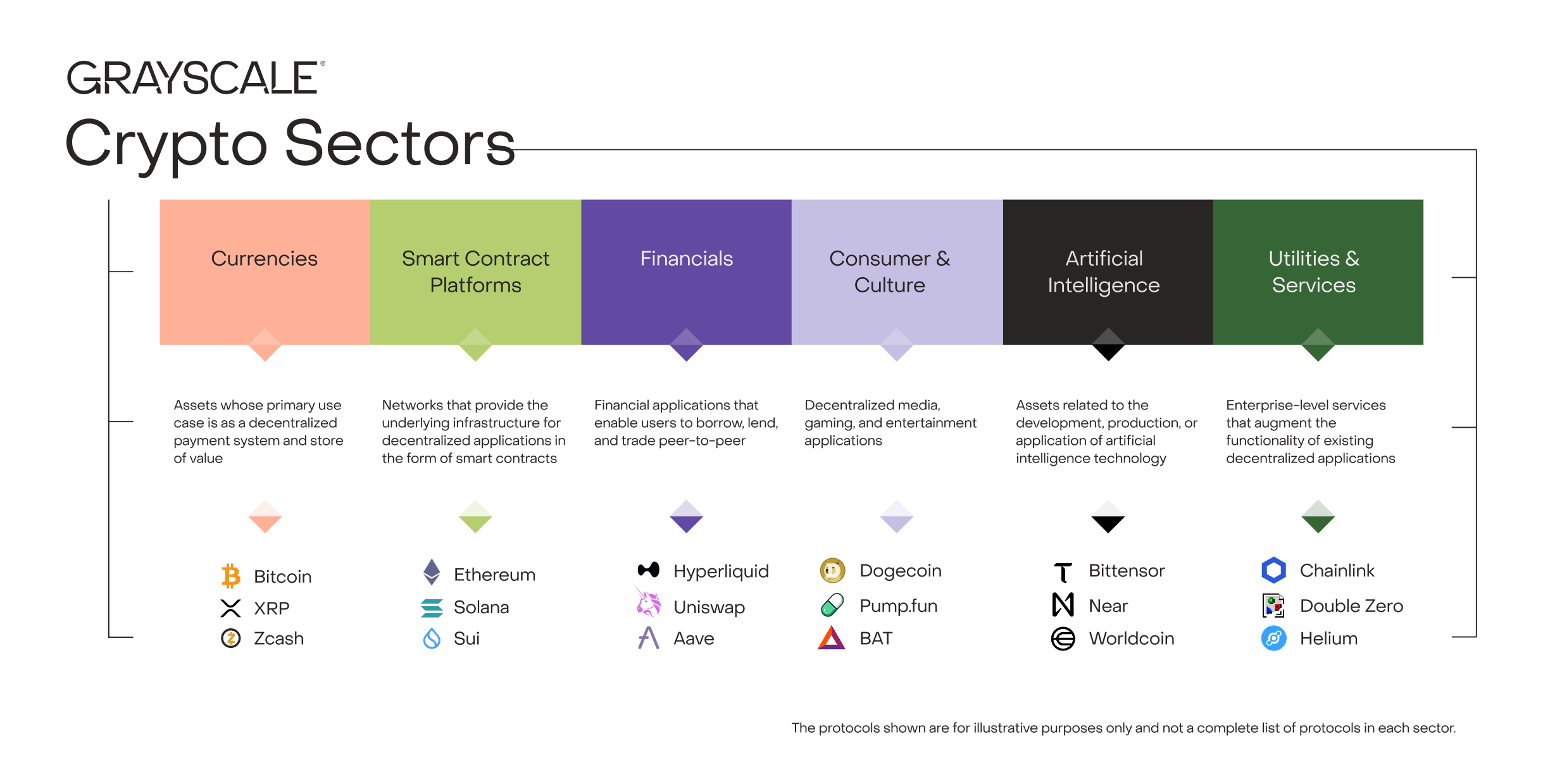
Grayscale Research organizes digital asset markets using its Crypto Sectors framework, developed in partnership with FTSE/Russell. The framework groups 208 tokens into six distinct market sectors (Exhibit 1), with a combined market cap of $2.1 trillion as of the March 2026 rebalance.[1]
Exhibit 1: Crypto Sectors framework helps organize digital asset markets
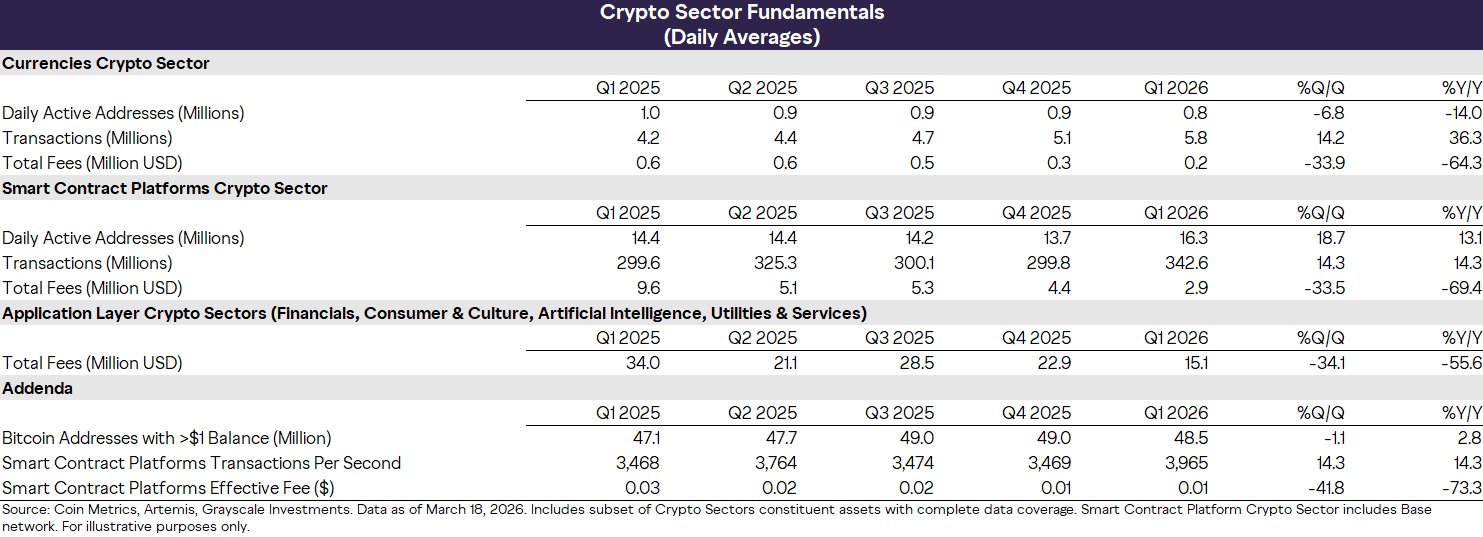
At a high level, fundamental indicators of blockchain activity were mixed in Q1 2026 (Exhibit 2), but a closer look at the data points to a more constructive underlying environment.
Blockchains are not businesses, but their economic activity can be measured in analogous ways. The three most important measures of onchain activity are users, transactions, and transaction fees. Because blockchains are pseudonymous, “active addresses” (addresses with at least one transaction) can serve as an imperfect proxy for the number of users. Fees reflect users’ willingness to pay for transactions to be validated.
Activity trends varied across Crypto Sectors. Within both Currencies and Smart Contract Platforms, average daily transactions increased by ~14% quarter over quarter. Total fees declined by more than 30% across all sectors, but much of this decrease can be attributed to price depreciation (i.e., in USD terms) instead of reduced usage. Active addresses declined modestly in the Currencies sector, but rose nearly 20% in Smart Contract Platforms, suggesting a shift in user activity toward networks with more robust and diverse use cases.
Exhibit 2: Blockchain fundamentals continued to decline in Q1 2026
Beneath the surface, pockets of adoption continued to gain traction in Q1. For example, growth in tokenization activity has remained robust. As shown in Exhibit 3, tokenized assets reached new highs, up 245% year over year. Stablecoins grew 35%. Activity has also accelerated: average daily stablecoin volume more than doubled year over year, approaching an all-time high in mid-March.[2]
Exhibit 3: Tokenization and stablecoin metrics increased in Q1 2026

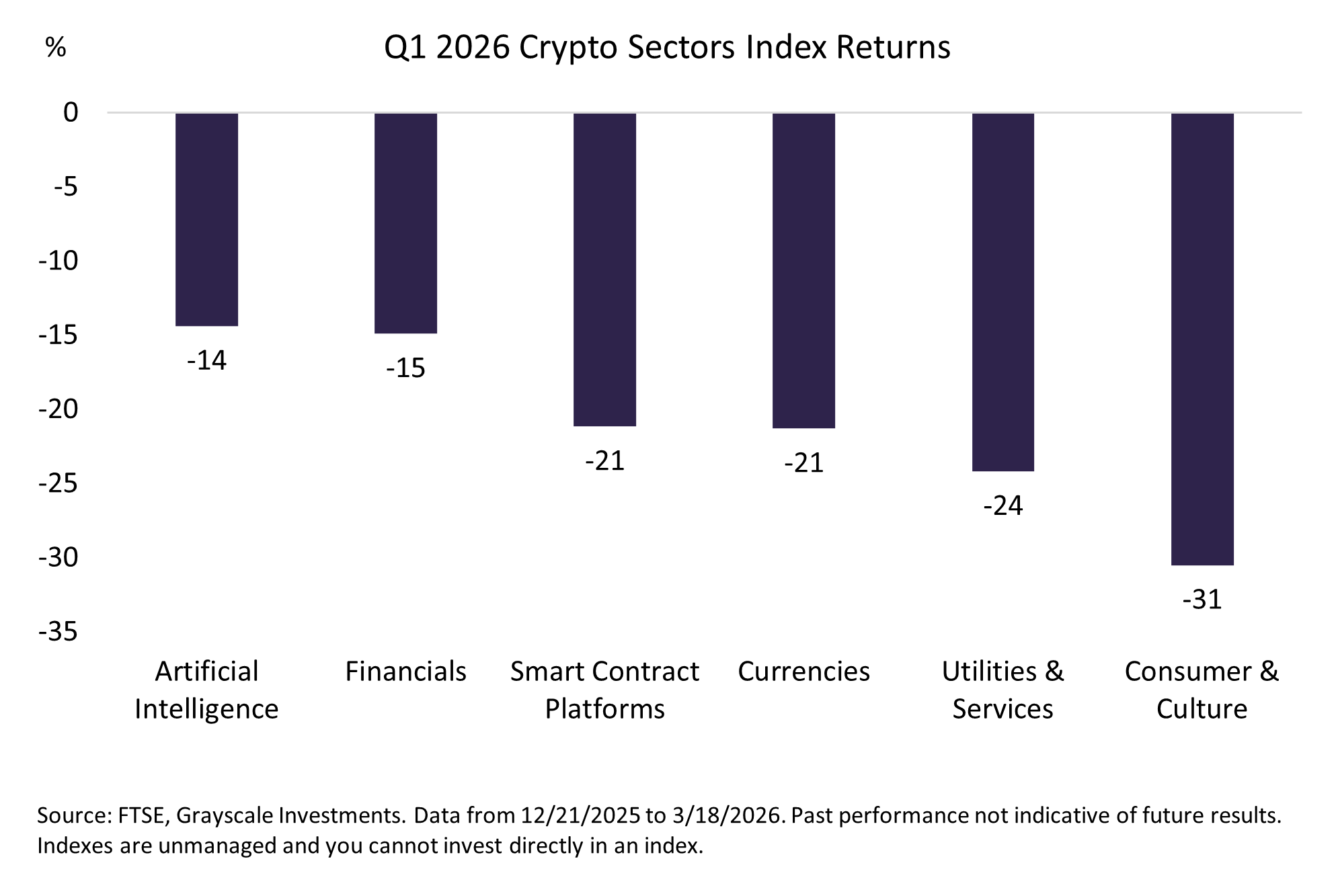
For the second consecutive quarter, returns were negative across all six Crypto Sectors (Exhibit 4). While Artificial Intelligence and Financials demonstrated relative resilience, Utilities & Services and Consumer & Culture experienced the steepest declines, as investor appetite shifted away from momentum-driven and more speculative segments. Despite subdued overall sentiment, capital appeared to rotate toward projects with stronger fundamentals and those aligned with key themes such as AI and tokenization.
Exhibit 4: Returns for each sector were negative in Q1 2026
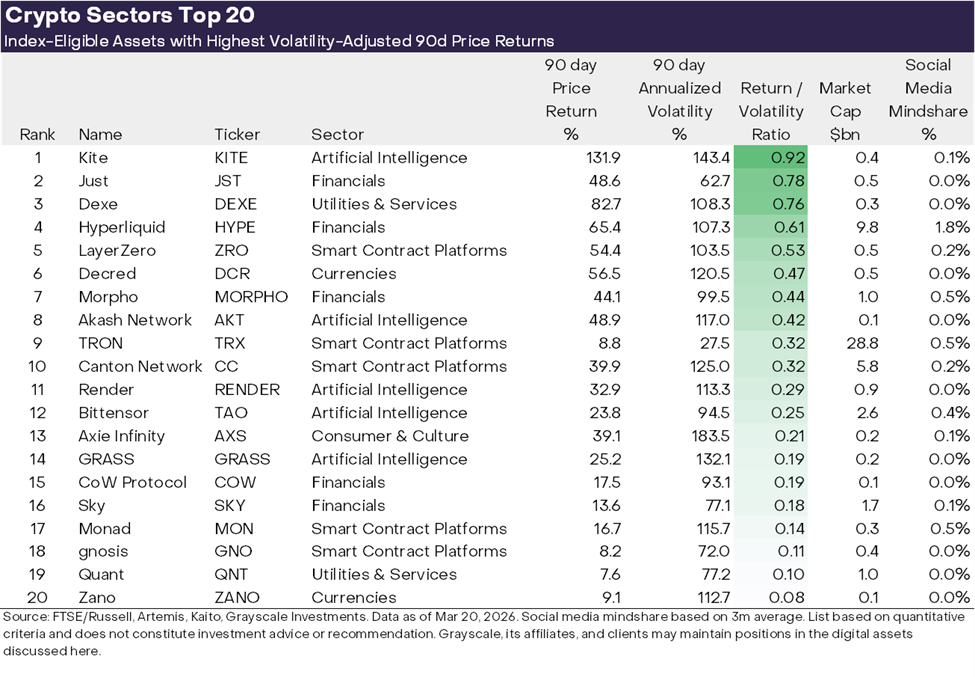
While nearly 90% of assets declined in Q1, a subset of tokens outperformed. Exhibit 4 highlights the top 20 index-eligible[3] tokens in Q1 2026 based on volatility-adjusted returns. These outperformers were largely concentrated in sectors tied to structural growth themes such as AI and financial infrastructure.
Exhibit 5: Top 20 highlights performance of AI- and DeFi-related projects
AI innovation is accelerating, impacting both broader markets and related crypto assets. (see February 2026: Signs of Stability). Blockchains are likely to serve as rails for AI agents given advantages over traditional finance, as discussed in the popular report by Citrini Research on possible AI disruptions[4]. Two examples of outperformers from the AI theme this quarter include:
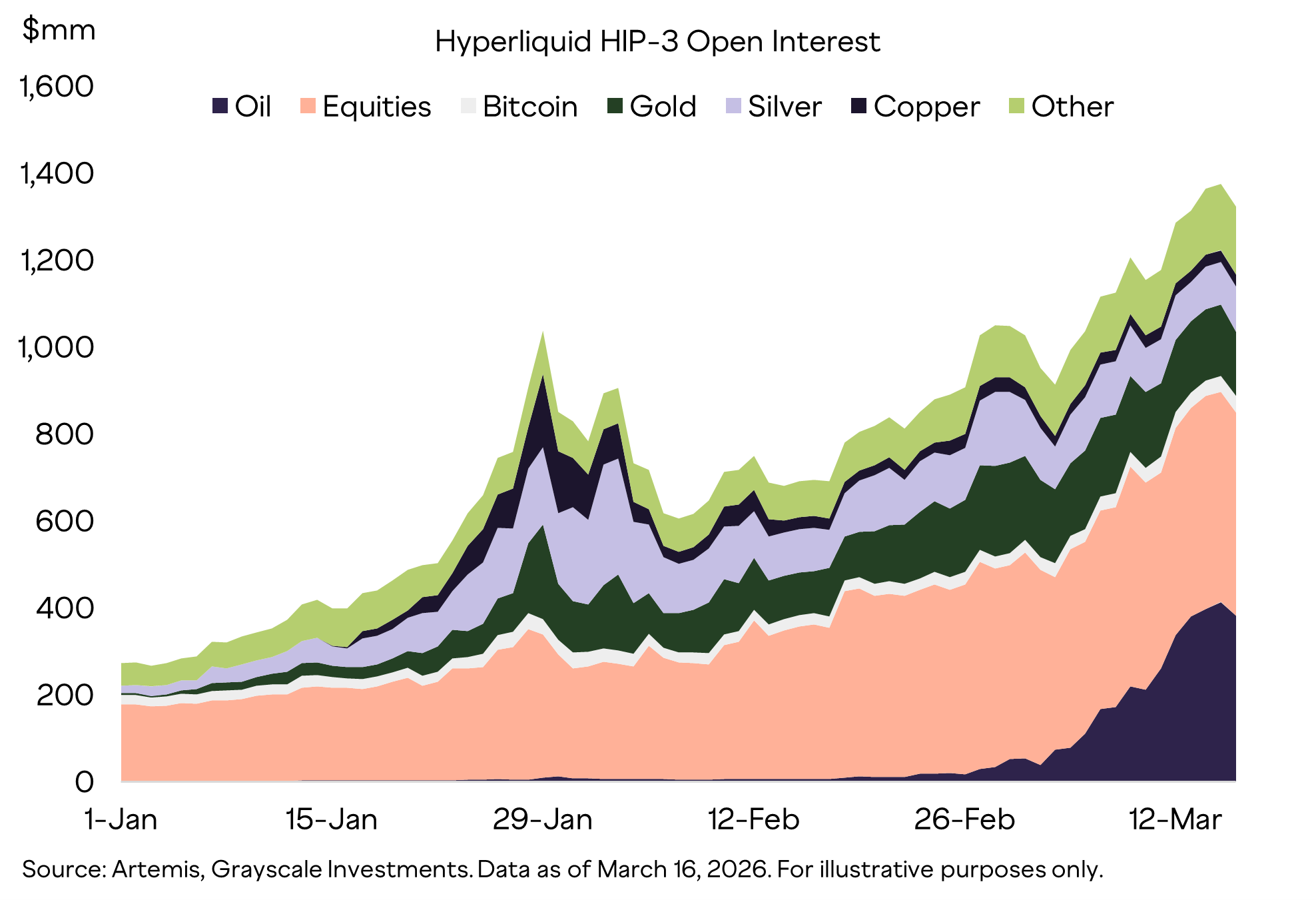
Financial applications of blockchain technology — such as tokenization and decentralized finance (DeFi) — also continued to gain. Market volatility exposed the limitations of traditional trading hours. Demand for continuous, onchain execution increased. Investor interest appeared to concentrate on projects facilitating institutional adoption and enabling the onchain movement and management of financial assets.
Exhibit 6: Q1 2026 saw impressive growth in HIP-3 open interest on traditional assets
In addition to the Financials sector, this quarter’s outperformers featured two smart contract platforms related to the tokenization theme:
The near-term outlook remains uncertain amid rate repricing and geopolitical tensions. However, crypto-specific tailwinds continue to emerge, offering encouraging signs for longer-term adoption and price appreciation.
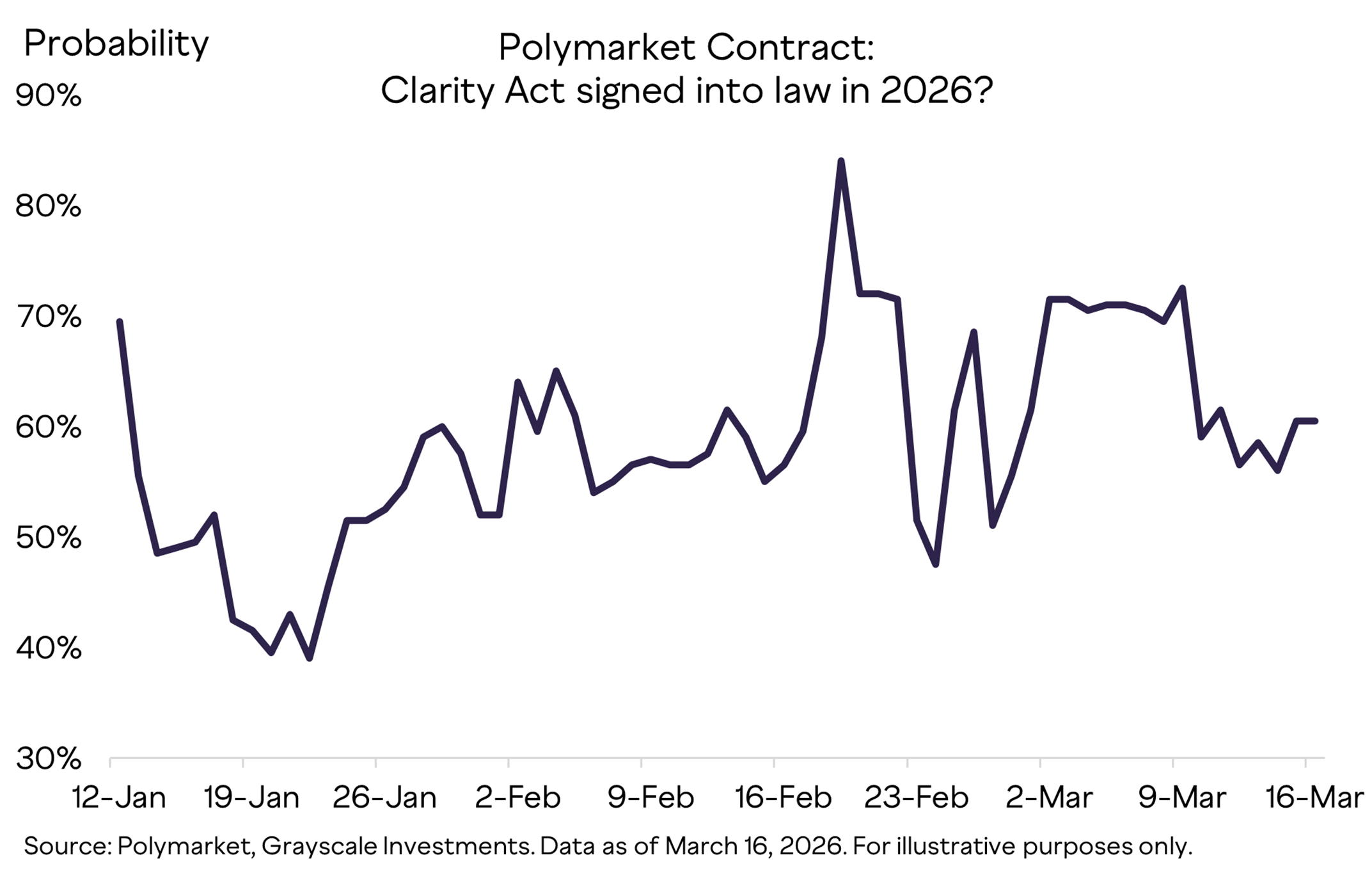
A key catalyst is regulatory progress, particularly the proposed Clarity Act, which aims to establish a traditional finance-style framework for crypto capital markets. The legislation addresses registration and disclosure requirements, asset classification, and rules governing insider activity. The bill has passed the House and is now under consideration in the Senate, with Polymarket odds currently implying greater than a 50% probability of approval by year-end (Exhibit 7).
In our view, passage of the Clarity Act would be a major win for the industry, particularly for sectors that support tokenized financial assets like Smart Contract Platforms and Financials.
Exhibit 7: Regulatory clarity could potentially be on the horizon
Index Definitions: The FTSE/Grayscale Crypto Sectors Index (CSMI) measures the price return of digital assets listed on major global exchanges. The FTSE Grayscale Smart Contract Platforms Crypto Sector Index was developed to measure the performance of crypto assets that serve as the baseline platforms, upon which self-executing contracts are developed and deployed. The FTSE Grayscale Utilities and Services Crypto Sector Index was developed to measure the performance of crypto assets that aim to deliver practical and enterprise-level applications and functionalities. The FTSE Grayscale Consumer and Culture Crypto Sector Index was developed to measure the performance of crypto assets that support consumption-centric activities across a variety of goods and services. The FTSE Grayscale Currencies Crypto Sector Index was developed to measure the performance of crypto assets that serve at least one of three fundamental roles: store of value, medium of exchange, and unit of account. The FTSE Grayscale Financials Crypto Sector Index was developed to measure the performance of crypto assets that seek to deliver financial transactions and services. The FTSE Grayscale Artificial Intelligence Crypto Sector Index was developed to measure the protocols for which AI applications are the primary use case.
[1] FTSE, Grayscale Investments. Data as of March 18, 2026.
[2] Artemis, Grayscale Investments. Data as of March 16, 2026.
[3] To be included in Crypto Sectors, tokens must be listed on a minimum number of qualifying exchanges and meet minimum market cap and liquid thresholds.
[6] Morpho.org, Grayscale Investments. Data as of March 3, 2026.
[7] Canton Foundation, as of March 23, 2026.