Zcash: Financial Privacy in the Age of AI

Michael Zhao
Last Updated: 8/19/2026 | 24 min. read
Key Takeaways
Privacy is not a niche feature of money; it’s part of what makes money work. People don’t want every transaction, balance, and financial relationship exposed. Cash has this property. And historically, intermediated (bank-based) financial systems have preserved a level of practical confidentiality. They limit third-party access to financial records, though information can still be exposed. Even law enforcement generally requires a court order to access personal financial data.
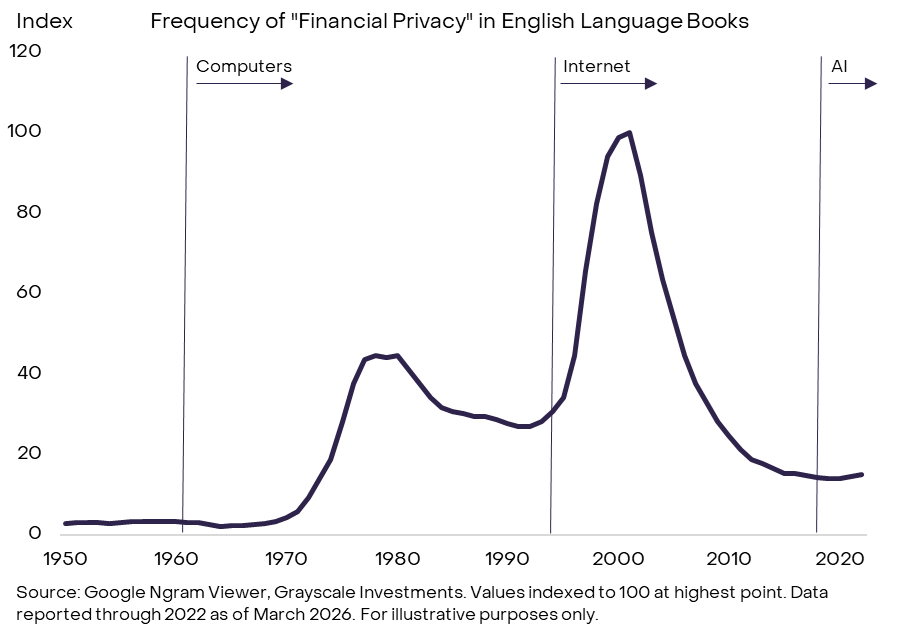
Technological and social change can put pressure on these systems, often triggering public debate about financial privacy and new methods to protect it. In the 1970s, the digitization of financial records and the Bank Secrecy Act brought more attention to financial privacy (Exhibit 1). Similarly, in the late 1990s and early 2000s, the expansion of the internet and online banking, along with the Patriot Act, led to another wave of focus on financial privacy—and eventually broader use of encryption, 2FA, and related tools.
Exhibit 1: Technological change can bring focus to financial privacy
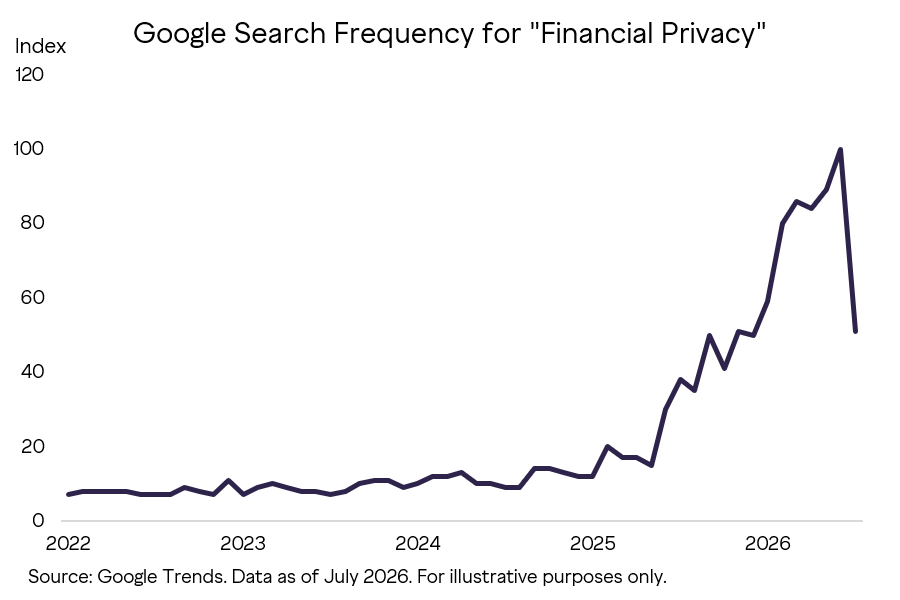
Today, Grayscale Research believes we are on the cusp of a third wave of widespread public attention on financial privacy, driven by the growth in stablecoins and other blockchain-based applications, as well as artificial intelligence (AI), which may offer new methods of financial surveillance. Based on higher-frequency indicators, public attention on these issues already seems to be increasing (Exhibit 2).
Exhibit 2: Recent increase in focus on financial privacy
This is where Zcash comes in. Zcash is a decentralized digital currency much like Bitcoin, but with sophisticated privacy features. Bitcoin made digital scarcity credible, but not digital privacy. Its transparency supports auditability, but limits money-like use cases where confidentiality matters. If cryptocurrency users eventually come to value private digital money as distinct from transparent digital assets, Zcash could capture part of that demand. At roughly 0.4% of total cryptocurrency market cap[1], ZEC appears small, in our view, relative to the quality of its technology and the potential addressable market of privacy-preserving digital money.
On public blockchains, balances, counterparties, and transaction histories can remain visible indefinitely. Even when users transact through pseudonymous addresses, activity often becomes linkable over time—through exchanges, counterparties, wallet behavior, and blockchain analytics. In practice, these systems often reveal more information than users expect.
However, most users expect some level of financial privacy. Individuals may not want balances or spending history exposed by default. Businesses may want to keep suppliers, payroll, treasury flows, and customer relationships confidential. Institutions may not want wallet structures or transaction patterns mapped in real time. Privacy demand is therefore not limited to users seeking full anonymity. In many cases, it reflects ordinary preferences around confidentiality in economic life.
Yet, within crypto, the privacy category’s main issue is that it has often resulted in weaker distribution. Stronger privacy protections can create more friction in exchange support, wallet integration, and market access. As a result, privacy in crypto has not just been a technical feature; it has also involved a commercial tradeoff.
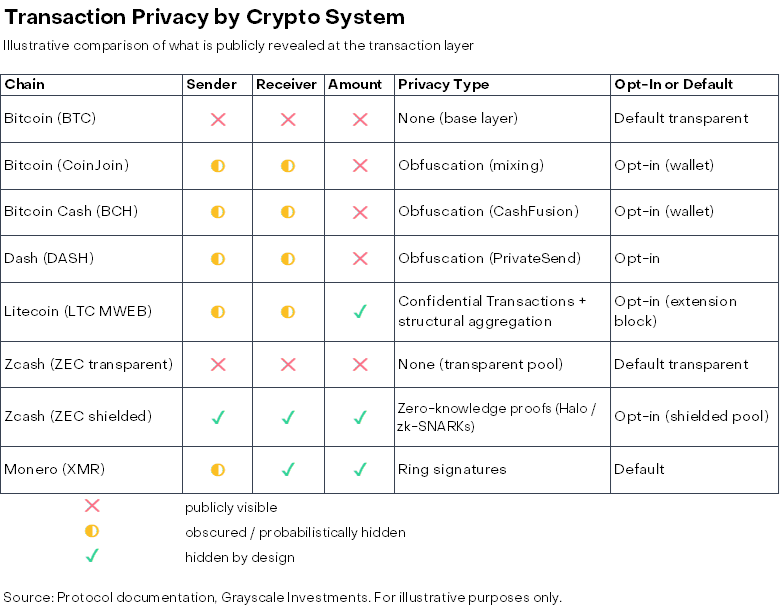
Not all crypto privacy systems hide the same information. Some mainly make transaction flows harder to trace on an otherwise transparent ledger. Others hide specific transaction fields more directly.
Within this privacy space, Zcash stands out as an optionally private base-layer system whose shielded transfers can hide sender, receiver, and amount at the transaction layer. These features place Zcash in a different category from privacy overlays on transparent blockchains (Exhibit 3).
Exhibit 3: Transaction privacy varies by cryptocurrency
Zcash is a public blockchain for peer-to-peer value transfer with a fixed 21 million coin supply and a Proof of Work security model. In many respects, it resembles Bitcoin. The main difference is that Zcash gives users the option to shield transaction data rather than publishing all transaction details by default.
The network supports two transaction types.
In effect, Zcash allows verification without full public disclosure.[2]
In Zcash, the privacy mechanism is a shielded pool validated with zero-knowledge proofs, which can reduce onchain disclosure substantially when users remain within shielded pools. Zero-knowledge proofs are a type of advanced cryptography that can be used for both privacy and scaling in a blockchain context—see the Appendix for more details.
Zcash also supports selective disclosure through viewing keys, allowing users to share visibility into shielded activity with specific third parties when needed. This matters because shielded transactions are not just simply “opaque”; they are private from the public while still allowing user-controlled disclosure when needed.
Zcash launched in 2016. This makes it old by crypto standards and easy to misread as a holdover from an earlier market cycle. But from the beginning, it was more ambitious than a simple focus on privacy suggests. The project grew out of a serious effort to bring zero-knowledge cryptography into a digital cash system. Its core idea was unique at the time: combine a Bitcoin-like monetary structure with the ability to transact privately on a public blockchain. That made Zcash one of the earliest attempts to build private digital cash as a base-layer asset[3], rather than as a wallet feature or privacy layer added after the fact.
That ambition, however, ran ahead of the product infrastructure around it at the time. For much of its history, shielded functionality was harder to use than the transparent alternative because early shielded transactions were computationally demanding. Several major upgrades gradually reduced those constraints:
The challenge, in other words, was not just building private transfers. It was making them easier to use at scale. That long effort to reduce technical friction may finally be paying off.
One important piece of that story is the wallet layer. Zodl, formerly known as Zashi, is increasingly positioned not just as a place to hold ZEC, but as a shielded-first interface for using it. Current product materials highlight built-in swaps powered by NEAR Intents, CrossPay functionality that lets users send shielded ZEC while the recipient receives another asset, and support for cold storage of shielded balances. These features matter because they reduce the number of steps where users would otherwise leave the shielded context to fund a wallet, make a payment, or move into another asset.
For Zcash, that’s important: the main bottleneck has historically not been whether private transfers were possible, but whether users could remain shielded through the full transaction flow.
There are also signs of broader infrastructure support around the network itself. Foundry, one of the largest cryptocurrency mining pools, announced plans to launch a US-based institutional Zcash mining pool in April 2026, aimed at institutional and public-company miners. That does not solve shielded wallet adoption directly, but it does suggest a different kind of ecosystem maturation: more industrial-grade infrastructure, more operational support, and potentially more institutional legibility around the network.
Finally, policy changes around fees and mempool behavior matter at the margin because they can make spam-style congestion less effective and improve network usability under load. That is not the core of the Zcash thesis, but it does fit the broader pattern: the network is being shaped not only for privacy in theory, but for more reliable use in practice.
The next phase of the Zcash story is likely to depend on whether the protocol can move from “privacy works” to “privacy scales.” The key development trends to watch are:
As of July 2026, the market is assigning very little value to privacy in crypto.
Grayscale categorizes all the crypto assets with a “digital currency” use case in our proprietary Currencies Crypto Sector. Today, this crypto market segment includes 15 assets with a combined market capitalization of $1.4 trillion. Bitcoin is king of the category, with a market share of about 90%. Zcash’s ZEC token is valued at just ~$8 billion today, or 0.6% of the Currencies Crypto Sector (Exhibit 4). If it were to capture just 5% of this market segment, its value would be 9x greater.
Exhibit 4: ZEC’s share of the Currencies Market Cap is small but growing
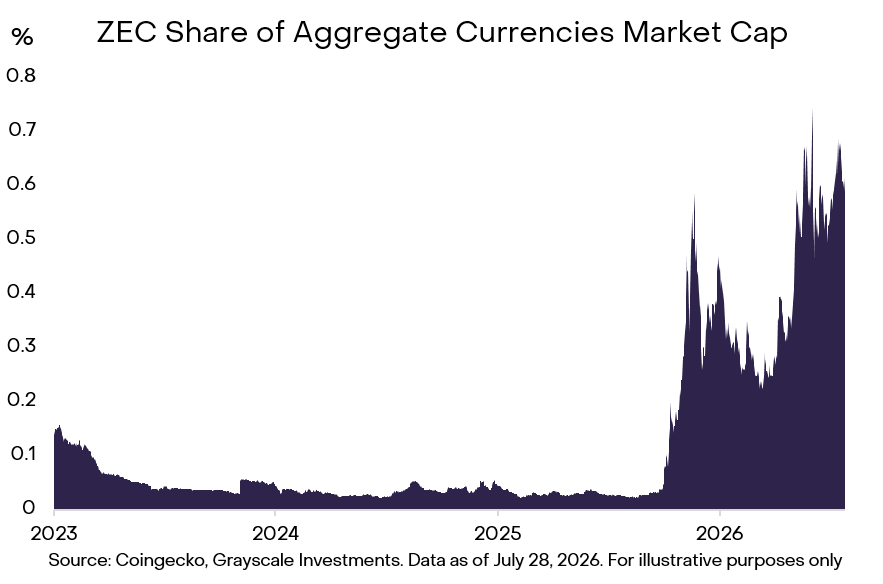
ZEC’s current valuation appears to reflect an assumption that privacy will remain peripheral: useful to some, but too narrow to command a meaningful premium. But if privacy becomes more valuable in a world of greater surveillance, tighter compliance rails, and more visible financial censorship, then a 0.6% market share may look less like a fair equilibrium and more like a market that has not fully priced the asset's optionality.
The bullish version of the Zcash thesis is that the market is currently valuing ZEC as if privacy demand will stay contained, even though the chain already shows evidence that privacy usage is real. As of July 20, 2026, shielded transactions have at times accounted for more than 50% of user activity, and shielded supply stood at about 4.2 million ZEC, or roughly 25% of current circulating supply (Exhibit 5). That suggests privacy is not merely a narrative attached to the asset, but an observable on-chain behavior.
Exhibit 5: ZEC’s shielded supply share has grown to an all time high
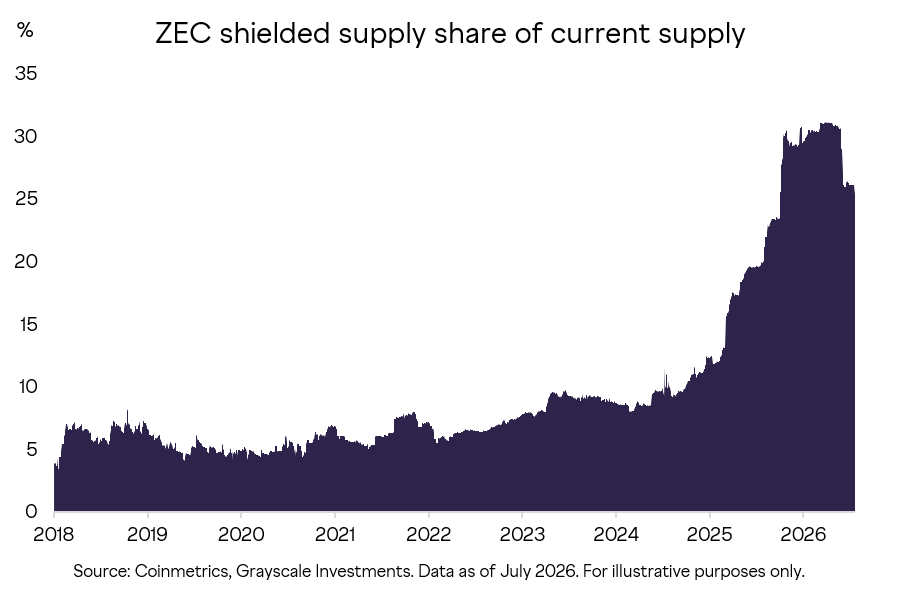
In other words, Zcash does not need explosive growth today to justify potential upside; it needs the market to change its view about what privacy is worth tomorrow. If investors eventually decide that privacy should command even a modest premium inside crypto's monetary stack, ZEC's current valuation could prove conservative, because the market is still treating privacy as more afterthought than a core property of money.
Zcash’s investment case is not just a question of privacy demand. It also depends on how investors think about legacy cryptographic assumptions, future security risks, and the network’s ability to keep shipping major upgrades without breaking coordination.
Regulatory risk
Zcash’s regulatory risk is not simply that it offers privacy, but that regulators and service providers may disagree on whether its selective disclosure tools are sufficient for compliance. Zcash’s viewing-key model gives a clearer compliance story than systems with no disclosure mechanism at all: a Full Viewing Key/Unified Full Viewing Key can be shared with a chosen party to reveal incoming activity and, for standard outgoing shielded payments, recipient address, amount, and memo. But that disclosure is still permissioned rather than default public traceability, while global AML/CFT standards for Virtual Asset Service Providers continue to emphasize customer due diligence, recordkeeping, suspicious activity reporting, and the Travel Rule, and Markets in Crypto Assets[5] (MiCA) adds authorization, disclosure, and supervisory requirements in the EU. For an investor, the right framing is that viewing keys likely reduce—but do not eliminate—the risk that exchanges, custodians, or regulators treat shielded activity as operationally or politically harder to support.
Trusted setup legacy pools
One historical concern around Zcash has been the trusted setup used for the older Sprout and Sapling shielded protocols. NU5 introduced Orchard and the Halo proving system, which removed the trusted-setup requirement for the Orchard shielded pool. Separately, a soundness vulnerability was discovered in the original Orchard circuit in 2026 that could theoretically have enabled undetectable counterfeiting within the Orchard pool. A network upgrade (NU6.2) corrected the circuit, while Ironwood (NU6.3) introduces a separate shielded pool. By preventing new value from entering the legacy Orchard pool and requiring funds leaving it to pass through Zcash’s turnstile accounting mechanism, Ironwood is designed to restore users’ ability to independently verify the integrity of Zcash’s circulating supply. This materially improves the forward-looking cryptographic story. The residual issue is that older pools still exist, and legacy funds can remain in them. In practice, this is best understood as a diminishing legacy risk rather than the defining risk of the current shielded design, but it is still relevant when comparing older and newer parts of the protocol.
Quantum risk
Quantum computing is a long-horizon risk for most public blockchains, not a Zcash-specific problem. At a high level, transparent and shielded funds may face different exposure paths depending on which cryptographic components are visible onchain and when spend-authorizing keys are revealed. Electric Coin Company, a company historically associated with building and launching Zcash, had recent roadmap work explicitly including quantum resilience as an area of focus[6], which suggests the issue is being treated as a real design consideration rather than a purely theoretical one. For an investment note, the most reasonable framing is that quantum risk matters, but likely on a longer time horizon than the near-term usability, adoption, and market-structure questions that dominate the Zcash thesis today.
Execution risk
Zcash has historically relied on major protocol upgrades to improve usability, security, and scalability. That creates execution risk in two forms. First, the roadmap itself is ambitious: proposals such as Tachyon, Crosslink, and related changes are meaningful technical efforts rather than simple parameter tweaks. Second, network upgrades require coordination across protocol engineers, wallet developers, infrastructure providers, and the broader ecosystem. Zcash’s upgrade process is structured and well documented through Zcash Improvement Proposals, which is a strength, but it also means the investment case depends in part on continued coordination and implementation quality.
Privacy has always been part of money’s usefulness, even if digital systems have made that easier to forget. Zcash was built around a limitation of transparent blockchains: they make transactions easy to verify, but difficult to keep confidential. After years of technical work, it now stands as one of the clearest attempts to close that gap. Whether private digital money becomes a major category or remains a niche one is still uncertain. But at current valuations, the market appears to be assigning little probability to privacy becoming materially more important from here. For investors, that may be the opportunity: not a bet that Zcash replaces Bitcoin, but that the value of private digital money has yet to be fully recognized.
Zero Knowledge
Shielded transactions rely on zero-knowledge proofs. A zero-knowledge proof is a cryptographic way to prove that a statement is true without revealing the underlying information.
A simple example is proving that you are over 18 without revealing your exact age. The verifier learns that the condition is satisfied, but not the data itself.
Zcash applies the same idea to transactions. Instead of publishing all transaction details, the system produces a proof that the transaction followed the protocol’s rules. That includes showing that the spender is authorized, that the transaction balances, and that no new coins were created outside the supply rules.
The network can verify all of that without seeing the sender, recipient, or amount.
SNARKs (Succinct Non-Interactive Argument of Knowledge)
SNARKs are the specific type of zero-knowledge proof used in Zcash’s shielded system.
At a high level, the prover is the party that knows the private information, and the verifier is the party checking the proof. The prover has a witness, meaning the hidden data that makes the statement true. In Zcash, that witness includes the private transaction information and the cryptographic data needed to show the spender is allowed to spend the funds.
Rather than revealing that witness directly, the prover generates a short proof showing that the hidden data satisfies a set of mathematical constraints. Those constraints encode the transaction rules of the protocol, such as authorization and value conservation.
You can think of the prover as the party saying “I know the hidden data, and it satisfies the rules. Here is the proof,” while the verifier checks the proof without learning the hidden facts themselves.
What makes SNARKs useful is the tradeoff they offer: proofs are small and fast for the network to verify, which is important for a live blockchain. In other words, nodes do not need to inspect all of the hidden data themselves. They only need to verify that the proof is valid.
The downside is that SNARK systems are generally more specialized and can involve setup assumptions and more complex engineering. For Zcash, their main value is practical: they make it possible to preserve privacy without making validation prohibitively slow or expensive.
STARKs (Scalable Transparent Argument of Knowledge)
STARKs are another family of zero-knowledge proofs that often come up in the same discussions as SNARKs. They follow the same broad structure: a prover uses a witness to convince a verifier that some statement is true without revealing the witness itself.
The main difference is in the design tradeoffs. Relative to SNARKs, STARKs are often described as relying on simpler cryptographic assumptions and avoiding the same kind of trusted setup, but they typically produce larger proofs.
In practice, that means they can be attractive in some systems, though with different costs around proof size and efficiency.
[1] Coingecko, as of March 2026
[2] That said, privacy is not always absolute in practice. Metadata such as timing, transaction patterns, and movement between transparent and shielded contexts can still reveal useful information to outside observers.
[3] https://z.cash/learn/who-created-zcash/
[4] Sprout was Zcash’s original shielded protocol at launch, enabling private transactions and later becoming the legacy shielded address format that Sapling improved upon.
[5] EU-wide rulebook for cryptocurrencies and related services that are not already covered by other EU financial services laws.
[6] https://zips.z.cash/draft-ecc-quantum-recoverability