March 2026: Resilience During Wartime

Research Team
Last Updated: 4/1/2026 | 9 min. read
The war in Iran overshadowed virtually all other market developments in March. For the world economy, the most important implication is a meaningful oil price shock: spot oil prices are now ~$46/bbl higher (+63%) and longer-dated futures have moved up as traders anticipate longer supply disruptions. The resulting inflation concerns have pushed interest rate expectations higher across major economies. Broad equity indexes, government bonds, and precious metals all moved lower.
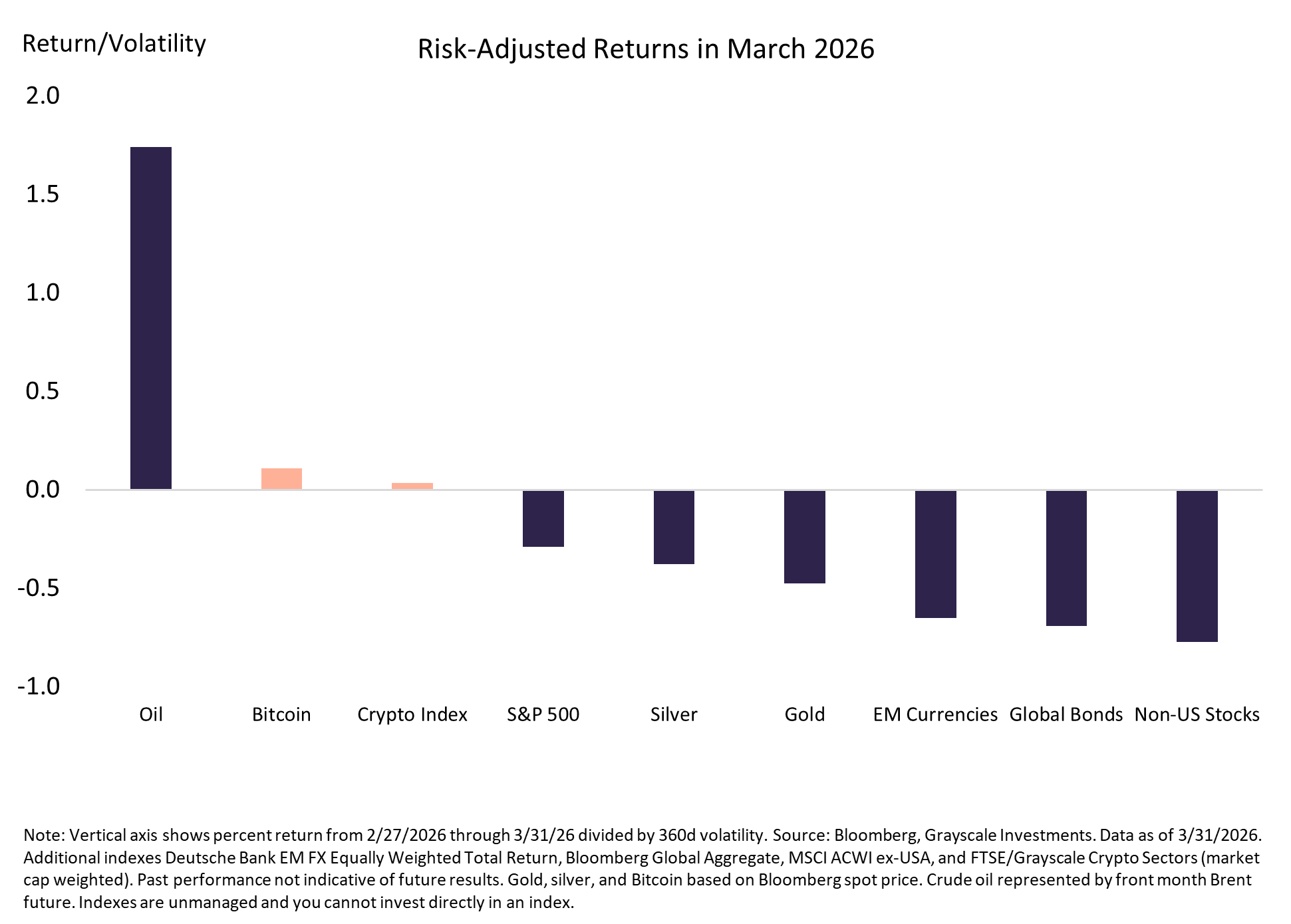
Despite the turbulence, crypto assets eked out a small gain (Exhibit 1). We think crypto’s resilience partly reflects how much risk has already been taken out of the market in recent months. Even with the broader market volatility in March, spot crypto ETPs saw modest net inflows and perpetual futures open interest edged higher. Bitcoin in particular got a lift from Strategy (formerly MicroStrategy), which purchased an estimated ~44.4k BTC (~$3.1bn) on the back of solid demand for its STRC preferred equity product.[1] (For a broader update on the DATs, see our recent blog post).
Exhibit 1: Crypto eked out a small gain in March
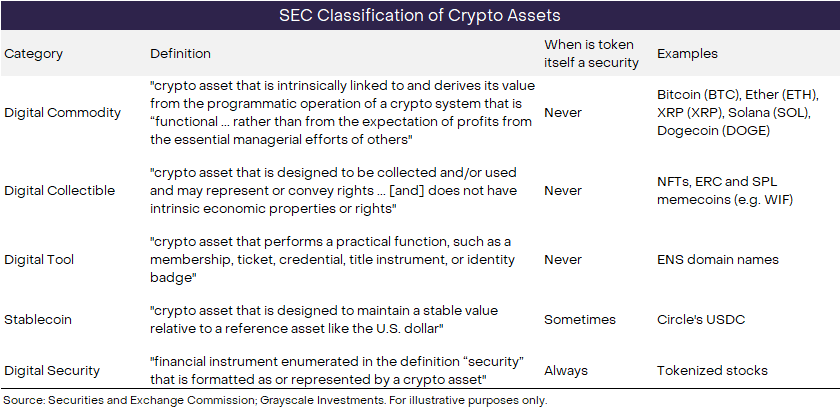
Crypto markets may also have benefited from improving regulatory clarity, including the SEC’s new interpretive guidance on the application of federal securities laws to crypto assets. This statement[2] — which was developed in conjunction with the CFTC — put to rest a number of long-standing questions that have bedeviled crypto entrepreneurs (and their lawyers). The guidance included three specific elements:
But what does this mean in practice? Blockchains offer alternative methods for capital formation, but potential issuers want to make sure they follow all applicable laws. The new joint guidance reduces uncertainty and may therefore stimulate new investment activity. For investors in crypto assets, the direct implications are (i) lower regulatory tail risks and (ii) potentially more blockchain activity from higher new token issuance. This increased activity may ultimately drive value back to the underlying networks and their native assets (e.g., ETH, SOL, SUI, BNB, and AVAX).
Exhibit 2: SEC clarified that most digital assets are not securities
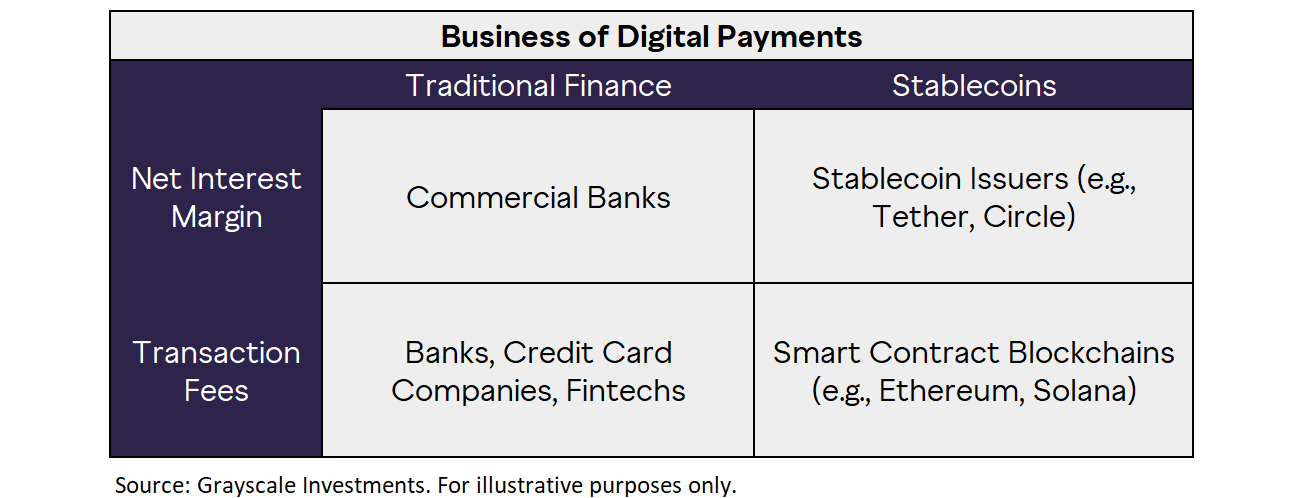
Meanwhile, the fate of the CLARITY Act in the U.S. Senate still appears uncertain; a Polymarket contract puts the odds of passage around 50%. Stablecoin rewards have emerged as a central point of debate — probably because they threaten certain bank revenues (Exhibit 3). On March 20, senators announced an agreement in principle to advance the bill out of the Senate Banking Committee. By March 24, a framework was introduced that would prohibit yield on purely passive stablecoin holdings while permitting limited activity-based rewards tied to payments or platform usage. The proposal was intended to address banks’ concerns around deposit displacement while preserving room for innovation. In response, industry participants have begun organizing around a counterproposal that seeks more flexible treatment of rewards. Negotiations continue, with the goal of enabling a committee markup in April and potential passage as early as May.
Exhibit 3: Competition over payments revenue potentially at stake in CLARITY Act
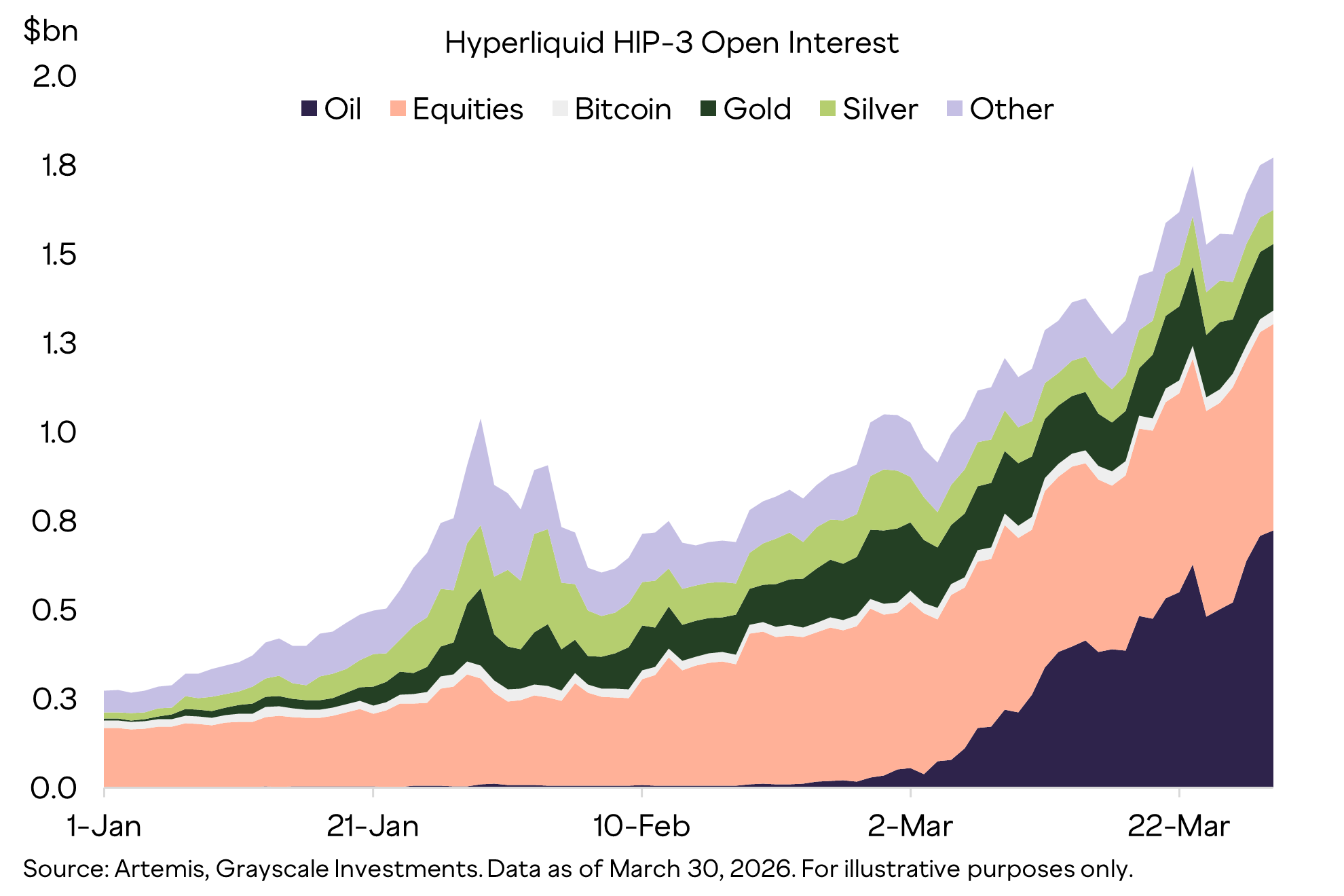
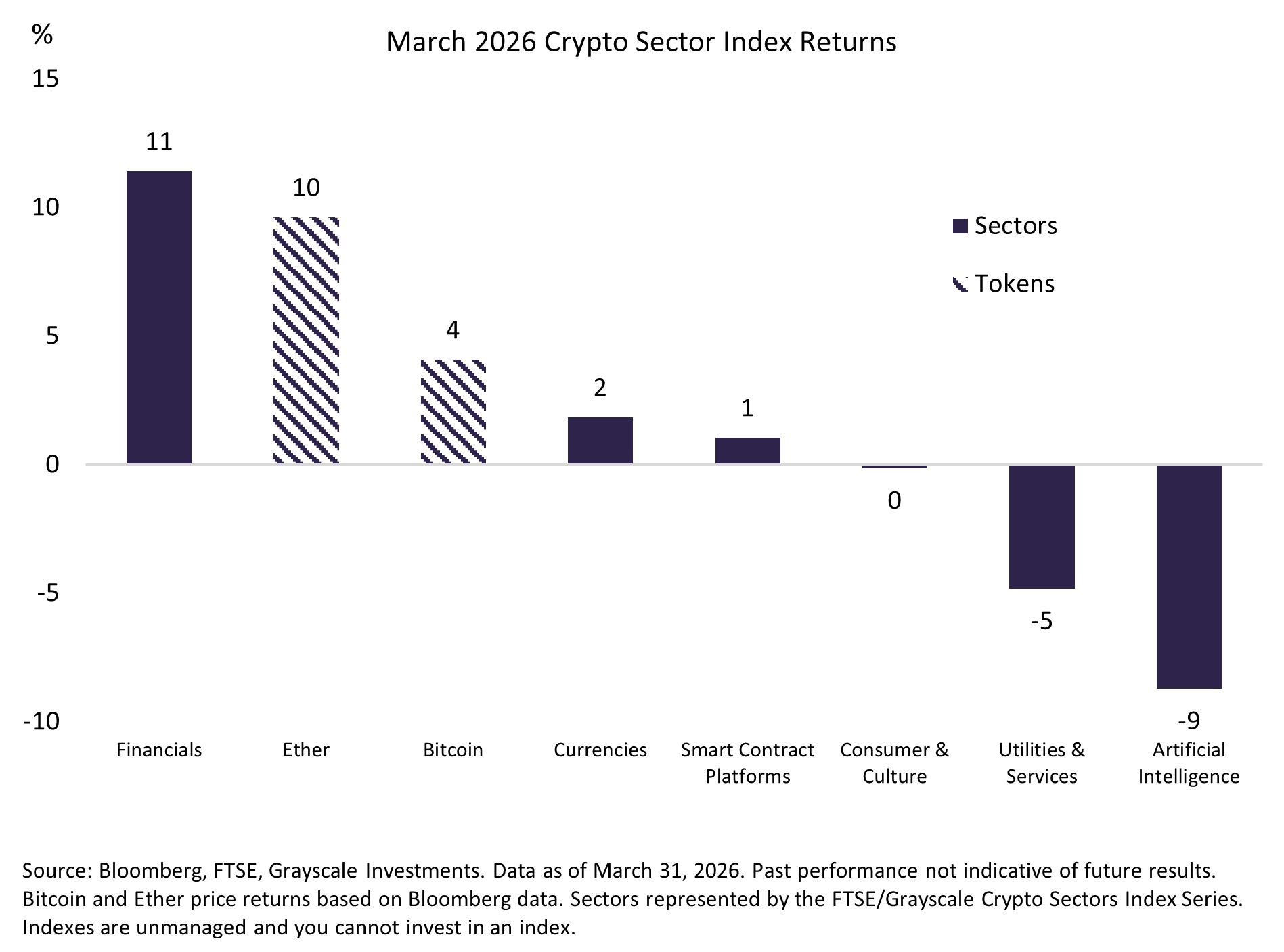
Financials were the best-performing Crypto Sector during March, led by Hyperliquid. The platform’s growth has been driven largely by HIP-3 (Exhibit 4), which enables 24/7 trading of traditional assets like equities and commodities — particularly impactful in volatile markets where traditional exchanges still close. Additionally, TradeXYZ (an HIP-3 deployer) partnered with S&P Dow Jones Indices to launch the first officially licensed S&P 500 perpetual contract on Hyperliquid[3], further deepening crossroads into traditional financial markets. Lastly, the long-anticipated HIP-4 upgrade gained traction as interest in prediction markets continued to accelerate.
Exhibit 4: Hyperliquid HIP-3 open interest continued to make all-time highs in March
At the same time, the AI narrative continued to gain momentum. Bittensor has emerged a notable beneficiary of this thematic tailwind, with TAO up 71% in March as investors increasingly focused on the convergence of blockchain and AI technologies. On March 10, a Bittensor subnet announced that it trained a 72 billion parameter large language model (LLM) using a permissionless network of nodes[4] — demonstrating that decentralized infrastructure can potentially support AI development at scale. Also during the month, Bittensor drew attention following a mention on the All-In Podcast during an interview with Nvidia CEO Jensen Huang. Together, these developments underscored Bittensor’s positioning at the intersection of two key structural trends: AI and decentralization.
Exhibit 5: Crypto Sector returns displayed meaningful dispersion
The outlook for crypto assets remains clouded by the ongoing military conflict in the Middle East. Before the war, the global economy looked strong and may have been accelerating, and central banks seemed open to rate cuts. If the active conflict ends soon and oil prices come down, markets could again price in a favorable macro backdrop. If not, a sustained increase in oil prices may weigh on growth and delay recovery. For now, we suspect that many investors will remain on the sidelines until geopolitical risks clear.
Despite this uncertainty, we believe now is a good time for longer-term crypto investors to build positions. Valuations have held since the start of the war, suggesting we may have put in a more durable bottom. Moreover, the megatrends driving blockchain adoption — especially rising adoption of stablecoins and tokenized assets — remain in place. Reduced macro uncertainty may be needed for token prices to rebound significantly. But in hindsight, periods like this often prove to be attractive entry points.
[1] Source: https://www.strategy.com/purchases
[2] Source: https://www.sec.gov/newsroom/press-releases/2026-30-sec-clarifies-application-federal-securities-laws-crypto-assets
[3] Source: S&P Dow Jones Indices Licenses S&P 500® to Trade[XYZ] for Perpetual Contracts on Hyperliquid
[4] Source: Covenant-72B: The Largest Decentralized LLM Training Run